
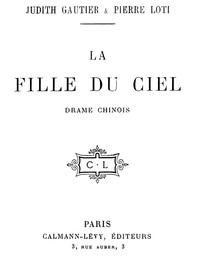
La fille du ciel: Drame Chinois by Judith Gautier and Pierre Loti
Let's talk about a book that shouldn't work, but somehow does. 'La fille du ciel' is a play written in 1911 by two French literary stars, Judith Gautier and Pierre Loti. They were obsessed with the 'Orient,' but their China was built from books, artifacts, and dreams.
The Story
The plot centers on the Empress Dowager Cixi, one of China's most powerful and controversial rulers. The story is set during the violent Boxer Rebellion, when Chinese nationalists rose up against foreign influence. Cixi is trapped in the Forbidden City, surrounded by court intrigue and the approaching chaos of war. The drama follows her impossible choices: protect her dynasty or save her people, uphold tradition or embrace change. Woven through this political crisis is a personal story of love and sacrifice, focusing on a young Manchu princess caught between duty and desire.
Why You Should Read It
I'll be honest, you don't read this for historical accuracy. You read it for the atmosphere. Gautier and Loti pour their romantic fascination into every line. The Forbidden City becomes a gilded prison, the ceremonies are described with lavish detail, and the emotions run high. It's a performance of 'Chineseness' filtered through a very French, very early-20th-century lens. That's what makes it so compelling today. You're getting a double story: the tragic tale of an empress, and the unconscious tale of how the West imagined the East. The characters feel like archetypes from a grand opera—noble, doomed, and intensely dramatic. It's a mood.
Final Verdict
This book is perfect for readers who love historical fiction with a side of meta-commentary. If you're interested in the Boxer Rebellion, colonial literature, or just want to experience a wildly imaginative (if flawed) version of imperial China, give it a try. It's also a great pick for anyone who enjoys works where the author's perspective is as much a part of the story as the plot itself. Approach it not as a history lesson, but as a beautiful, complicated artifact of its time. You'll come away with a great story and a lot to think about.
This text is dedicated to the public domain. It serves as a testament to our shared literary heritage.
Kevin Brown
8 months agoThis is one of those stories where the content flows smoothly from one chapter to the next. Absolutely essential reading.
Oliver Davis
1 year agoHaving read this twice, it challenges the reader's perspective in an intellectual way. Truly inspiring.
James Rodriguez
11 months agoBeautifully written.
Kenneth Taylor
8 months agoClear and concise.




Emma Brown
1 year agoGreat read!