1

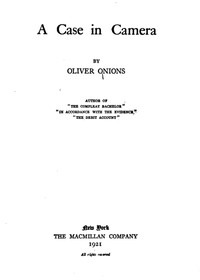
A Case in Camera — Story, Setting & Ideas
(4 User reviews)
1119
Project Gutenberg
2013
Murder -- Fiction; England -- Social life and customs -- 20th century -- Fiction; Mystery fiction
Readers of public-domain and historical texts
Project Gutenberg digital edition
en
Edition facts
Words: 85,055
Reading time: 370 min
Text sections: 9
Source:
Project Gutenberg record #43063
Oliver Onions' 1921 mystery novel uses a first-person narrator to recount the killing of a young man in Chelsea, weaving together a breakfast party, a barrister's recovery of paintings, and a seaside encounter with the accused, all structured around shifting scenes and recurring images of ladders, masks, and khaki ghosts.
Editorial Edition Score
4.7/5
★★★★★
★★★★★
Calculated from edition completeness, EPUB availability, text structure and catalogue metadata. Not a user rating.
Edition quality
The narrator of A Case in Camera announces his tale as one of a killing on a May morning in 1919, but he delays the violence to dwell first on a breakfast party at Philip Esdaile's studio in Lennox Street, Chelsea. The opening scene is crowded with details: a newly elected A.R.A., a barrister friend who has tracked down fourteen of Esdaile's early paintings, and a carrier's van arriving at the gate. The narrator's voice is unhurried, almost conversational, as he sets the stage for a story that will move from London studios to a Santon headland, from a ladder held by a neighbor to a platform bright with geraniums and lobelia.
A Narrator Who Steps Forward and Steps Back
The first-person narrator is an unnamed presence who admits to taking “a slight liberty with time” and introduces characters as he himself encountered them. He describes watching Billy Mackwith jump from a carrier's van, then later confesses that he first saw Charles Valentine Smith on a Santon platform, not in the chronological order of events. This deliberate manipulation of sequence gives the narrative a retrospective, almost memoir-like quality. The narrator also positions himself as a participant: he is invited to stay with the Esdailes, takes children down to the shore, and is introduced to Smith as “still young at heart.” Yet he never claims omniscience, leaving gaps in knowledge that mirror the reader's own uncertainty.
Recurring Images: Ladders, Masks, and the Ghost of Khaki
Two images recur with particular force. The first is a ladder: Westbury, a neighbor, holds a ladder while a man descends, and the narrator later realizes that Westbury's hands had been on the victim's pockets before Philip Esdaile's. The ladder becomes a symbol of access, of witness, and of guilt. The second image is the “ghost of khaki” that clings to men who have returned from war. The narrator observes that even in mufti, their faces and movements are edged with a faint rim, like a color-print out of register. This visual metaphor ties the murder to the lingering effects of war, suggesting that the violence of 1919 cannot be separated from the violence of 1914–1918. A third motif, the mask, appears in the epigraph: “One Mask doth to another say / ‘Let us be open as the Day’ / The better to conceal himself.”
Movement Between London and the Coast
The story shifts between two primary settings: the studio in Lennox Street, Chelsea, and the Santon headland on the coast. The London scenes are crowded with people—Philip Esdaile, Billy Mackwith, the carrier, the neighbor Westbury—and with objects: a quill pen, a roll of paintings, a ladder. The coastal scenes are more open, filled with light and flowers: a station platform decorated for a flower competition, a trap waiting at a level crossing, a cliff path too steep for a wounded man. This movement from enclosed urban space to expansive seaside setting mirrors the narrator's own journey from observer to participant, and from the immediate aftermath of the killing to a longer, more reflective view of its consequences.
The Unnamed Victim and the Young Assassin
The victim is named only once in the excerpts—Monty Rooke—and the killer, Charles Valentine “Chummy” Smith, is introduced not as a murderer but as a young man in an unbelted sky-blue uniform, walking with a stick. The narrator calls him “our young murderer” and “her pleasant young assassin,” but these labels come after a description of his appearance and manner. Smith speaks of distances in kilometers, talks of motor-bicycles, and sprinkles his speech with ragtime French. He is a product of the war, and his crime is presented not as a shocking aberration but as something that emerges from the same world that produced the khaki ghost. The narrator never explains the motive, leaving the reader to piece together the circumstances from the fragments of conversation and observation.
Readers should attend to the narrator's careful management of time and perspective. He withholds information, jumps ahead, and then returns, forcing the reader to reconstruct the sequence of events. The recurring images—ladders, masks, khaki ghosts—are not decorative but structural, linking the personal violence of the murder to the larger violence of the war. The book rewards a slow reading that notices these patterns and questions the narrator's reliability.
Camila Allen
2 days agoGrayson Gonzalez
3 weeks agoMatthew Torres
1 week ago-

Brian Walker - 3 weeks ago
{'review_type': 'Positive', 'content': 'A cleverly plotted legal thriller that keeps you intellectually engaged. A Case In Camera weaves an intricate puzzle with sharp dialogue and believable legal intricacies. The courtroom scenes are tense, and the characters are well-crafted. The pacing is brisk, and the final reveal is satisfying. An outstanding example of the genre that will appeal to mystery and legal fans alike.'} -
Calvin Zamora - 1 week ago
{'review_type': 'Neutral', 'content': "A competent legal mystery with a solid central case. The courtroom drama is interesting, and the protagonist is sympathetic. However, the plot relies on some legal coincidences, and the solution may not surprise seasoned readers. Still, it's a decent read for those who enjoy courtroom procedurals."} -
Kathleen West - 6 hours from now
{'review_type': 'Negative', 'content': "Despite its promising setup, A Case In Camera is underwhelming. The legal details are dry and often slow down the story. The mystery is easily solvable, and the characters are stock archetypes. The author seems more interested in showing off legal knowledge than telling an engaging tale. I was bored and wished I hadn't picked it up."}
Reader reflection
Take a moment to reflect on this book
Create a short personal record of your experience with this book.
Your progress
0
/
10
2
How did the book work for you overall?
3
Would you encourage someone else to read it?
4
How easy was the book to follow?
5
How did the pace of the book feel?
6
Could you see yourself revisiting this book?
7
How strong was your personal connection to the text?
8
Was the book easy to understand?
9
In one sentence, what did you learn?
10



Madison Garcia
1 week ago