1

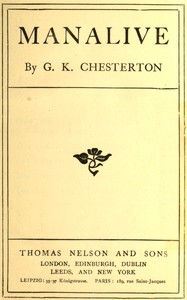
Manalive — Context and Discussion
(6 User reviews)
769
Project Gutenberg
1999
Humorous stories; Attempted murder -- Fiction; Mystery fiction; False arrest -- Fiction
Readers of public-domain and historical texts
Project Gutenberg digital edition
en
Edition facts
Words: 62,098
Reading time: 270 min
Text sections: 11
Source:
Project Gutenberg record #1718
Chesterton's novel opens with a personified wind that invades London, bringing chaos and joy. The narrative voice shifts between exuberant description and philosophical dialogue, as seen in the contrast between the wind's 'unreasonable happiness' and the 'melancholy Smith's' pessimistic reflections on starlight and puddles.
Editorial Edition Score
4.8/5
★★★★★
★★★★★
Calculated from edition completeness, EPUB availability, text structure and catalogue metadata. Not a user rating.
Edition quality
The first chapter of Manalive introduces a wind that is both literal and symbolic, described as a 'wave of unreasonable happiness' that tears across England. Chesterton’s prose is energetic and personifying, attributing to the wind the power to 'carry the trump of crisis across the world.' This opening sets a tone of exuberant disruption, contrasting sharply with the later, more introspective passages where the character Smith contemplates the 'cruel' stars and the 'puddles' of academic thought.
The Wind as Narrative Engine
The wind in the opening pages is not merely a weather event but an active force that transforms mundane scenes: it fills shirts on a clothesline 'as if five fat imps had sprung into them,' lifts a hammock 'like a balloon,' and clatters poplars 'like a wreath or salutation of seraphic wings.' Chesterton uses the wind to inject drama into 'undramatic lives,' a technique that recurs throughout the novel. The language is deliberately hyperbolic, with similes that veer toward the fantastical, yet grounded in domestic imagery. This juxtaposition of the ordinary and the extraordinary is a hallmark of Chesterton’s style, and the wind serves as a narrative device that propels characters into unexpected situations.
Shifts in Pace and Voice
The excerpts reveal a marked shift in pace between the opening chapter and the later sections. The wind-driven first chapter is swift and cinematic, with long, rolling sentences that mimic the wind’s movement. In contrast, the passage describing Smith’s walk to Brakespeare College slows to a meditative crawl, with Smith’s 'sullen fancy' and the 'hollow' skies. The narrative voice also changes: the omniscient, almost gleeful tone of the opening gives way to a more ironic, philosophical register when the text mocks the 'pessimists' who think 'starlight was atrocious because it was true.' This tonal shift suggests a deliberate alternation between action and reflection.
Recurring Motifs of Light and Water
Two motifs recur across the excerpts: light and water. The wind brings 'frosty scent of forests' and 'cold intoxication of the sea,' while Smith’s environment is filled with 'glittering pools,' 'stripes of canal,' and 'rainy gutters.' Light appears as both literal starlight and metaphorical 'light' of academic reflection. Chesterton contrasts the 'glittering pools below' with the 'glittering skies,' and later uses the image of a 'peacock-green curtain' as a focal point. These motifs are not merely decorative; they underscore the novel’s thematic tension between surface and depth, as when the text notes that a puddle 'reflects infinity' by being 'shallow and standing still.'
Readers should attend to how Chesterton modulates his prose between the boisterous and the contemplative. The wind that opens the novel is a character in its own right, and its return in the final chapter title suggests a structural symmetry. Pay attention to the way the narrative voice shifts from exuberant description to ironic commentary, often within the same paragraph, as this is central to the novel’s effect.
Luke Sanchez
10 hours agoAva Nguyen
3 weeks agoWyatt Hernandez
18 hours agoMatthew Jones
2 weeks ago-

Peter Johnson - 3 weeks ago
An invigorating read with a unique protagonist. The first half is brilliant, but the latter part becomes repetitive as Smith's antics grow tiresome. Still, its core message about embracing life is uplifting. -
Jeffrey Harris - 3 weeks ago
Manalive is a burst of pure joy and energy. Chesterton's protagonist, Innocent Smith, is a delightfully eccentric character who challenges conventionality. The book is a philosophical romp that makes you rethink what it means to be truly alive. Packed with wit, humor, and profound insights—it's impossible not to smile while reading. -
Patrick Ochoa - 2 days ago
This is chaotic and unfocused. The story jumps from one absurd scenario to another without a clear narrative thread. The characters are caricatures, and the 'profound' moments feel forced. I couldn't connect with the protagonist's childish behavior. A disappointment from a usually brilliant author.
Reader reflection
How will you remember this book?
Save your reaction, strongest insight, and memorable passage.
Your progress
0
/
10
2
Did this book hold your interest?
3
Would you pass this book on to a friend?
4
What was the reading difficulty like?
5
How clearly were the main ideas presented?
6
Did the book offer a fresh perspective?
7
Would this book work well in a reading group?
8
What did you think about the pace?
9
What is the main idea you are taking away?
10






Sofia Baker
2 weeks ago