1

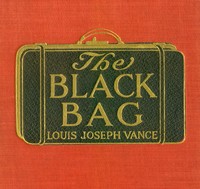
The Black Bag — Inside the Classic
(4 User reviews)
494
Project Gutenberg
2006
Adventure stories; Mystery fiction; Jewel thieves -- Fiction
Readers of public-domain and historical texts
Project Gutenberg digital edition
en
Edition facts
Words: 99,066
Reading time: 431 min
Text sections: 24
Source:
Project Gutenberg record #9779
This editorial note examines the structural and imagistic patterns in Louis Joseph Vance's 1908 crime novel, focusing on the interplay between confinement and movement, the recurring motif of the black bag, and the narrative's episodic shifts between London interiors and maritime settings.
Editorial Edition Score
4.9/5
★★★★★
★★★★★
Calculated from edition completeness, EPUB availability, text structure and catalogue metadata. Not a user rating.
Edition quality
Louis Joseph Vance's The Black Bag (1908) opens with Philip Kirkwood, an American artist in London, discovering himself "Alone in London"—a phrase that sets the tone for a narrative preoccupied with sudden displacements and constrained spaces. The novel's structure alternates between claustrophobic interiors (a ship's cabin, a London flat) and open, often perilous, exteriors (the Thames, the North Sea). This oscillation is mirrored in the recurring image of the black bag itself, a portable container that holds secrets and shifts hands unpredictably. The following observations trace how Vance uses setting, movement, and the titular object to build suspense and character.
Confinement and Sudden Transit
The novel's first chapter establishes a pattern of enclosure followed by abrupt relocation. Kirkwood's initial predicament—stranded and penniless in London—is described with a focus on interior space: he occupies a room where his "base of supplies" has been cut off. The narrative then shifts to a ship's cabin, where he wakes disoriented, having been drugged and transported. The cabin is rendered in precise, oppressive detail: "dingy and smoky lamp swinging violently in gimbals," "thwartships transom," "forward bulkhead." This attention to spatial coordinates creates a sense of entrapment. The transition from London to the North Sea is not narrated but inferred, leaving the reader to piece together the journey from Kirkwood's groggy perceptions. This technique recurs throughout the novel, as characters are frequently moved against their will or without full knowledge of their destination.
The Black Bag as Narrative Anchor
Though the excerpts do not reveal the bag's contents, its title role signals its importance as a plot device. The bag is a physical object that passes between characters, creating connections and conflicts. In the opening, Kirkwood's pockets are empty—his possessions gone—which suggests the bag may contain items of value or incriminating evidence. The bag's black color and portability make it both conspicuous and easy to conceal, a paradox that drives the mystery. Vance uses the bag to link disparate settings: it appears in London rooms, on ships, and in transit. Its movement from one character to another often coincides with shifts in power or knowledge. The bag is never static, mirroring the novel's restless pacing.
Maritime Settings and Perilous Crossings
The excerpts include extended passages set aboard a vessel in a storm. The ship is described as a "frail fabric" housing Kirkwood's fortunes, with the wind "strengthening materially" and the vessel bound for Antwerp. This maritime sequence serves multiple functions: it isolates Kirkwood from his familiar world, introduces the threat of the open sea, and provides a confined space where confrontations can occur. The chapter titles—"Off the Nore," "Below Bridge," "Picaresque Passages"—indicate that waterborne travel is a structural element, not merely a backdrop. The storm itself becomes a character, with its "chorused groans and plaints" affecting the mood. Vance uses the ship's motion and the characters' physical reactions (hunger, disorientation) to heighten tension.
Episodic Structure and Chapter Headings
The table of contents reveals a deliberate patterning of chapters. Several titles are repeated with variations: "Diversions of a Ruined Gentleman" appears as chapters I and VII, creating a framing effect. "Below Bridge" is used for chapters VI and IX, suggesting a return to a key location. Other headings like "Desperate Measures," "Stratagems and Spoils," and "Rogues and Vagabonds" emphasize action and deception. The final chapter is subdivided into three parts ("The Uxbridge Road," "The Crown and Mitre," "The Journey's End"), indicating a climactic sequence. This structure gives the novel a picaresque quality, with Kirkwood moving through a series of discrete episodes rather than a single continuous plot. The headings themselves hint at the novel's blend of adventure and crime.
Readers approaching The Black Bag should attend to how Vance orchestrates movement between cramped interiors and open landscapes, and how the titular object functions as both a literal and symbolic container. The novel rewards attention to its chapter architecture and the recurring imagery of transit—by foot, carriage, and ship. These elements, rather than character psychology or moral themes, drive the narrative forward.
Leo Hall
4 weeks agoSophia Flores
3 days agoCarter Torres
2 weeks agoThere are no comments for this eBook.
Reader reflection
How will you remember this book?
Save your reaction, strongest insight, and memorable passage.
Your progress
0
/
10
2
How much did you enjoy the reading experience?
3
Is this a title you would suggest to others?
4
How easy was the book to follow?
5
Would this book work well in a reading group?
6
Did the book deliver what you hoped for?
7
How clear did the writing feel?
8
Would a second reading be valuable?
9
What changed or sharpened your thinking?
10

Wyatt Carter
4 weeks ago