1

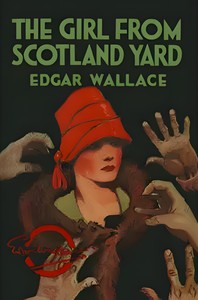
The girl from Scotland Yard — Edition Insights
(12 User reviews)
1565
Project Gutenberg
2025
Detective and mystery stories; Police -- Great Britain -- Fiction; Women detectives -- Fiction
Readers of public-domain and historical texts
Project Gutenberg digital edition
en
Edition facts
Words: 67,185
Reading time: 293 min
Text sections: 7
Source:
Project Gutenberg record #76677
Edgar Wallace's 1926 mystery introduces Lady Raytham, a woman of cold gray eyes and classical beauty, and Peter Dawlish, a former convict. The opening tea scene establishes a moody London atmosphere and hints at hidden marriages and coded inscriptions. Wallace's diction and dialogue reveal character through precise observation.
Edgar Wallace opens The Girl from Scotland Yard with a February tea scene in Berkeley Square, where Lady Raytham draws aside velvet curtains to watch rain, sleet, and a thin yellow mist. Her classical beauty—'cold English gray' eyes, a face suggesting a 'patrician abbess'—is immediately set against an interior of lavish furnishings and museum-bound pictures. The butler brings a telegram from Constantinople, and the narrative voice shifts between atmospheric description and clipped dialogue. Wallace uses the setting to mirror psychological tension: the 'bare-limbed trees and shivering shrubs' outside echo Lady Raytham's own uncertainty, a mood he calls 'the nearest emotions to fear that she knew.'
Diction and the Construction of Class
Wallace's word choices consistently mark social standing. Lady Raytham's salon 'bore evidence of money lavishly spent'; three pictures are 'earmarked for the National Gallery.' The butler is 'portly in his way, a man with double chin and an unlined face'—the phrasing suggests a servant whose appearance is part of the household's polished surface. In contrast, Peter Dawlish speaks of 'envelope addressing' and a mother who wants him to milk cows in Saskatchewan. The clipped, understated dialogue—'You're unfortunate,' she says, then adds 'both as a son—and as a husband'—relies on implication rather than explicit emotion. Wallace avoids melodrama; even a revelation about a hidden marriage comes through a coded inscription in a volume of Elizabeth Barrett Browning, where the first letters of each line, read upward, spell 'Jane Hood.'
Voice and the Unreliable Observer
The narrative voice shifts between omniscient description and focalized perception. Early in the tea scene, the reader sees the fog through Lady Raytham's eyes: she 'looked blankly toward the desolation of the gardens … as though she expected to see some fog wraith take a definite and menacing shape.' This simile is the narrator's, not her thought, yet it colors her mood. Later, when Peter describes a neglected child, the narrator reports his 'sense of awkwardness' and his admission that 'Elizabeth has got a grip on me.' Wallace lets dialogue carry subtext: 'I had a wild idea that possibly you might be able to find—to do something with her,' Peter says, and the broken syntax reveals his hesitation. The reader must gauge how much each character withholds.
Recurring Details: Perfume, Cigarettes, and Codes
Small, tangible objects recur as clues to character and plot. Lady Raytham, who 'rarely smoked,' takes a cigarette and watches the blue vapour; then she carefully spoons coffee onto the glowing end. The gesture is deliberate, almost ritualistic. A silk shawl appears in the chapter list, and a telltale perfume is mentioned. The coded inscription in a book—'doggerel blank verse' whose first letters spell a name—is a device Wallace uses to signal hidden knowledge without exposition. These details are not merely decorative; they function as the narrative's own forensic evidence. The reader is invited to notice, as the detective might, that a woman who claims not to smoke nevertheless handles a cigarette with precision, and that a man who speaks lightly of his mother's visit may be concealing deeper wounds.
Structure and the Unfinished Scene
The excerpts show Wallace's preference for scenes that begin in medias res and end without resolution. Chapter I opens with Lady Raytham already at the window; the telegram is torn open but its contents are only hinted at. The conversation about the child Elizabeth is left hanging—'I had already considered the possibility,' she says, but the plan is not detailed. Later, Peter's mother 'saved me the trouble and came last night,' he says, and the encounter is dismissed as 'a normally strained interview.' Wallace trusts the reader to infer the weight of these offstage events. The chapter titles themselves—'At Tea,' 'The Girl Detective,' 'Meeting Peter'—promise encounters rather than conclusions. This structural choice keeps the focus on character interaction and withheld information, not on plot mechanics.
Wallace's prose rewards attention to what is said and what is left unsaid. The reader may note how often characters interrupt themselves, how gestures replace declarations, and how objects—a telegram, a book, a cigarette—carry more weight than speeches. The excerpts offer no complete mystery, but they do reveal a writer who builds suspense through restraint, not revelation.
Gabriel White
4 weeks agoThere are no comments for this eBook.
Reader reflection
Record your reading impressions
A brief reflection can help important ideas stay with you longer.
Your progress
0
/
10
2
Was reading this book enjoyable?
3
How likely are you to recommend this book?
4
How much effort did this book require?
5
Did it raise ideas you would like to talk about?
6
How did the reading compare with what you expected?
7
Did the book offer a fresh perspective?
8
What did you think about the pace?
9
What changed or sharpened your thinking?
10



Leo Gonzalez
3 weeks ago