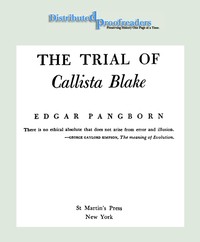
The Trial of Callista Blake — A Closer Reading
Edition facts
The catalog record for The Trial of Callista Blake — A Closer Reading provides practical reading context through 103,802 words, 7 hr 32 min estimated reading time, and 10 detected text sections.
The text analysis averages about 14.7 words per sentence, while the detected sections provide another way to judge how the source is divided.
Project Gutenberg metadata also associates the work with “Trials (Murder) -- Fiction,” connecting these edition facts with the source record’s subject description.
Calculated from edition completeness, EPUB availability, text structure and catalogue metadata. Not a user rating.
How this score is calculated
- Description quality20 pts
- Title & short description10 pts
- Source metadata20 pts
- Text length15 pts
- Chapters / structure15 pts
- EPUB file integrity20 pts
Total of 100 points, scaled to a 2.5-5.0 range. Editions with an empty description or a missing EPUB file are not scored.
Read the Text
Doherty had after all been a respectable suburban housewife, not a glamor girl. Catering to the perennial hunger for a scapegoat, most of the papers were writing of Callista Blake on a note of hate just inside libel--Crippled Teen-Age Intellectual, Prodigy Girl in the Monkshood Case. But that carried a phony note, for Callista Blake had managed to remain so essentially unknown that so far there was really no one to hate but a paper image. Some voices dissented, too. One sob sister had declared Callista was a woman, with human needs, feelings, a tragic childhood. That writer might have read an article on psychiatry--even two articles.
There were certain letters, from Callista Blake to her lover James Doherty, the last one written about a week before Doherty's wife was found dead--poisoned and drowned. If those letters arrived in evidence over the protests of Cecil Warner, they would demonstrate Callista Blake's humanity more intensely than any journalistic gulping.
Judge Mann had read them, Cecil Warner and District Attorney Lamson present. James Doherty, Lamson said, had handed over the first three voluntarily. The fourth, found in Callista Blake's possession, had not been mailed to Doherty. For Mann, to read them had been like blundering into a private room where lovers clung together with locked loins and tortured faces; like being compelled to watch, afterward, when the woman was alone and wounded with loss. He had skimmed, his mind wincing aside, knowing it was not possible to understand the letters under those conditions. They had not been read to the grand jury. Some passages in them might be construed as admissions of guilt--or not, as you pleased. Warner evidently felt that this notion could be demolished.
As for beauty and glamor, the prosecution would introduce other photographs of Ann Doherty that were no pretty portraits. Old Warner would object routinely and be overruled; the jury would then meet the unmitigated spectacle of a death by drowning. When Ophelia perishes offstage you don't think of post-mortem lividity or foam on the mouth.
"Mr. District Attorney?"
Assistant District Attorney Talbot J. Hunter nodded briskly but solemnly: he was being the man who profoundly regrets what he must do. That had not been altogether predictable. Dealing with professional crooks, T. J. could act downright jolly in a ferocious give-nothing way, often sweeping a jury along. With a tiger's grace, handsome in spite of too much chin and early frontal baldness, Hunter could have been athlete, actor, singer. He was a near-professional with the Winchester Choral Society, having once gone splendidly through the baritone solo in the Brahms _German Requiem_ when the guest artist turned up with laryngitis. Mann, himself a serious pianist, had heard that achievement, and remembered it at times when Hunter's courtroom personality annoyed him: the man could hardly have sung that well unless there was in him, somewhere, the element of compassion. In the law, Mann supposed, Hunter could use and enjoy his musical and histrionic abilities and at the same time make a living. "Call the Blake case!" The voice, Mann observed, was in top form, rich, melodious, and acceptably stern.
"The defense is ready." Cecil Warner was standing also, heavy and old, a man listening to other voices though capable of employing his own heavy thunder. The other voices were conscience, tradition, books; overtones of what witnesses and lawyers don't say. The seamed ancient face was fat, the kindness obvious but not the strength. Mann wondered occasionally whether Warner had ever, like Darrow, faced all the implications of a certain pessimism that colored most of his opinions. A fracture imperfectly set had crippled Cecil Warner's left arm in childhood; he could not bend the elbow beyond a ninety-degree angle. And Warner's mind, the Judge speculated, might suffer a similar limitation, never hitting with quite all its power. He would need it all in the next few days.
"The People of the State of New Essex against Callista Blake."
Reasonable words; but as Mr. Delehanty intoned them, the Judge's mind perversely visualized an army of five or six million, uniformed, with rifles, tanks, flame-throwers, advancing in ponderous wrath against one cornered chipmunk with tinfoil helmet and paper sword. Foolish, he knew: the individual was not alone, and faced not the People roaring and multitudinous but merely their representative, who might be no more powerful a champion than his own counsel. Yet the image had pestered Judge Mann before now, and faded in the style of the Cheshire Cat.
At other times he could not avoid the impression that the adversary system was too distressingly close in nature as well as origin to the absurdities of medieval justice, in which truth could be determined by the beef of a hired champion. Were prosecutor and defender today any more concerned with truth than those bumbling muscle-men? Were juries?
"Counsel to the bench, please." They approached, Hunter light on his feet, Warner slow and carrying too much weight in the middle. "When we get started, gentlemen, I intend to bear down on the formalities, some. I think it's that kind of case. Anything more we should discuss now?"
Warner's hand rested on the bench. Mann noticed the pale freckles, the frailty of deep-crinkled flesh, blurred rims of the irises of Warner's melancholy brown eyes. Cecil Warner was sixty-eight. "Don't think so, Judge, unless T. J.'s got some load on his mind."
Hunter murmured: "Can't imagine a plea--poison and drowning."
"My God, do you imagine us taking one?" Mann frowned; Warner's anger was rumbling too loudly. "We're here for acquittal. My girl didn't do it. It's that simple, and that's where we stand."
Hunter nodded gravely, courteously, unmoved.
In the night, Terence Mann had felt he was not asking himself the right questions. If as prosecutor he could frame them, allowing rational objections from himself as defender, perhaps as witness (or accused?) he might find answers acceptable to himself as judge, jury, and appellate court. But under torment of insomnia the many selves of the mind may abandon the congress of reason and start a rat-race. And now--well, this was full tide; he could not let counsel stand there wondering what ailed him. "That's it, then. Let the defendant be brought in."
As they returned to their places he sketched on the doodle-pad two egg-shaped boxers: tangled eyebrows for Cecil Warner, for Hunter too much forehead and shovel chin.
A police matron appeared, and a court officer. A hush, then a murmur, each voice swelling but slightly, the crescendo joining others in one uproar that expresses no more than the human need to make a noise under stress. Heads turned, weeds under water. Mann heard the s-whispers, water over sand: _Callista Blake--Callissssta_ ...
She walked with a barely noticeable limp--polio in childhood, Mann recalled from the record. She was also very slightly hunchbacked, her thin pale arms seeming too long. As Warner escorted her to the defense section, Judge Mann saw she wore no make-up, though powder might have hidden the narrow scar that ran from her left ear to her jaw. Dark blue suit and white blouse were neat, unobtrusive, severe. A natural curl held her black hair in lines of grace above a skin of porcelain white.
She was ignoring Warner's arm, and walked alone.
Her eyes were the blue of undersea. Mann searched for other compensating beauty--hard to find. High cheekbones, large nose, small abrupt chin, high forehead modified by the curls but still too high. The extreme whiteness of skin made one think of marble, or heart disease. The medical report declared that apart from the unimportant deformity she was quite healthy. And the State's psychiatrist was prepared to testify, following the quaint barbarism of the once useful McNaughton Rule, that Callista Blake was legally sane. As the jargon had it, she knew the difference between right and wrong, the nature and consequences of her acts.
With no word yet, Callista Blake rejected sympathy, dared the world to pity her, indicated a readiness to spit in its eye.
Warner said: "Give the clerk your name for the record."
Mann heard a strong contralto drawl; it might have sounded warm and pleasant at other times: "Which is the clerk?"
Some idiot woman in the back row giggled.
Warner spoke quickly: "Up there, my dear, that's Mr. Delehanty."
The girl glanced casually at the clerk's dapper dignity, and resumed her level examination of Judge Mann. "I am Callista Blake."
Judge Mann opened the record book and wrote: _State vs. Blake, Dec. 7, 1959_. Eighteen days to Christmas and he still hadn't bought that Diesel train for David, his brother Jack's youngest.... The Blake girl sat down, Warner on her other side where his bulk might partly shield her from the assault of eyes. She moved with grace, the deformity a nothing; the disturbing grace of a wild thing--a cat, a snake, a soaring bird, who makes never one waste motion but appears to flow with no instant of transition known. On the scratch-pad Mann's pencil labored through the fussiness of Old English script:
He said: "If you're ready, Mr. Hunter, we can choose a jury."
The squirrel-cage squeaked. Mr. Delehanty called: "Peter Anson."
The bald stubby man waddling forward looked neither calloused nor hypersensitive. Thirtyish; young enough not to be too congealed in acquired prejudices, old enough to have rubbed off some of the certainties the young must use in place of experience. Mann imagined for him a cute pink-and-white wife, two kids, mortgage, Chevvy. Anson might do.
As Mr. Delehanty called more names, Mann ripped off the top sheet of the doodle-pad, to bury it in the minute-book instead of the wastebasket. Never mind Mr. Delehanty's feelings. Some later page might show only cats, mermaids, stripteasers--he could have that one.
Relaxed and genial, T. J. Hunter spoke to the potential jurors as well as to those first called: "I'm Talbot Hunter, assistant district attorney who will try this case. Judge Terence Mann is presiding. At the other table is Mr. Cecil Warner, defense counsel, and beside him is the defendant Callista Blake. She's not a resident of Shanesville, by the way, though she lived there till about a year ago. I don't think any of you come from Shanesville--very nice town, about three miles beyond the city line." Mann drew a lightning sketch of the Governor's mansion, and wrote: _Nice town, but alas, T. J., wrong county!_ "Callista Blake is the daughter, by an earlier marriage, of Mrs. Herbert Chalmers of Shanesville. Callista's father, Kramer Blake, died in 1947. In 1951 her mother married Dr. Herbert Chalmers, Associate Professor of English at our own Winchester College. Miss Blake lived in Shanesville until July of last year, when she took an apartment by herself here in Winchester--21 Covent Street. Then, and up to the time of her arrest, she was employed by a portrait photographer, Miss Edith Nolan--"
"Still is," said a thin red-haired woman among the spectators.
Mann's rap with the gavel was reflex action. "That can't be permitted." The redhead sat frozen in evident astonishment at herself. It would be Edith Nolan, Mann guessed; he could feel no genuine annoyance. "The Court assumes the impulsive remark just made by a spectator was inadvertent, an accident. Disciplinary action will be necessary if anything like that happens again. All relevant statements will be made properly, at the proper time. Go ahead, Mr. Hunter." A blush flooded the woman's keen homely face; she nodded, no doubt a promise to behave. In the early thirties, tense, intelligent, explosive, but without the look of a crackpot; Mann expected no further trouble there.
Hunter said: "Please search your memories. Are any of those names familiar? Blake? Chalmers? Nolan?... Don't worry if you've read or heard of Mr. Warner. He's a very distinguished attorney. It'd be more surprising if you hadn't heard of him. That's not the sort of familiarity I mean--wouldn't disqualify you."
Mann noted the purloined Warner special. Now if the Old Man tossed his opponent verbal violets he would appear imitative and absurd.
"Other names--Nathaniel Judd, senior partner in the real estate and insurance firm of Judd and Doherty. Ann Doherty--that is, Mrs. James Doherty.... Welsh? Jason? No familiarity? Good." Hunter swept on his reading glasses, which were perhaps clear glass. "This paper I'm holding charges that on the evening of Sunday, the 16th of last August, Callista Blake, at her apartment at 21 Covent Street, Winchester, gave to Ann Doherty, who was about to leave that apartment after a short visit and return to her home in Shanesville, a drink of brandy containing the poison aconite. It charges that within the half-hour thereafter Callista Blake followed Ann Doherty to Shanesville, and found her near a small pond which lies at the edge of the Dohertys' property. It charges that Callista Blake, willfully, with malice aforethought, drowned Ann Doherty in this pond. The State will ask for the verdict of murder in the first degree."
Under spreading silence, words moved sluggishly in Judge Mann's mind--words remembered from the hours when he could not sleep. He had lurched sandy-eyed out of bed, prowled at the bookshelves, settled by the chilling fireplace with a volume of the _Britannica_ and a shot glass of brandy. "_The cerebrum is totally unaffected by aconite, consciousness and the intelligence remaining normal to the last._"
His diaphragm twisted in a spasmodic yawn. He covered it swiftly, but the reporters would have seen it. He thought: _Let them!_ But he must not start woolgathering. Plump Mr. Anson had folded his arms and declared that he was a plumber by trade. T. J. Hunter was asking: "Have newspaper or radio accounts caused you to give any advance opinion?"
"No, sir, I b'lieve I can honestly say they haven't."
"Have you read the editorials in the Winchester _Courier_ or the morning _Sentinel_ on this case?"
"Well, no, I kind of let the wife do the heavy reading."
Crowd laughter mildly rumbled; Anson evidently didn't mind it.
"Have you ever been the victim of a robbery or burglary?"
"No, sir, never was."
Routine questions continued a while, Hunter relaxed and casual yet really wasting no time.... "Mr. Anson, my next question has been under a good deal of discussion in recent years. Like any good citizen, you must have given it thought. Have you, sir, any conscientious objection to the death penalty?"
"Well ..." The man was unhappy. "I been asking myself that, ever since I got called. All's I can say, if I was certain-sure about the guilt, I mean the first-degree thing, I wouldn't hesitate to vote for the ch--for the death penalty--if I was certain-sure, that's what I'd have to do."
"And you would do it?"
"I would," said Mr. Anson. "Seems--seems only right."
Another yawn assailed the Judge. He groped for causes of his weariness other than lack of sleep. "_The world is too much with us_--" if too much for Wordsworth long ago, what about now? A tractor-trailer answered the thought, groaning through the street three stories below, a Cyclops in anguish, rattling windows, sending elderly foundations into a sympathetic shudder. Judge Mann wondered if he might be coming down with a cold.
Edith Nolan studied eleven faces, and the twelfth now giving the prosecutor stiffly reasonable answers. She wondered if Cecil Warner would dislike, as she did, Mr. Francis Fielding's buttoned-in upper lip. A statistician in the records office of Winchester's biggest department store, forty, consciously literate, rather too good to be true. Edith sensed the fanatic, the acrid mind that must be always right. But such a disposition might harden in favor of acquittal instead of conviction.
Since her tasteless sandwich luncheon, the afternoon had been for Edith a desert of echoes, all voices unfamiliar except Cecil Warner's. Fast work, she supposed, to have a jury almost complete, and the hour not quite four. The heat had been turned higher after the noon recess, the courtroom growing sickly with a mustiness of flesh, disinfectant, dust. Edith's head ached, a dull frontal throb. The hard seat nagged at thin buttocks, unpadded backbone. When Callista looked her way, Edith wriggled and grimaced, trying to add a mild humor to her silent message: _Head up, Cal! We're going to win._ Briefly, Callista smiled.
Imaginary pressure of eyes at the back of her neck was a misery. Callista's mother and stepfather were two or three rows behind. At the noon recess they had been unwillingly jammed against her in the corridor outside. Mrs. Chalmers would have liked to cut her then, Edith thought, but washed together so in the loud human tide, that hadn't been quite possible even for Victoria Chalmers. The Pale Professor might even have rebelled at it--he was bravely friendly, pleased to stoop in his weedy tallness and shake hands, keeping haunted uncourageous eyes obstinately turned away from the great stone face. And so the Face had talked, pronouncing deadly commonplaces in Victoria's public manner, which always suggested the need of an organ obligato--a spate of commonplaces, all of them somehow conveying the implication that Edith Nolan was at the very least a Bad Influence.
Edith had never discovered much resemblance between Victoria and her daughter, except for prominent cheekbones and uncommonly white skin. Victoria's nose was classically straight, without the irregularity that gave Callista's features an almost Indian cast. Victoria's smoky-pale hyperthyroid eyes somehow lacked alertness, as though she could not be bothered with anything so simple as direct observation. Her hands were stodgy, unalive--nothing there of Callista, and nothing of Callista in her mother's rugged frame and Madam-Chairman chestiness. Edith could picture that bust inflating for voice projection when Victoria was about to read a paper before the Thursday Society of Shanesville--they "did" book reviews and current events. She had met Victoria on her home grounds twice, when Callista had invited her out to Shanesville with wry warnings. At home, Victoria was invincible, a conversational Juggernaut riding over a crumpled evening with every adverb in place.
And yet now, Edith thought, Victoria was probably suffering, in her fashion. She would be regarding Callista's trouble as an unwarranted attack of the universe against Mrs. Victoria Johnson Blake Chalmers; but with whatever strength of emotion remained, with whatever capability of love may exist in a person who must be always right, Victoria would be feeling a genuine distress for her maverick daughter, perhaps also for dead Ann Doherty, even for Jim Doherty. Maybe. Or maybe Callista had been right in the quick, casual, bitter remark that Edith remembered from many months ago: "Something was left out when Mother's chromosomes got slung together--I believe it was humanity."
Or the truth could lie as usual somewhere in the middle. In the noon recess, it had seemed to Edith that she glimpsed flickerings of real pain in Victoria--some kind of pain; under such conditions it might be hard to tell the difference between grief and the pinch of a tight girdle. Then the crowd had thinned enough to let them escape, and Victoria, still resonantly talking nothings, had marched Professor Herbert Chalmers away, a trainer jerking the leash on a shambling mournful Great Dane.
The electric clock behind Mr. Delehanty clicked and twitched, another scrap of eternity chipped off as Mr. Fielding declared: "I have no objection to the death penalty, and would make no exception for a woman."
The bald athlete Talbot J. Hunter stepped aside, and Cecil Warner, wilted and ancient, took over. The Old Man was tired, his questions a mere mopping up of areas Hunter had ignored: Fielding's newspaper reading, length of residence in Winchester; perhaps he just wanted to hear a few more overtones. In this case Cecil Warner--(Edith understood it fully today for the first time)--was not interested in the fee, the publicity, or the abstraction of justice. He was there because, with the curious devotion of an old man, he loved Callista. To use one of his own worn phrases, it was that simple. Since a woman of thirty-one does not live in the world of a battle-worn man of sixty-eight, Edith knew she could grasp the quality of that love from the outside only, with the mind only: enough, to accept the fact. But didn't a defense counsel need some inner coldness to sustain him?
She studied the twelve faces, their names already carved into her memory. She would retain the look of them as vividly as though each juror had sat in her studio under the clever lights while she examined the faults, planes, good points, chatted with them to let self-consciousness and vanity subside, searched for the portrait they wouldn't see, and at last finished her shots--one to please the customer if possible; one, if lucky, to please herself as a frozen instant of relative truth.
The novel opens not with the crime but with Judge Terence Mann observing doves above a winter city, a moment of quiet before the trial of The People vs. Blake. Pangborn immediately establishes Mann as a focal point: a short, slight man with silvering temples and a chronic pucker of doubt on his forehead. The courthouse is a late-Victorian-Gothic firetrap, and Mann reflects on the city's haphazard growth—details that ground the story in a specific, imperfect place. The epigraph from Montaigne—'Now laws maintain their credit not because they are just, but because they are laws'—signals the novel's central tension between legal authority and moral truth.
A Judge's Interior Landscape
Pangborn filters the trial through Mann's consciousness, giving readers access to his private reflections. In the opening pages, Mann checks his pockets for reading glasses and aspirin, a small human detail that undercuts the formality of his robe. His thoughts drift to the war years, where he recalls how people 'gagged at the gnat of that word expendable' then swallowed the camel of fact. This memory surfaces as he presides over a capital case, hinting at his unease with the death penalty. The narrative voice is measured, often ironic, and attentive to physical sensations—the smart of bright light, the weight of a black sleeve. These interior moments create a counterpoint to the courtroom's procedural exchanges, suggesting that the judge's own history and doubts will shape how the trial unfolds.
The Witness's Strained Testimony
When prosecution witness Judd takes the stand, the excerpts reveal a man visibly uncomfortable. He describes Callista Blake's 'cynical attitude, atheism, all that stuff,' prompting a sharp objection from defense attorney Warner. The exchange escalates: Warner accuses the prosecution of injecting religious bias, and Judge Mann intervenes, warning both lawyers to watch the witness's health—'Can't have him conking out.' The moment is layered: Judd's breathlessness and flushed pallor suggest more than nerves, while Mann's concern for a potential coronary introduces a medical fragility into the legal arena. The testimony itself is sparse—Judd recalls only one visit from Callista, when she brought maple syrup on a Sunday morning—but the subtext of religious prejudice and physical vulnerability thickens the atmosphere.
The Defendant's Unreadable Calm
Throughout the courtroom scenes, Callista Blake remains 'white, cool, unreasonably peaceful,' staying 'in the country of her own thoughts.' When Warner leaves her side to approach the bench, she looks up, and Mann feels 'the puzzled study of her eyes.' Pangborn offers no interior access to Callista; she is observed from the outside, her stillness a contrast to the agitated witness and the judge's inner turmoil. This opacity makes her a figure of mystery—neither innocent nor guilty in the reader's mind, but a blank onto which the court projects its assumptions. The novel's title promises her trial, but the excerpts suggest that the real subject may be the system that judges her, and the men who run it.
The Weight of Epigraphs and Allusions
Pangborn frames the novel with two epigraphs: one from Montaigne on the authority of laws, another from paleontologist George Gaylord Simpson stating that 'no ethical absolute' arises without error. These are not decorative; they prime the reader to question legal certainty. The author's note insists the locale is 'semifictitious,' mapping New Essex onto any northeastern state within 300 miles of New York City—a deliberate vagueness that universalizes the setting. The acknowledgments cite Erle Stanley Gardner's The Court of Last Resort and Clarence Darrow's autobiography, linking the novel to real-world legal skepticism. Readers attentive to these paratexts will find a work less concerned with whodunit than with the flawed machinery of justice itself.
Because the excerpts are drawn from the trial's early stages, the outcome remains unknown. Readers should attend to Mann's evolving perspective and the small, telling details—a witness's shortness of breath, a defendant's unreadable calm—that accumulate beneath the legal surface. Pangborn's prose rewards patience; the novel's moral weight emerges not from plot twists but from the quiet friction between procedure and humanity.
I finished The Trial of Callista Blake feeling strangely tender toward Judge Mann’s quiet doubt—how the law’s certainty cracks under a human weight. That same ache followed me into Deep Moat Grange — Context and Discussion, where the murk isn’t solved so much as lived with. Pangborn’s book stays close, like an old scar. Some stories just sit with you, unasked.
Liam White
1 week agoJohn Nguyen
1 week agoAlexander Adams
3 weeks agoHenry Robinson
2 weeks agoRecord your reading impressions
A brief reflection can help important ideas stay with you longer.
Evelyn Adams
3 weeks ago