1

Dancing Devil range — Text and Context
(6 User reviews)
1442
Project Gutenberg
2025
Western stories; Detective and mystery stories; Bank robberies -- Fiction; Hartley, Hashknife (Fictitious character) -- Fiction; Stevens, Sleepy (Fictitious character) -- Fiction
Readers of public-domain and historical texts
Project Gutenberg digital edition
en
Edition facts
Words: 20,226
Reading time: 88 min
Text sections: 3
Source:
Project Gutenberg record #76049
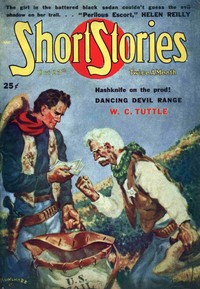
W. C. Tuttle's 'Dancing Devil Range' follows drifting cowboys Hashknife Hartley and Sleepy Stevens into a Christmas-season mystery on the Arizona range. The story opens with a shotgun murder at a desert depot and builds through nocturnal surveillance, cryptic visitors, and fatalistic dialogue, all set against the sparse, dusty landscape of the Dancing Devil country.
Editorial Edition Score
4.6/5
★★★★★
★★★★★
Calculated from edition completeness, EPUB availability, text structure and catalogue metadata. Not a user rating.
Edition quality
The story begins not with a crime but with a train: a long, dusty freight rattling through desert hills, its caboose carrying two saddle-weary drifters. Hashknife Hartley sprawls on an uncomfortable seat, gazing through a dusty window; across the aisle, Sleepy Stevens lies with his head pillowed on his war-sack. The description of their worn gear—home-made gun-belts, blackened Colt butts, colorless shirts—establishes a pair of cowboys who are neither flashy nor new. When the train slows at Northgate, the railroad point for the Dancing Devil range, the men step down with heavy saddles. Within moments, a shotgun blast from behind a loading platform kills a man named Oren Blakely. The shooter vanishes into the darkness, leaving Hashknife and Sleepy at the center of a mystery before they have even found a place to stay.
Arrival by Rail and a Sudden Killing
The opening sequence is tightly constructed around movement and observation. The freight train is described as “seemingly in no hurry to anywhere,” a phrase that sets a languid pace abruptly broken by violence. Hashknife and Sleepy are introduced through their physicality—Hashknife tall and slender, Sleepy shorter, broad-shouldered, slightly bow-legged—and their plain attire. The murder occurs just as the conductor crosses into the depot, a kerosene lamp yellow-lighting the windows. The victim, Oren Blakely, is hit by a dozen buckshot and dies on the platform. No law officer is in Northgate; the sheriff’s office is thirty miles south at Tomahawk Flats. The scene establishes the isolation of the Dancing Devil range and the immediate need for the drifters to become involved.
Fatalism and the Big Book
Later, during a supper at Aunt Judy’s, Hashknife engages in a philosophical exchange about fate. When Nell mentions Christmas Eve, Hashknife hopes “that it’s all written our way in the Big Book.” Aunt Judy, surprised, says she has never heard of it. Hashknife explains: “No mortal’s eyes have ever seen it—but the finger of Fate writes in that book. It shows what we do, how we live, how we die—and when.” Aunt Judy calls this fatalism, but Hashknife counters with a practical example: men survive hell and high water only to trip over a chair in the dark. The conversation is cut short by Aunt Judy’s admission that she has forgotten her arguments, and Hashknife grins, “School is dismissed.” This moment of reflection contrasts with the action-oriented plot and hints at Hashknife’s worldview.
Surveillance in the Dark
Returning to Tomahawk Flats, Hashknife and Sleepy witness a horse and buggy stop at the Pasatiempo Saloon. The driver asks directions to Thomas Colton’s home. Hashknife recognizes the passenger as Slim Regan, a gambler and promoter from Wyoming. Despite Sleepy’s reluctance, they follow the buggy to Colton’s house, where the windows are shaded. They then hear a spur-wearing pedestrian approach and enter the dark house. Hashknife and Sleepy backtrack to find the visitor’s horse—a tall roan with a Bar N brand, which Sleepy identifies as Buck Nolan’s mark. They wait in darkness for fifteen minutes, but no one comes. The scene is built on careful observation: the rasp of buggy-wheels, the scratch of a match to read a brand, the sound of footsteps on a wooden sidewalk. Hashknife’s curiosity drives the investigation, even when Sleepy sees no point.
Recurring Images of Dust and Darkness
Throughout the excerpts, the physical environment is rendered in sparse, tactile detail. The train is dusty, the caboose window is dusty, and the depot is lit by a kerosene lamp. Night scenes are dark: no lights on the street, shaded windows, and the need for matches to see a brand. The characters move through this landscape with deliberate economy—Hashknife and Sleepy carry heavy saddles, wear high-heel boots, and their gun-belts are “form-fitted by wear.” The murder weapon is a shotgun, not a pistol, and the victim is hit by buckshot, a messy, close-range weapon. The setting of the Dancing Devil range is evoked through place names—Northgate, Tomahawk Flats, the Bar N brand—but the land itself remains a backdrop of desert hills and loading corrals. The story’s structure alternates between static observation (the train ride, the supper conversation) and sudden, unexplained movement (the shooting, the buggy’s departure).
Readers approaching Dancing Devil Range should pay attention to the way Tuttle uses physical details—a brand, a spur, a shaded window—to build a puzzle without overt explanation. The narrative moves through a series of dark, half-seen encounters, and Hashknife’s fatalistic remarks may offer clues to how he reads the events. The excerpts cover only the first portion of the story, so the resolution of the murder and the role of Slim Regan remain unknown. The book rewards attention to small observations and the rhythms of cowboy speech.
-

Ryan Peck - 2 weeks ago
Dancing Devil Range offers a decent western tale with a good atmosphere and a solid plot. The characters are likable, but the story follows familiar tropes without much innovation. It's a quick read that delivers on action, but don't expect a transformative experience. Good for a casual western fan. -
Charles Joanna Campbell - 3 hours from now
Dancing Devil Range is a generic western with a forgettable plot and weak character development. The dialogue is clunky, and the action sequences are uninspired. There's little to distinguish this from countless other westerns. Only die-hard fans of the genre might find something to appreciate here. -
Richard Anthony - 12 hours from now
Dancing Devil Range is a thrilling western with a strong sense of place and a plot full of action and intrigue. The protagonist is rugged and resourceful, and the conflict over a ranch is classic but well-executed. The desert landscapes are vividly described, and the pace never lets up. Fans of traditional westerns will find this an engaging read from start to finish.
Reader reflection
Record your reading impressions
A brief reflection can help important ideas stay with you longer.
Your progress
0
/
10
2
Was reading this book enjoyable?
3
Is this a title you would suggest to others?
4
Did the language feel accessible?
5
How useful did the reading feel?
6
Did you relate to its people, ideas, or situations?
7
What did you think about the pace?
8
How original did the book feel?
9
What did this book teach you most?
10




Sebastian Thompson
2 weeks ago