1

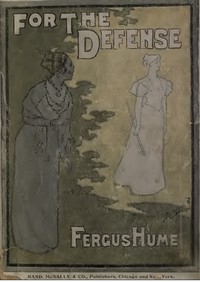
For the Defence — Story, Setting & Ideas
(4 User reviews)
582
Project Gutenberg
2017
England -- Fiction; Trials (Murder) -- Fiction; Mystery fiction
Readers of public-domain and historical texts
Project Gutenberg digital edition
en
Edition facts
Words: 60,084
Reading time: 262 min
Text sections: 7
Source:
Project Gutenberg record #55420
Fergus Hume's 1897 mystery novel opens with Major Jen adopting two boys after the Ashantee war, then shifts to a murder trial involving a stolen 'devil-stick' and a Voodoo perfume. The excerpts reveal a layered narrative: a domestic setup, a supernatural-tinged weapon, and a suspicious witness whose testimony is questioned.
Editorial Edition Score
4.7/5
★★★★★
★★★★★
Calculated from edition completeness, EPUB availability, text structure and catalogue metadata. Not a user rating.
Edition quality
The first chapter of For the Defence introduces Major Laurence Jen, a retired bachelor who has renamed his Surrey estate ‘Ashantee’ after the West African campaign where he fought. He has adopted two unrelated boys: Maurice Alymer, son of the woman he loved, and David Sarby, whose origins are not yet explained. The domestic setup is orderly, yet the chapter’s title—‘The Major and His Household’—hints at hidden tensions. The Ashantee devil-stick, a carved wand associated with the king’s palace, appears early as a stolen object, and the narrative quickly moves toward a murder trial. The excerpts show a story that balances colonial adventure, courtroom drama, and a mysterious perfume that may be a poison.
A Household Founded on Loss
The opening establishes Major Jen as a man shaped by unrequited love and war. He adopts Maurice after the boy’s mother dies of shock following her husband’s death in the Ashantee campaign. The major’s decision to rename his estate after a ‘barbaric’ kingdom is described with ‘some irony,’ suggesting a complex attitude toward his military past. The two boys, Maurice and David, are not related to him, and their presence creates an unusual family dynamic. The text notes that Jen ‘devoted his life to cherishing and training’ Maurice, but David’s role is left unclear. This asymmetry may drive later conflicts. Readers should note how the household’s origins—rooted in death and disappointment—set a somber tone that contrasts with the sensational crime to come.
The Devil-Stick and Its Poison
The devil-stick, also called the ‘wand of sleep,’ is a carved object from the Ashantee king’s palace. Major Jen once owned one, but it was stolen. The excerpts reveal that the stick can be filled with a poison that becomes active when water is added. A character named Dido, a Black servant, is suspected of stealing it and using it to kill Maurice. She denies this, claiming the poison was already dried up. The perfume used on a handkerchief is linked to Voodoo practices: Dido says it is meant to ‘drib away de evil spirit,’ but a scratch from the poison can kill. The weapon’s exotic origin and the supernatural language around it—‘Obi,’ ‘Voodoo’—give the mystery a colonial Gothic flavor. Readers should watch how the stick’s physical properties are verified or debunked as the trial proceeds.
Isabella’s Evasive Testimony
Isabella Dallas, the woman who loved Maurice, is a key witness. In Chapter XIV, Major Jen questions her about how Dr. Etwald came to use her mother’s handkerchief. She claims she overheard the doctor apologize, but her answers are ‘suspiciously prompt’ and she hesitates when pressed. Jen notes that her conduct ‘suggested … that she knew more than she cared to talk about’ and that her knowledge might implicate her mother. The dialogue is clipped, with Isabella leaving the major’s side abruptly. This scene shows how the narrative uses cross-examination to reveal character: Isabella’s love for Maurice is stated, but her evasiveness undercuts her reliability. Readers should compare her account with Dido’s later explanation of the perfume and the stick.
Dido’s Accusation and Denial
Dido, the Black servant, is confronted by Major Jen about the devil-stick and the perfume. She responds with a mix of scorn and defiance, repeating his suspicions back to him: ‘You say I took de debble-stick … and dat I kill wid him massa.’ She denies each point, insisting the poison was in the stick but that she did not take it or kill anyone. Her speech is rendered in dialect, and she claims the perfume is merely to drive away evil spirits. The scene is tense, with Dido turning the major’s questions back on him. Her role as a practitioner of ‘Obi’ marks her as an outsider in the English setting, and the narrative leaves open whether she is a scapegoat or a genuine suspect. Readers should note that her denial is the only direct account of the poison’s origin.
These excerpts show a novel that weaves together domestic drama, colonial artifacts, and courtroom procedure. The devil-stick and the perfume are not mere props; they carry cultural weight and are central to the murder method. Pay attention to how each character’s knowledge of these objects is revealed or concealed. The trial chapters likely test the evidence presented in these earlier scenes, and the final surprise mentioned in the contents may hinge on a detail that seems minor now.
Leo Campbell
1 week agoHenry Adams
2 weeks agoJames Sanchez
1 week agoThere are no comments for this eBook.
Reader reflection
What was your reading experience?
Capture what you thought, learned, and would like to remember.
Your progress
0
/
10
2
How much did you enjoy the reading experience?
3
Would you pass this book on to a friend?
4
How much effort did this book require?
5
Did any part of the book feel personally relevant?
6
Did you gain anything practical from the text?
7
How did the pace of the book feel?
8
Is this a title worth rereading?
9
In one sentence, what did you learn?
10









Aria Clark
2 weeks ago