1

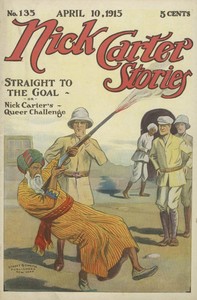
Nick Carter Stories No. 135. April 10, 1915; Straight to the Goal; Or, Nick Carter's Queer Challenge — Reading Notes
(1 User reviews)
293
Project Gutenberg
2021
India -- Fiction; Detective and mystery stories; Attempted murder -- Fiction; Millionaires -- Fiction; Dime novels; Kidnapping -- Investigation -- Fiction
Readers of public-domain and historical texts
Project Gutenberg digital edition
en
Edition facts
Words: 38,521
Reading time: 168 min
Text sections: 25
Source:
Project Gutenberg record #66486
This editorial note examines the authorial choices in Nick Carter's 1915 dime novel, focusing on the controlled diction of the detective, the mechanical precision of the Golden Scarab's poison apparatus, and the rapid, action-driven dialogue that propels the plot without psychological depth.
Editorial Edition Score
4.7/5
★★★★★
★★★★★
Calculated from edition completeness, EPUB availability, text structure and catalogue metadata. Not a user rating.
Edition quality
The opening of Straight to the Goal; or, Nick Carter's Queer Challenge establishes a signature calm in the face of sudden violence. When a spear lands quivering in the camp, Nick Carter does not flinch; he merely glances at it 'as if it were a rather curious visitor.' This deliberate understatement sets the detective apart from his alarmed companions and signals a narrative voice that prizes composure over panic. The authorial choice to have Carter remain seated, cigar in mouth, while others spring to action, immediately defines his character through physical stillness and laconic speech.
Diction of Control
Nick Carter's dialogue consistently employs short, declarative sentences that convey authority without explanation. When Jefferson Arnold warns of more spears, Carter replies, 'I hardly think so. That is a message only, unless I am much...' The trailing off suggests a mind already analyzing, not reacting. This verbal economy contrasts with the more excitable lines of Patsy Garvan and Chick, who 'jumped to their feet, rifle in hand.' The narrator rarely describes Carter's internal thoughts; instead, his calm words and actions serve as the primary indicators of his deductive process. The effect is a protagonist who seems to operate on a plane above the chaos around him.
Mechanical Horror of the Golden Scarab
The description of the Golden Scarab's mechanism is rendered with clinical precision. The horns are 'hollow, and jointed, like those of a lobster,' with knives 'gilded to look like part of the Scarab's claws.' The poison is 'concealed in the handles of the knives, the blades of which were hollow, so that the deadly stuff would run through and empty into a wound.' This technical detail, far from being sensationalized, is presented as a puzzle to be solved. The narrative lingers on the craftsmanship—'the skill that marked everything done under the guidance of Calaman'—treating the murder device as an object of grim admiration rather than horror.
Action-Driven Dialogue
Dialogue in the excerpts serves primarily to advance action and coordinate movement, not to reveal character. Lines like 'Beat them back, boys! It's only a bluff!' and 'Lend me a gun, somebody!' are functional, stripped of introspection. Even when Chick wonders about a widow's knowledge, the exchange is cut short by Nick: 'We won't tell her, at all events.' The rapid back-and-forth mimics the pace of a fight scene, with each utterance triggering a physical response. This style prioritizes momentum over emotional depth, fitting the dime-novel format where plot velocity is paramount.
Setting as Threat
The camp setting is sketched with minimal detail—'a rock,' 'a small fire'—but the environment is immediately hostile. The spear arrives 'sailing over the bluff,' and later the 'sound of tramping feet on the sand' signals an ambush. The natural landscape is not described for atmosphere but as a stage for sudden intrusion. The Scarab itself is a fusion of animal and machine, its 'hollow horns' and 'poisoned knives' blurring the line between organic and artificial. This treatment of setting as a source of threat, rather than backdrop, reinforces the story's focus on immediate physical danger.
Readers approaching this dime novel should attend to how the author uses restraint—in Carter's dialogue, in the technical descriptions of weapons, and in the sparse setting—to create a tone of controlled menace. The story does not dwell on motive or morality; it moves from one violent set piece to the next. The pleasure lies in watching a detective who never raises his voice solve puzzles that others find terrifying.
There are no comments for this eBook.
Reader reflection
What was your reading experience?
Capture what you thought, learned, and would like to remember.
Your progress
0
/
10
2
Was reading this book enjoyable?
3
Would you encourage someone else to read it?
4
How easy was the book to follow?
5
Did anything about the book feel genuinely new?
6
How understandable was the text?
7
How personally connected did you feel to the book?
8
How valuable was this book for your own interests?
9
What did this book teach you most?
10



John Brown
3 weeks ago