1

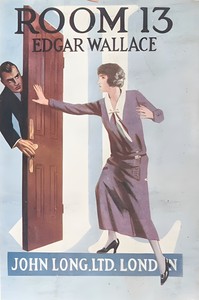
Room 13 — Themes and Context
(1 User reviews)
221
Project Gutenberg
2025
Detective and mystery stories; England -- Fiction; Ex-convicts -- Fiction; Detectives -- Fiction; Reeder, J. G. (Fictitious character) -- Fiction
Readers of public-domain and historical texts
Project Gutenberg digital edition
en
Edition facts
Words: 64,863
Reading time: 283 min
Text sections: 6
Source:
Project Gutenberg record #76168
Edgar Wallace's 1924 crime novel follows ex-convict Johnny Gray and detective J.G. Reeder. The excerpts show prison life at Dartmoor, a cryptic rabbit parable, and the tension between criminals and law. Catalog subjects include ex-convicts and detectives, but the text emphasizes moral ambiguity and psychological games.
Editorial Edition Score
4.7/5
★★★★★
★★★★★
Calculated from edition completeness, EPUB availability, text structure and catalogue metadata. Not a user rating.
Edition quality
The novel opens not with a crime but with a carved Latin motto over a prison gate: PARCERE SUBJECTIS. Johnny Gray, an inmate, translates it wryly as “Parky Subjects,” rejecting the official meaning “Spare the Vanquished.” This small act of defiance sets the tone for a story where language, interpretation, and hidden meanings matter as much as action. The excerpts show Gray working on a hand-cart with a lifer named Lal Morgon, discussing a past conviction for horse-switching—a “frame-up” he accepts without complaint. The setting is Dartmoor Prison, described in grim, specific detail: pitch-painted halls, broken asphalt, a garish church, and a graveyard for lifers. The catalog lists “Ex-convicts — Fiction” and “Detectives — Fiction,” but the opening chapters dwell less on detection than on the texture of incarceration and the quiet negotiations between prisoners.
Prison as a Landscape of Details
The excerpts devote unusual attention to the physical environment of Dartmoor. The narrator notes “the gaunt ‘halls,’ pitch painted against the Dartmoor storms,” the “low-roofed office,” the “gas house,” and the “big, barn-like laundry.” These are not generic prison descriptions; they are catalogued with the precision of someone who has memorized every building. The exercise yard has “broken asphalt,” the church is “garishly decorated,” and the benches have “raised seats for the warders.” Even the graveyard is specified: “where the happily released lifers rested from their labours.” This accumulation of concrete detail grounds the story in a real, oppressive place. The catalog subject “England — Fiction” is thus realized not as a vague setting but as a specific, almost documentary depiction of a notorious prison. The reader is given the sensory weight of confinement before any detective work begins.
The Rabbit Parable and Reeder’s Indirect Method
Detective J. G. Reeder appears in a later excerpt, and his method is anything but direct. He speaks to Jeffrey Legge in a series of oblique analogies. He asks, “Do you love rabbits?” and then explains that he buys caged rabbits and releases them into the wild, acknowledging it may be a “foolish kindness.” He warns, “Never be a rabbit in a cage.” This parable is a threat, but it is delivered with elaborate courtesy and literary quotation (“painted ships upon a painted ocean”). Reeder refers to a predecessor named Golden, who “could not stand this climate” and “suffered terribly from asthma, or it may have been sciatica.” The vagueness is deliberate. He never accuses Legge directly of forging banknotes (“slush”), but he describes exactly what a reformer would do: “burn his paper and his water-markers, dismiss all his agents.” The catalog subject “Detectives — Fiction” is accurate, but Reeder’s style—evasive, whimsical, menacing—is far from the hard-boiled or deductive archetype. He works by insinuation and parable.
Voice and the Criminal’s Perspective
The excerpts are narrated in a close third person that often adopts the vocabulary and attitudes of the prisoners. Johnny Gray thinks of the Latin motto in the “argot of his companions.” Lal Morgon speaks of getting another “lagging” (prison sentence) and refers to prison as “boob.” The dialogue is colloquial and specific: “They framed up Spider King to catch me. I am not complaining.” This voice gives the reader access to the criminal underworld without romanticizing it. The catalog subject “Ex-convicts — Fiction” is present, but the text does not treat Gray as a victim or a hero. He is matter-of-fact about his innocence and his acceptance of the frame-up. The lifer Morgon is wizened and cynical: “I’m the only guilty man in boob.” The excerpts do not reveal the full plot, but they establish a world where guilt and innocence are less important than survival and the codes of prison life. The narrative voice shifts seamlessly from Gray’s perspective to Reeder’s, creating a dual viewpoint that the catalog’s single “Detectives — Fiction” label does not fully capture.
Readers should pay attention to the way Wallace uses indirect speech and layered meanings. The prison scenes are not merely backdrop; they establish a vocabulary and a set of rules that carry into the outside world. Reeder’s parables and Gray’s quiet observations reward careful reading. The excerpts do not reveal whether Gray returns to crime or becomes Reeder’s ally, but the tension between the two perspectives—the inmate’s and the detective’s—is the engine of the novel. Approach the text as a study in how people talk around what they mean, and how cages can be made of words as well as stone.
-

Matthew Brooks - 3 weeks ago
Room 13 offers a solid, spooky premise and maintains suspense throughout, but the pacing can be uneven, with some slow sections in the middle. However, the chilling climax makes it worth the read for fans of horror and mystery. -
Alicia Brittney Quinn - 6 days ago
Room 13 has a promising premise but fails to deliver. The characters are flat and the plot is predictable, with few genuine scares. The writing is average, and the story drags in places. If you're looking for a fresh, original horror, this isn't it. -
Ryan Phillips - 13 hours from now
Room 13 is a gripping thriller that had me on the edge of my seat from the first page. The eerie atmosphere and well-developed characters make it a standout in the genre. The plot twists are clever and keep you guessing until the very end. If you're a fan of atmospheric horror with a psychological edge, this is a must-read. Highly recommended!
Reader reflection
Take a moment to reflect on this book
Create a short personal record of your experience with this book.
Your progress
0
/
10
2
How did the book work for you overall?
3
Would you pass this book on to a friend?
4
What was the reading difficulty like?
5
Did the story or argument move comfortably?
6
Could you see yourself revisiting this book?
7
Which aspect of the book did you value most?
8
Did you gain anything practical from the text?
9
What did this book teach you most?
10


Michael Harris
2 days ago