1

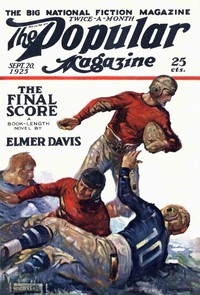
Splashes of red — Inside the Classic
(2 User reviews)
379
Project Gutenberg
2024
Short stories; Detective and mystery stories; Murder -- Investigation -- Fiction; Man-woman relationships -- Fiction; Rodeos -- Fiction
Readers of public-domain and historical texts
Project Gutenberg digital edition
en
Edition facts
Words: 9,133
Reading time: 40 min
Text sections: 1
Source:
Project Gutenberg record #73618
In this rodeo-set mystery, J. Frank Davis uses clipped dialogue, precise physical description, and a recurring red motif to build suspicion around a cowboy accused of murder. The editorial note examines how the author's diction and structural choices shape the investigation.
Editorial Edition Score
4.4/5
★★★★★
★★★★★
Calculated from edition completeness, EPUB availability, text structure and catalogue metadata. Not a user rating.
Edition quality
From its opening scene at Speedway Park, Splashes of Red establishes a world where rodeo competition and criminal investigation share a vocabulary of speed, precision, and physical risk. J. Frank Davis writes bulldogging contests with the same attention to timing and detail—"eleven and two fifths seconds"—that he later applies to alibis and evidence. The narrative voice shifts between the announcer's booming public address and the private, terse exchanges of cowboys under suspicion. This editorial note examines three authorial choices visible in the excerpts: the use of color as a marker of emotional and narrative tension, the compression of dialogue to convey character and conceal motive, and the structural parallel between rodeo events and detective work.
The Red Splash as a Visual and Thematic Cue
The title's "splashes of red" is not merely decorative. In the opening pages, a "brilliant toque hat" makes a "splash of violent red" in the grandstand, drawing the attention of both the rodeo performer Curly and the reader. The color recurs in the "red handkerchief" that the judge, Pres Campbell, pointedly notices on Curly's neck. Davis uses these details to create a visual thread that ties together jealousy, evidence, and atmosphere. The hat belongs to a woman named Florrine, whose presence disrupts the existing relationship between Curly and Millie Wayne. The handkerchief, meanwhile, becomes a point of inquiry—the judge asks about it without explaining its relevance, leaving the reader to wonder whether it is a clue or a red herring. Davis does not overexplain these images; he lets them accumulate meaning through repetition and context.
Dialogue That Reveals and Conceals
The conversation between Curly and Judge Campbell is a masterclass in oblique communication. Curly's speech is full of hesitations, corrections, and defensive qualifications: "I don't know as I ever heard her mention" and "We don't want to drag any nice lady's name into this." The judge, by contrast, uses a folksy, probing tone that masks his investigative purpose. He interrupts Curly's rambling with pointed questions: "Did you say they were father and mother both?" and "Who did you see there you knew?" The dialogue is laced with colloquialisms—"trompled on her feelings," "beat it home to the hotel"—that ground the characters in a specific regional and occupational identity. Davis also uses silence and evasion: Curly never directly answers whether he intended to meet Florrine, and the judge never reveals what he knows about the murder weapon. The reader must parse what is said and what is left unsaid.
Rodeo Structure Mirrors Detective Procedure
Davis structures the investigation with the same precision as a rodeo event. The judge, a former Texas ranger, treats the murder inquiry as a series of timed, rule-bound actions. He notes Curly's alibi—"I went in at the front—tonight and the other two times I've been there"—and checks it against the physical layout of the Monaco dance hall, asking about an alley and a side door. This echoes the earlier description of Curly's bulldogging: "Feet braced, he slid backward for two seconds, then man and steer came to a struggling stop." Both scenes depend on exact timing and spatial awareness. The rodeo announcer's voice, which calls out times and placements, is replaced by the judge's methodical questioning. Even the language of competition bleeds into the investigation: Curly worries about his reputation, and the judge speaks of "bad shots in the dark." The excerpts suggest that Davis uses the rodeo setting not just as local color but as a formal model for how truth is pursued.
Physical Detail as Character and Plot Device
Davis invests heavily in physical description that serves both characterization and narrative tension. Millie Wayne's hands are described as "not unbeautiful but hard, competent ones," contrasting with Florrine's "soft, pinkly manicured hand." This single detail encapsulates the romantic triangle and class tension between the rodeo world and the city. Similarly, the description of the steer's fall—"its head twisted slowly, grotesquely, as though it cocked its startled eyes to squint sidewise at the sky"—is both vivid and ominous, foreshadowing the violence to come. The pistol that Curly "forgot to clean" is another physical object that carries narrative weight: it was fired by another performer, Red Peeks, but the police find it dirty, creating ambiguity. Davis trusts these concrete details to do the work of exposition, avoiding lengthy explanations in favor of sensory cues that the reader must interpret.
Because the excerpts end before the resolution, the reader is left with a series of unanswered questions: Who killed Red Peeks? Is Florrine involved? Does the red handkerchief matter? Davis's method rewards careful attention to what characters say, what they avoid saying, and how objects and colors recur. The rodeo setting is not merely backdrop but an organizing principle for the story's logic. Readers interested in how genre fiction can use setting and dialogue to create suspense will find much to examine in these pages.
William Green
3 weeks agoThere are no comments for this eBook.
Reader reflection
What was your reading experience?
Capture what you thought, learned, and would like to remember.
Your progress
0
/
10
2
What was your overall reaction to the book?
3
How likely are you to recommend this book?
4
What was the reading difficulty like?
5
Did the book deliver what you hoped for?
6
Is this a title worth rereading?
7
Would this book work well in a reading group?
8
Did the book offer a fresh perspective?
9
In one sentence, what did you learn?
10






Emma Nelson
1 week ago