1

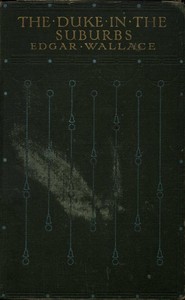
The Duke in the Suburbs — Context and Discussion
(7 User reviews)
1463
Project Gutenberg
2015
Detective and mystery stories, English; Nobility -- Fiction; Murder -- Fiction; Suburbs -- England -- London -- Fiction
Readers of public-domain and historical texts
Project Gutenberg digital edition
en
Edition facts
Words: 51,668
Reading time: 225 min
Text sections: 10
Source:
Project Gutenberg record #49694
Edgar Wallace's comic mystery follows a duke's disruptive arrival in Brockley, S.E., where his refusal to pay rent and mysterious past spark suburban intrigue. The narrative moves between farcical council-of-war scenes and the duke's own perspective, using a satirical directory and parodic Shakespeare to mock local pretensions.
Editorial Edition Score
4.8/5
★★★★★
★★★★★
Calculated from edition completeness, EPUB availability, text structure and catalogue metadata. Not a user rating.
Edition quality
The novel opens not with the duke but with a satirical 'private amendment' to the local directory, exposing the secret lives of Kymott Crescent residents: Mr. Wilkes drinks, Mrs. Coyter smokes, and young George is 'a most insufferable little beast.' This device immediately establishes the work's structural play between public facade and private truth. The author's apology further frames the challenge: to extract 'tragedy and farce' from Brockley, S.E., a suburb deemed unpromising for romance. The duke's arrival is thus set against a backdrop of petty scandals and comic self-importance.
The Council of War and Its Comic Mechanics
The central scene—a council of war against the duke—showcases Wallace's structural skill. Sir Harry, Hal, Mr. Rake, and Mr. Smith debate how to oust the intruder. Their proposals escalate from a leader on 'Democratic ideals' to cutting off water or gas, each suggestion undercut by practical or legal obstacles. Mr. Rake's parody of Julius Caesar ('You hard hearts, you cruel men of Lee') is met with Sir Harry's furious refusal to be called Pompey. The comedy lies in the gap between their grandiloquent schemes and the mundane reality of suburban life. Hal's interjection—'what the devil's the good of you thinking that any muck you write is likely to shift this Duke fellow'—punctures Rake's journalistic pretensions, while Mr. Smith's legal quibbles ground the farce in property law.
The Duke's Letter and the Rent Question
The duke's letter, read aloud by Mr. Smith, is a turning point. It reveals his American-acquired defiance: 'I regard the service of such a notice as constituting a breach of contract, and must respectfully decline to pay any further rental.' The phrase 'respectfully decline' is a masterstroke of passive aggression. The letter's formal tone contrasts sharply with the council's bluster, and its mention of 'the American gent who lives with him' hints at a transatlantic influence. The rent question becomes a structural pivot, shifting the conflict from social embarrassment to legal standoff. Wallace uses this document to advance the plot without direct narration, letting the duke's own words expose his character.
Recurring Images: Suburbia as Stage
Wallace repeatedly frames Brockley as a theatrical space. The directory's 'authorized statement' versus 'private amendment' mirrors the public/private divide. The council of war is explicitly a 'council of war' with theatrical flourishes—Rake's Shakespeare parody, Hal's 'tangented' outburst. The duke himself is a figure of mystery, arriving from America and refusing to conform to suburban norms. His lease dispute becomes a performance of resistance. The image of climbing 'up to walls and battlements, to towers and windows, yea, to chimney pots' to see the duke is both absurd and evocative, suggesting a community that turns ordinary houses into arenas for spectacle. This theatricality extends to the narrative structure itself, which moves between scenes of dialogue and direct address.
Movement Between Scenes: From Directory to Council to Letter
The excerpted text shows a deliberate movement from the static, list-like directory to the dynamic council scene, then to the duke's letter. Each shift changes the narrative register: the directory is satirical and omniscient; the council is dialogic and farcical; the letter is formal and confrontational. This alternation keeps the reader off-balance, never settling into a single mode. The council scene itself contains micro-movements: from Rake's literary pretensions to Hal's blunt practicality to Mr. Smith's legalism. Wallace uses these transitions to build momentum, culminating in the letter's revelation. The effect is a narrative that feels both episodic and tightly plotted, each scene advancing the central conflict while revealing character through action and speech.
Readers should attend to the way Wallace uses documents—the directory, the letter—as structural devices that advance plot without authorial intrusion. The council scene rewards attention to its layered comedy, where each character's speech reveals their social position and limitations. The duke himself remains largely offstage in these excerpts, a presence felt through others' reactions. This indirect approach invites speculation about his true nature, but the text offers only hints. The novel's movement between satire, farce, and legal wrangling suggests a work that refuses to settle into a single genre, much as its protagonist refuses to settle into suburban life.
Grayson Hernandez
3 weeks ago-

Sarah Sellers - 3 weeks ago
{'review_type': 'positive', 'text': "The Duke In The Suburbs is a delightful romantic satire that pokes fun at high society and suburban life. The duke's attempts to adapt to middle-class conventions are both hilarious and touching. The dialogue is witty, the characters are charming, and the social commentary is sharp. A light-hearted read that leaves a smile on your face."} -
Meredith Karen Keller - 3 weeks ago
{'review_type': 'neutral', 'text': "The Duke In The Suburbs is an amusing story with a humorous premise and a few laugh-out-loud moments. The duke's interactions with suburbanites are entertaining, but the plot is predictable and the romance is tepid. It's a pleasant diversion, but not very deep. If you're in the mood for light comedy, it works."} -
Robert Hamilton - 7 hours from now
{'review_type': 'negative', 'text': 'The Duke In The Suburbs is a tedious and unfunny attempt at comedy. The jokes are stale, and the characters are one-dimensional. The plot is thin and meanders without purpose. The satire lacks bite and feels dated. I found myself checking the page count hoping for it to end. Not recommended.'}
Reader reflection
Take a moment to reflect on this book
Create a short personal record of your experience with this book.
Your progress
0
/
10
2
What was your overall reaction to the book?
3
Would you pass this book on to a friend?
4
How demanding did the text feel?
5
Did any part of the book stay with you emotionally?
6
Could you see yourself revisiting this book?
7
Could you apply anything you learned?
8
How personally connected did you feel to the book?
9
What did this book teach you most?
10

Sofia Gonzalez
1 week ago