1

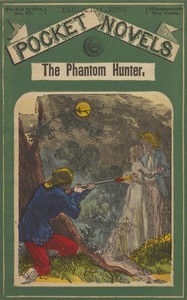
The phantom hunter; or, love after death — Reading Companion
(6 User reviews)
1935
Project Gutenberg
2022
Western stories; Detective and mystery stories; Guardian and ward -- Fiction; False imprisonment -- Fiction; Frontier and pioneer life -- Fiction; Kentucky -- Fiction; Attempted murder -- Fiction; Dime novels; Unrequited love -- Fiction; Wyandot Indians -- Fiction; Girty, Simon, 1741-1818 -- Fiction; Arson investigation -- Fiction
Readers of public-domain and historical texts
Project Gutenberg digital edition
en
Edition facts
Words: 39,572
Reading time: 173 min
Text sections: 18
Source:
Project Gutenberg record #69168
An 1872 dime novel set in a Kentucky frontier settlement, where a young man is hanged for murder, a hunter tracks a villain, and a scout named Kirby Kidd speaks in a distinctive dialect. The narrative uses third-person omniscience, shifting between characters and locations.
Editorial Edition Score
4.7/5
★★★★★
★★★★★
Calculated from edition completeness, EPUB availability, text structure and catalogue metadata. Not a user rating.
Edition quality
The novel opens with a public execution on a village green, described as a scene the settlers had never before witnessed. The condemned man, Russell Trafford, is a respected orphan living with his uncle, Doctor Trafford. The narrative immediately establishes a tension between communal justice and individual reputation, a pattern that recurs throughout the excerpts.
The author, writing under the pseudonym Edwin Emerson, employs a third-person omniscient narrator who moves freely between characters. In one passage, the narrator directly addresses the reader with "This we instantly observe," a technique common in dime novels that creates a sense of shared observation. The prose is economical, favoring action and dialogue over interiority.
Dialect and Diction: Kirby Kidd's Voice
The scout Kirby Kidd speaks in a thick dialect that marks him as a backwoods character. His speech is rendered phonetically: "Mold me into buckshot ef ’tain’t beginnin’ to look a trifle suspicious!" and "I’m a-setting hyur as cool as a cowcumber in Jinawary." This dialect serves multiple purposes. It distinguishes Kidd from more educated characters like Russell Trafford, whose speech is not marked in the excerpts. It also signals authenticity, a common device in frontier fiction to suggest the speaker is a product of the wilderness rather than civilization.
Kidd's idiom is not merely decorative. The author uses it to convey his shrewdness and humor. When Kidd mutters "Bah! I might gab in that strain from now till the world comes to an eend," the dialect underscores his self-awareness and his role as a comic yet capable figure. The phonetic spelling—"hyur" for "here," "kum" for "come"—is consistent, suggesting the author paid careful attention to the sound of the character's voice.
Narrative Structure: Shifting Perspectives
The excerpts reveal a narrative that moves between multiple characters and locations, often within the same chapter. Chapter I focuses on the execution and the backstory of Russell Trafford. Chapter X shifts to a different setting—a glen by a river—and introduces Kirby Kidd alone by his fire. The narrator then follows Nick Robbins as he trails Jim McCabe, and later returns to Kidd awaiting the return of an Indian scout named Wapawah.
This structure creates a sense of simultaneity, as if events are unfolding in parallel. The narrator signals these shifts with phrases like "On this same morning another fire had been kindled" and "Thus cogitating, Nick Robbins followed the villain." The effect is a widening of the story's scope, moving from a single dramatic event to a network of characters whose paths are likely to converge.
Setting as Character: The Frontier Landscape
The Kentucky frontier is rendered in precise, functional detail. The settlement is described with its palisades, block-house, and brass field-piece "reflecting every sunbeam from its polished surface." Later, a glen is described as "hemmed in on three sides by a semi-circular ledge of rocks," with a fire placed so that its smoke becomes "very nearly invisible" by the time it rises above the rocks.
These details are not merely atmospheric. They serve the plot: the glen's concealment is crucial for a character hiding from Indians. The author also notes the "knowledge of Indian perspicacity" required to choose such a spot, linking setting to character skill. The landscape is a stage for survival, and the narrator treats it with the same attention given to human actors.
Dialogue and Action: Economy of Speech
Dialogue in the excerpts is sparse but functional. When Nick Robbins confronts Jim McCabe, the narrator reports only that he "laid his hand on McCabe’s shoulder" without recording any words. This restraint is typical of the dime novel style, where action often carries more weight than speech.
Kirby Kidd's monologue is the exception. His extended muttering serves as exposition, revealing his concern for Wapawah and his opinion of Nick Robbins. The author uses this soliloquy to convey information that would otherwise require a separate scene. Kidd's speech is also a marker of his isolation—he talks to himself because there is no one else to hear. The contrast between his loquacity and the silence of other characters highlights the range of the author's technique.
Readers attentive to the author's choices in diction and narrative structure will find a work that balances formulaic elements with specific, observed details. The dialect of Kirby Kidd, the shifting perspectives, and the functional descriptions of the frontier landscape all reward close reading. The novel does not offer psychological depth, but it does demonstrate how dime novels of the 1870s constructed a sense of place and character through economical prose and strategic use of voice.
Camila Brown
3 weeks agoAria Lewis
13 hours agoAva Moore
3 weeks agoAria Lee
4 weeks ago-

Rachael Jensen - 4 weeks ago
A deliciously Gothic romance with a supernatural twist. 'The Phantom Hunter Or Love After Death' blends love, loss, and the supernatural in a hauntingly beautiful narrative. The characters are compelling, and the mood is perfectly eerie. It's a thought-provoking read that stays with you long after the final page. -
Robert Lane - 4 weeks ago
The title promises more than the book delivers. The 'phantom' appears rarely, and the romance feels forced. The prose is overly flowery and slows down the plot. The concept has potential, but the execution is weak. A disappointing read overall. -
Roger Ingram - 2 weeks ago
The atmosphere is genuinely spooky and the romance is touching, but the pacing is uneven. Some chapters are thrilling, others drag. Also, the identity of the phantom is predictable. Nevertheless, it's a decent read for fans of classic ghost stories.
Reader reflection
Record your reading impressions
A brief reflection can help important ideas stay with you longer.
Your progress
0
/
10
2
Did this book hold your interest?
3
How likely are you to recommend this book?
4
How demanding did the text feel?
5
Could you see yourself revisiting this book?
6
Did any part of the book feel personally relevant?
7
Did the book deliver what you hoped for?
8
How would you describe its reading pace?
9
In one sentence, what did you learn?
10
Alexander Campbell
1 week ago