1

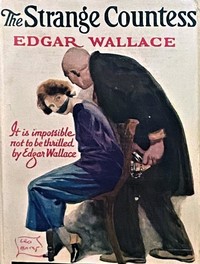
The strange countess — Inside the Classic
(4 User reviews)
1289
Project Gutenberg
2025
Detective and mystery stories; Young women -- Fiction; Crime -- Fiction; Household employees -- Fiction; Countesses -- Fiction
Readers of public-domain and historical texts
Project Gutenberg digital edition
en
Edition facts
Words: 67,288
Reading time: 293 min
Text sections: 7
Source:
Project Gutenberg record #75858
Edgar Wallace's 1926 mystery follows secretary Lois Reddle into the employ of the Countess of Moron, where a locked-room assault and a missing woman expose a web of deception. The narrative shifts from domestic realism to breakneck pursuit, with clipped dialogue and a detective's frantic race against time.
Editorial Edition Score
4.7/5
★★★★★
★★★★★
Calculated from edition completeness, EPUB availability, text structure and catalogue metadata. Not a user rating.
Edition quality
The novel opens with a precise domestic scene: Lois Reddle sits on her bed, holding a letter from the Countess of Moron that is 'thick and slightly perfumed.' The tea is 'too sweet,' the bread 'cut generously even as it was buttered economically'—details that establish a world of small economies and careful observation. Wallace’s voice here is brisk, leaning on concrete nouns and short clauses. The dialogue between Lois and her landlady Lizzy is colloquial and rapid, with Lizzy’s blunt 'Bathroom’s empty' and Lois’s quiet humor. This early passage grounds the story in a recognizable, lower-middle-class London, before the narrative accelerates into a very different register.
From Domestic Realism to Urgent Action
The excerpts reveal a sharp shift in pace and voice. The opening chapters are measured, filled with the textures of shared lodgings and secretarial duties. Lizzy’s complaints about a stingy employer and Lois’s reflective 'I’ve tried hard to move on all my life' give the prose a patient, observational quality. Later, however, the narrative becomes almost breathless. Michael Dorn tears open a telegram, 'read it in a fury of anger,' and 'flew out of the hall.' Sentences shorten: 'A run of ten minutes brought him to his garage.' The language turns to action verbs—'sprang,' 'leapt,' 'shot up'—and the setting shifts from interiors to roads, filling stations, and police stations. This structural contrast between the early, slower exposition and the later, cinematic chase is one of the book’s most notable features.
Clues and Miscommunication in the Dialogue
Wallace uses dialogue to convey information and create tension, but the excerpts show that characters often speak at cross-purposes. The countess’s formal note—'is pleased to learn that Miss Reddle will take up her duties'—contrasts with Lizzy’s earthy 'Sleep in, of course? That means I’ve got to get somebody to share these digs.' Later, Michael’s exchange with the porter is clipped and urgent: 'Which blue envelope?' 'It is downstairs, sir.' The detective-sergeant sees Michael’s 'face change' after reading a letter, but the content is withheld. This technique of partial revelation, where dialogue hints at events without full explanation, keeps the reader guessing. The telegram that has been 'obviously opened and reclosed' suggests a pattern of intercepted messages, a recurring motif in the excerpts.
The Chase as Structural Device
The later excerpt is dominated by a pursuit sequence that unfolds in real time. Michael drives from London to Telsbury, then to Letchford, and finally back to Chelsea. Wallace marks time precisely: 'Midnight was booming from Telsbury Parish Church,' 'At four o’clock in the morning a weary man brought his machine to a standstill.' The geography is specific—'the junction of the Telsbury by-road,' 'the westerly road'—and the detective’s frustration is palpable when he reaches 'a place where four roads met, and there was no trail.' This section reads almost like a procedural, with Michael gathering information from a filling station attendant and a town policeman. The pace is relentless, and the prose strips away description to focus on movement and decision. It is a marked departure from the novel’s opening, and it suggests that Wallace is as interested in the mechanics of investigation as in character.
Readers should pay attention to how Wallace handles the passage of time. The early chapters unfold over days, while the later ones compress hours into pages. This variation in tempo is not accidental; it mirrors the protagonist’s growing urgency. The countess herself remains a shadowy figure in these excerpts—her letter is formal, her statement is mentioned but not quoted. The novel’s title promises a strange countess, but the excerpts leave her motivations and true nature largely unexplored, making her an enigma that the reader must piece together from the actions of others.
Grace Lee
4 days agoJohn Nguyen
5 days agoGrayson Adams
1 week ago-

Katelyn Hawkins - 3 weeks ago
The Strange Countess is an enjoyable period mystery with an intriguing plot. The countess is a compelling character, and the atmosphere is well-established. However, the pacing slows down considerably in the middle, and the romance subplot felt a bit predictable. It's still a solid read for fans of classic mysteries. -
Christina Stuart - 2 weeks ago
The Strange Countess is a masterful blend of suspense and romance, set in a beautifully rendered Victorian era. The countess is a fascinating, complex character, and the twists in the plot are both surprising and satisfying. The author's descriptive prose brings every scene to life. This is a captivating novel that will keep you reading late into the night. -
Christopher Parker - 2 weeks ago
The Strange Countess disappoints with its meandering plot and flat character development. The countess, who could have been a fascinating protagonist, is inconsistent. The mystery is weak, and the romantic elements are clichéd. The writing is verbose and often tedious. I wouldn't recommend this to anyone seeking a gripping mystery.
Reader reflection
Take a moment to reflect on this book
Create a short personal record of your experience with this book.
Your progress
0
/
10
2
Did this book hold your interest?
3
Is this a title you would suggest to others?
4
What was the reading difficulty like?
5
How understandable was the text?
6
Would you like to discuss this book with someone?
7
Did the book meet your expectations?
8
What was the strongest part of the book?
9
Which lesson or insight stayed with you?
10


Emma Green
3 weeks ago