1

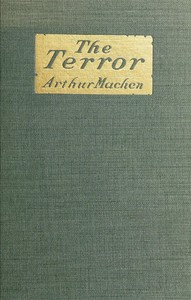
The Terror: A Mystery — Text and Context
(6 User reviews)
1386
Project Gutenberg
2011
London (England) -- Fiction; Murder -- Fiction; Mystery fiction; World War, 1914-1918 -- Great Britain -- Fiction; Animals -- Great Britain -- Fiction
Readers of public-domain and historical texts
Project Gutenberg digital edition
en
Edition facts
Words: 41,371
Reading time: 180 min
Text sections: 16
Source:
Project Gutenberg record #35617
Arthur Machen's 1917 novel intertwines World War I home-front anxiety with a series of unexplained deaths, as characters struggle to connect isolated incidents involving animals and hidden enemies.
Editorial Edition Score
4.8/5
★★★★★
★★★★★
Calculated from edition completeness, EPUB availability, text structure and catalogue metadata. Not a user rating.
Edition quality
The narrator of The Terror: A Mystery begins not with a corpse but with the boredom of wartime Britain: after two years of war, the public craves news, yet the Western Front has gone quiet. This opening establishes a world where the expected drama of battle has been replaced by an eerie stillness—a stillness that soon gives way to something far more unsettling. Machen builds his mystery not through a single detective but through a chorus of witnesses: a doctor, a scientist, a holidaymaker, each holding a fragment of the truth. The catalog subjects list murder, mystery, and animals, but the excerpts reveal a story more concerned with how people fail to communicate what they see.
Fragmented Testimony and the Failure to Connect
The excerpts repeatedly show characters who possess partial knowledge but refuse to share it. Dr. Lewis worries that his brother-in-law might learn of “the intolerable and tragic mysteries” around them, while Merritt keeps silent about the Midlands events because “he hated to think of them.” The narrator observes that “A and B met every day … each having in his possession half of the truth, which he concealed from the other.” This structural pattern—information deliberately withheld or simply not volunteered—becomes the engine of the plot. The reader is left to piece together clues that the characters themselves never assemble. Machen emphasizes this fragmentation by moving between locations and perspectives, never granting any single character full understanding.
The Landscape as Witness and Deceiver
Machen’s descriptions of the Welsh coast are lush and specific: “red rocks and firm yellow sands,” “crimson bastions and bays,” “the odd-shaped promontory called the Dragon’s Head.” Yet this beauty is immediately undercut by suspicion. Merritt, enjoying the view, notices flashing lights from a farmhouse and interprets them as heliographic signals—a message from hidden Germans. The natural world, so vividly rendered, becomes a screen onto which wartime paranoia is projected. The porpoises tumbling in the sea are a momentary charm, but the same sea may conceal a rowboat engaged in unknown activity. Machen uses the setting to blur the line between innocent observation and dangerous misinterpretation, a tension that runs through the entire narrative.
The Z Ray and the Limits of Scientific Explanation
Mr. Remnant, a character introduced in the chapter titled “Mr. Remnant’s Z Ray,” represents the urge to explain the inexplicable through science. The doctor, however, dreads “having to hear about the Z Ray all over again,” suggesting that Remnant’s theory is both obsessive and unconvincing. The excerpts do not reveal what the Z Ray is, but the dynamic is clear: a rational framework is offered, yet it fails to satisfy those who have witnessed the actual events. Machen contrasts Remnant’s abstract theorizing with the visceral, unspoken horror that characters like Merritt carry. This tension between scientific system and lived experience is a recurring motif, and the novel seems to side with the latter—the truth, if it exists, lies not in a ray but in the details people refuse to utter.
Readers approaching The Terror should attend to what is left unsaid as much as to what is described. The novel’s power lies in its gaps: the conversations that trail off, the observations that go unshared, the theories that irritate rather than illuminate. Machen’s prose rewards patience; the mystery is not solved by a final revelation but by a gradual accumulation of hints that the characters themselves never fully grasp. Treat each chapter as a piece of a puzzle that the narrator is still assembling, and note how the war—both present and absent—shapes every perception.
Grayson Clark
3 weeks agoElijah Wilson
4 weeks agoMatthew Wright
3 days agoAnthony Smith
2 weeks agoThere are no comments for this eBook.
Reader reflection
Before you leave, reflect on the book
Use these questions to collect your thoughts before moving on.
Your progress
0
/
10
2
Did this book hold your interest?
3
Would you recommend this book to another reader?
4
How much effort did this book require?
5
How strongly did the book affect you emotionally?
6
Is this a title worth rereading?
7
What did you think about the pace?
8
How original did the book feel?
9
What changed or sharpened your thinking?
10
Benjamin Lewis
2 weeks ago