1

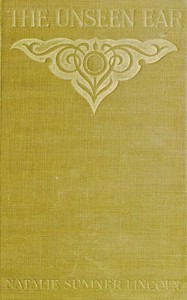
The unseen ear — Reading Companion
(7 User reviews)
1063
Project Gutenberg
2022
Detective and mystery stories; Murder -- Investigation -- Fiction; Washington (D.C.) -- Fiction; Husband and wife -- Fiction; Families -- Fiction; Deaf people -- Fiction
Readers of public-domain and historical texts
Project Gutenberg digital edition
en
Edition facts
Words: 63,453
Reading time: 276 min
Text sections: 24
Source:
Project Gutenberg record #68679
Natalie Sumner Lincoln's 1921 mystery uses a deaf character and a stolen Mizpah locket to explore hidden tensions in a Washington, D.C. household, where a bride's secret discovery of a body drives a web of suspicion and blackmail.
The opening chapter of The Unseen Ear introduces a man who enters a bedroom silently, hangs his coat, and is startled by his own reflection—a distorted face in the mirror. This moment of self-confrontation sets a tone of psychological unease that runs through the novel. The narrative quickly shifts to Judith Richards, a new bride, who discovers a body and later admits to removing a Mizpah locket from it, a detail she uses to threaten another woman. The excerpts reveal a story built on secrets, silent movements, and the weight of unspoken knowledge.
Silence and Surveillance
The novel's title, The Unseen Ear, points to a preoccupation with hidden listening and unnoticed presence. The text repeatedly emphasizes noiseless actions: doors open on oiled hinges, characters enter through portières without sound, and movements are described as stealthy or cautious. This auditory attention extends to the characters' awareness of being overheard. In one scene, Polly accuses Judith of trying to drive her away, and Judith counters by revealing she found Austin's body first—a secret she has kept from the police. The threat of exposure hinges on a physical object, the locket, but the real power lies in what has been heard or unseen.
The Mizpah Locket as Evidence
A Mizpah locket—a sentimental token often exchanged between friends or lovers—becomes the central piece of evidence in the mystery. Judith admits to taking it from Austin's body, and she uses it to blackmail Polly into leaving Washington. The locket's significance is not explained in the excerpts, but its role as a tangible link to the crime is clear. The novel treats the object with care: Judith places it in her lap, Polly watches her fascinated, and the threat of giving it to the police drives the confrontation. This focus on a single, small item suggests a plot where meaning is encoded in personal belongings.
Domestic Spaces and Hidden Tensions
The action unfolds in domestic interiors—a bedroom, a library, a dining room—where the boundaries between private and public are porous. Characters move through portières and past open doors, and conversations are interrupted by unexpected arrivals. The household includes a deaf person (per the catalog subject), though the excerpts do not show this directly. The setting of Washington, D.C., is mentioned but not developed in the provided text; the focus remains on the claustrophobic dynamics within the family. Judith's marriage, Polly's position in the household, and the unresolved death of Austin create a network of suspicion that plays out in these confined spaces.
Readers should attend to the novel's use of sensory details—especially sound and silence—as clues to character and plot. The excerpts offer only fragments of the larger mystery, but they establish a pattern of concealed knowledge and strategic revelation. The Mizpah locket, the distorted mirror reflection, and the repeated emphasis on stealthy movement all reward close attention. The complete text likely develops these elements into a fuller puzzle.
Daniel Jackson
8 hours ago-

Elijah Clark - 3 weeks ago
A chilling and atmospheric mystery that uses sound as its central motif. 'The Unseen Ear' is a brilliant exploration of paranoia and perception. The author's ability to create tension through auditory descriptions is unmatched. The twist at the end is genuinely surprising. Highly recommended for thriller lovers. -
Benjamin Dickson - 1 week ago
The concept of a mystery centered on 'hearing' is refreshing, and the early chapters are engaging. However, the middle part drags with repetitive inner monologues, and the resolution feels rushed. It's decent, but not as sharp as it could be. -
Martin Christopher Cobb - 6 days ago
A forgettable thriller that relies on gimmicks. The 'unseen ear' idea is underdeveloped, and the protagonist's constant second-guessing becomes irritating. The plot holes are glaring, and the ending is unsatisfying. I wouldn't recommend this to serious mystery readers.
Reader reflection
Record your reading impressions
A brief reflection can help important ideas stay with you longer.
Your progress
0
/
10
2
Did this book hold your interest?
3
Would you encourage someone else to read it?
4
How much effort did this book require?
5
How distinctive were its ideas or approach?
6
Could you see yourself revisiting this book?
7
Would you like to discuss this book with someone?
8
How closely did the book connect with your experience?
9
Which lesson or insight stayed with you?
10







William Gonzalez
2 weeks ago