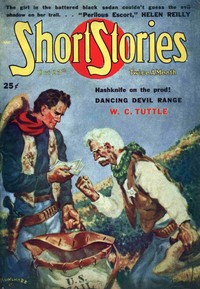
Dancing Devil range — Text and Context

(6 User reviews)   1478
In Category - Mystery Collections
Tuttle, W. C. (Wilbur C.), 1883-1969, Kuhlhoff, 1903-1972 [Illustrator] Project Gutenberg 2025 Not confirmed
Western stories; Detective and mystery stories; Bank robberies -- Fiction; Hartley, Hashknife (Fictitious character) -- Fiction; Stevens, Sleepy (Fictitious character) -- Fiction Readers of public-domain and historical texts
Project Gutenberg digital edition en

Edition facts

Words 20,226
Reading time 88 min
Text sections 3

The source record for Dancing Devil range — Text and Context measures this digital text at 20,226 words, 1 hr 28 min estimated reading time, and 3 detected text sections.

The text analysis averages about 12.0 words per sentence, while the detected sections provide another way to judge how the source is divided.

Project Gutenberg metadata also associates the work with “Western stories,” connecting these edition facts with the source record’s subject description.

W. C. Tuttle's 'Dancing Devil Range' follows drifting cowboys Hashknife Hartley and Sleepy Stevens into a Christmas-season mystery on the Arizona range. The story opens with a shotgun murder at a desert depot and builds through nocturnal surveillance, cryptic visitors, and fatalistic dialogue, all set against the sparse, dusty landscape of the Dancing Devil country.
Share
Editorial Edition Score 4.6/5

Calculated from edition completeness, EPUB availability, text structure and catalogue metadata. Not a user rating.

How this score is calculated
  • Description quality20 pts
  • Title & short description10 pts
  • Source metadata20 pts
  • Text length15 pts
  • Chapters / structure15 pts
  • EPUB file integrity20 pts

Total of 100 points, scaled to a 2.5-5.0 range. Editions with an empty description or a missing EPUB file are not scored.

Edition quality

Read the Text

shknife was inches over six feet tall, of slender, steel-muscled manhood, his sombrero pulled low over his gray eyes. Sleepy Stevens was less than six feet tall, broad of shoulder and beam, slightly bow-legged. Sleepy had a grin-wrinkled face, wide mouth and innocent-looking blue eyes, which seemed amazed at the world.

In garb they were merely a pair of drifting cowboys; well-worn Stetsons, colorless shirts, stringy vests, little more than a depository for tobacco and papers, faded overalls and high-heel boots. There was nothing fancy about these two cowpokes. Their gun-belts were home-made, form-fitted by wear, and even their Colt guns, tucked into short holsters, had plain wooden butts, blackened by wear.

A sleepy-eyed brakeman climbed down from the cupola and wiped a grimy forearm across his dusty eyes and lighted his lantern. He said, “We’re pullin’ into Northgate, boys.”

Sleepy swung around on the seat, yawned widely and picked up his war-sack. The train was slowing down, as they came out on the platform. Each one of them picked up a heavy saddle and stepped down. There were few lights in Northgate, the railroad point for all of the Dancing Devil range.

There were huge loading corrals along the tracks, indicating that much livestock was shipped from Northgate. The train stopped, with the caboose close to the depot, and the two men swung down. The conductor crossed in front of them, going into the depot, where a kerosene lamp yellow-lighted the windows. A man came from the near corner of the depot, walking swiftly toward the rear platform of the caboose.

He had just reached the steps and was about to enter the caboose, when a shotgun blasted from down behind the loading platform. The man twisted around, tried to grasp the doorway, but missed, and went backwards off the platform, falling in the middle of the tracks behind the caboose.

Hashknife and Sleepy dropped their impedimenta and ran over to the caboose. There was no sign of the shooter. The conductor, depot-agent and a brakeman came running. They picked the man up and placed him on the platform while Hashknife told them where the shot came from. There was no one in sight. The victim had stopped a dozen buckshot, and was beyond any medical assistance.

There was no law officer in Northgate, the sheriffs office being at Tomahawk Flats, thirty miles south, center of the Dancing Devil range. Someone summoned a doctor, and other curious people arrived. A cowboy said, “I know who he is--he’s Oren Blakely. I think he worked for the Circle H, down at Tomahawk Flats.”

Hashknife and Sleepy secured a room at a little hotel, and, after considerable haggling, bought two horses from the man who owned the livery-stable and feed corral. They told him they were leaving for Tomahawk Flats in the morning. He said, “if yo’re lookin’ for work down there--”

“What about it?” asked Hashknife quickly.

“I just meant that they prob’ly ain’t lookin’ for cowpokes. Yuh see, the bank went busted and that busted most of the cowmen, makin’ things kinda bad down there. If a feller was lookin’ for work-- But that’s yore business.”

“Much obliged,” said Hashknife, but he didn’t say whether it was for the advice or the information.

Over at the hotel they heard a man say that they had sent for the sheriff and the coroner. Another man said, “It ain’t goin’ to be a very merry Christmas down there this year.”

In their little room, Hashknife sprawled on the bed, smoking a cigarette, while Sleepy looked moodily from a dusty window. Sleepy said, “I just hope we ain’t playin’ Sandy Claws for Bob Marsh.”

Hashknife laughed shortly. “Where’d yuh get that idea?”

Sleepy sat down and began manufacturing a cigarette.

“Distrust of Bob Marsh,” he replied. “Bob sets there at his desk, his big, brown eyes as full of honesty as a coyote pup is full of fleas, and explains that all on earth he wants us to do is come down here, get the best possible price on three, four cattle spreads, and let him know.”

“Well?” suggested Hashknife curiously.

“That’s all we’ve got to do,” sighed Sleepy. “No rustlers, no horse-thieves--just a couple real estate men on horseback.”

“Sounds all right to me,” said Hashknife. “We get paid so much for the job, and if the deals go through we get more money. It’s an honest job, Sleepy. Bob Marsh, as secretary of the Cattlemen’s Association, can’t afford to be mixed up in a crooked deal.”

“Yeah, I know but--well, a man was murdered tonight.”

“Men,” remarked Hashknife quietly, “are murdered every day.”

“Yeah, I know, but--you heard that man at the livery-stable, sayin’ that everybody in the Dancin’ Devil country are broke. The bank went busted--”

“Are you lookin’ for boogers, Sleepy?”

“No, I’m tryin’ to figure out why Bob Marsh got us down here. If he can’t get us into trouble one way, he’ll--well, all right.”

“I’ve just thought of somethin’ else,” said Hashknife soberly. Sleepy looked sharply at him and said, “Yeah? What?”

“It ain’t long until Christmas, pardner.”

“I heard that mentioned tonight, High Pockets. Christmas! Heat and dust. Yuh know, I’d like to spend a Christmas in the snow agin, Hashknife. It ain’t Christmas down here, except on the calendar. We had real Christmases in Idaho.”

“We had ’em in Montana, too,” said Hashknife. “My old man, bein’ a range preacher, was strong for things like that. I ’member the church trees decorated with popcorn in strings, popcorn balls, and little, red sacks of mosquito-nettin’, full of hard candy, with a tired-lookin’ orange in the bottom. They’d read telegrams from Santa Claus, showin’ that he was comin’--and then he’d come, all in a bear-skin coat, sleigh-bells, whiskers--”

“Bringin’ a pair of skates for little Hashknife,” suggested Sleepy.

“They called me Henry,” smiled Hashknife, “but I never got any skates. A range preacher didn’t make money enough--and we had a whopper of a family. We was poor folks, Sleepy.”

“Poor folks in Tomahawk Flats, too, they say. Be a bad Christmas down there--and we’re goin’ down to try and buy ’em out as cheap as possible.”

Hashknife nodded slowly. “That’s life, Sleepy.”

“It’s a tough life for busted folks. Yuh know,” Sleepy began rolling a cigarette, “I’ll bet yuh a dollar agin a doughnut that we don’t buy any spreads.”

“Anythin’ to base that bet on?”

“Bob Marsh. Listen, tall-feller; Bob Marsh used that as an excuse, or my original name ain’t Stevens. He wanted us to come here and let Nature take her course. Yuh can’t fool me, feller; I’m wise to Bob Marsh. No, I don’t say that Bob’s crooked, but he’s allus been a connivin’ critter.”

“He told the idea as straight as a string, Sleepy.”

“And here we are,” added Sleepy. “We get off the train--and what happens? A man is blasted down with a load of buckshot, that’s what happened. He poked cows for one of them poverty-stricken outfits at Tomahawk Flats.”

Hashknife grinned. “A coincidence, Sleepy. Prob’ly a grudge between two men--nothin’ to do with us.”

“No? Nothin’ t’ do with us, sez he. Huh! And yore long nose has been wigglin’ and sniffin’, like the nose of a bloodhound, ever since that poor devil done a hooligan off the end of that caboose. Nothin’ to do with us, eh? Let’s go to bed, before yuh get me all riled up.”

Hashknife laughed. It was like Sleepy to complain of things that might happen. They had been together a long time, these two drifting cowboys, always trying to find out what was going on over the next hill, only working long enough to suffice for their few wants, and then going on, always looking, helping some under-dog, asking nothing for themselves.

Hashknife, with his ability to solve range mysteries, could have sold his services to the law, and made money. But neither law nor money meant anything to them. They had seen the law miscarry too often. They loved justice--which is not necessarily law. At rare times they worked for the Cattlemen’s Association, asking only that they be given a free hand and not be hampered by rules. But neither of them enjoyed nor appreciated the work. Bob Marsh would have almost given his right hand to have them work for his organization. In fact, he used every sort of ruse to get them on certain jobs, knowing that Hashknife, confronted by a problem, would never give up, until it was solved. That was why Sleepy mistrusted Bob Marsh’s casual suggestion that they make some money for themselves by asking prices on some cattle ranches.

They found the depot-agent in the little restaurant next morning, eating breakfast with Nick McGarvin, the sheriff, and his deputy, Frenchy Arnett. The agent recognized them, and told the sheriff that these were the two men who had just arrived on the freight train, and were present when Oren Blakely was shot. Hashknife introduced himself and Sleepy, and sat down at their table. He was unable to tell them any more than they already knew about the shooting.

Nick McGarvin was a big, two-fisted sort of person, and Hashknife mentally listed him as a much better man with his fists or gun than with his brains. Frenchy Arnett was small, dark, hatchet-faced, with a sour disposition and need of sleep. The agent went back to the depot, and the sheriff remarked:

“You two came in on the freight, packin’ saddles, bought two broncs from the feed-corral, and said you was headin’ for Tomahawk Flats tomorrow morning--that bein’ today.”

“The corral man told yuh,” said Hashknife. “Did he also tell yuh what else we said?”

“No, he didn’t. What else did yuh say?”

“I don’t remember,” replied Hashknife. “It was prob’ly just as important as what he told yuh.”

The sheriff nodded, but Frenchy grinned and looked sideways at the sheriff. Frenchy said, “It’s allus best to write it out. Things like that require study.”

“What are you talkin’ about?” asked the sheriff.

“Tells us some more about us,” suggested Sleepy soberly. “It’s shore interestin’.”

“We don’t know any more,” replied the sheriff. “It’s my duty to know things.”

“Yuh mean--findin’ out about everybody’s deep, dark past?” asked Sleepy.

“Askin’,” corrected Frenchy. “Nick’s good at it.”

“Any idea who shot the man, Sheriff?” asked Hashknife.

“No. He’s worked for the Circle H for over a year, and I ain’t never knowed him to have trouble with anybody. ’Course, I’ll have to check up with Sam Hack--he owns the Circle H. Sam might know who Oren was feudin’ with--I dunno.”

They finished breakfast, and Hashknife and Sleepy decided to ride to Tomahawk Flats with the two officers, who had, so far, failed to find out why Hashknife and Sleepy were going there. As they were saddling at the livery-stable, a rider, on a very tired horse, swung off the street and into the stable:

The sheriff said, “Hello, Jim.”

Jim Bailey swung off his saddle and came over close to the sheriff. He said, “Nick, I got here as quick as I could. Somebody shot and killed Chiquita Morales last night!”

The big sheriff stared at Jim Bailey, while Frenchy Arnett said, “Aw, Gawd, they didn’t do that, Jim!”

Bailey nodded grimly. “She musta been in town, Frenchy--in a buggy. They tied the horse about a mile out of town and shot her.”

Hashknife did not ask any questions as the sheriff said wearily, “We’re headin’ home right now, Jim. Doc Miles left about three o’clock with the body of Oren Blakely.”

“It’s shore gettin’ to be a awful tough country,” sighed Jim Bailey. “She was settin’ there in the buggy--”

“Shut up!” snapped Frenchy sharply. He dropped his reins and walked over to the big, sliding doors, where he stood, staring out at the street. Jim Bailey shook his head.

“Chiquita was Frenchy’s sweetheart,” whispered the sheriff.

“That’s what _he_ thought--mebbe,” said Bailey.

Bailey and Frenchy rode ahead, leaving the sheriff to ride with Hashknife and Sleepy.

“We heard that the bank went busted in Tomahawk Flats,” remarked Hashknife.

“Robbed,” corrected the sheriff. “Three men.”

“Cleaned it out, eh?”

“Nothin’ left--and it busted a lot of folks. Yuh see, Thomas Colton owned the bank--the Cattleman’s Independent Bank. Old Ed Weed was the cashier. It was a good bank, too, with plenty cash. Tom Colton is a fine feller--everybody liked him. He played square with everybody--never hounded ’em on mortgages and all that.

“Well, a short time ago, three men got into Ed Weed’s house, made him give ’em the combination of the safe, took his keys, tied Old Ed up so tight that he ain’t rid of the kinks yet, and took their sweet time in bustin’ the bank. They emptied the vault. As far as we can find out, there wasn’t a thin dime left. It broke a lot of folks, I’ll tell yuh that. I lost seven hundred dollars myself.”

“Where,” asked Hashknife, “does this Chiquita Morales figure in the deal, Sheriff?”

“She don’t. Her father, Pete Morales, owns a little rancho. Chiquita is about eighteen. I reckon, and as pretty as a bug’s ear. I’m past forty and I’m married, but every time she looked at me and grinned--I lost at least fifteen years of age. They’re poor, them Morales are. Poor old Pete, this’ll hit him hard.”

“No idea who busted the bank, eh?” queried Sleepy.

The sheriff sat disgustedly. “We’ve got a prisoner,” he said.

“Oh, yuh caught one of ’em, eh?” remarked Hashknife.

“Quien sabe? Yuh see, it’s thisaway. Andy Davidson--we call him Uncle Andy, and his wife, Aunt Judy--the finest folks yuh ever knowed--have a son, Johnny. Johnny’s fine. Hell, yuh can’t have a pa and ma like them, and not be fine. Johnny’s engaged to marry Nell Frawley on Christmas Eve. Well, Johnny’s in jail.”

“It don’t seem to work out,” said Hashknife.

“That’s right--but there he is. Yuh see, Johnny wears a ring. That is, he did. Navajo, I reckon. Big ring, silver and with a turquoise cross. Anybody’d know that ring. Tom Weed says that one of the men who robbed the bank wore that ring. Johnny didn’t have it on his finger when we arrested him, and he can’t tell us where it is. He just sets there in his cell, staring at the bars. It’s a tough situation, Hartley.”

“Well, can’t he prove where he was that night?” asked Sleepy.

“If he can--he won’t. Yuh can’t get a word out of him.”

“What does his girl think of the deal?” asked Sleepy.

“Nell Frawley. Lord, I dunno what she thinks. Nell is one of the finest yuh ever seen, and yuh can’t beat her folks. They got hit awful hard in that bank bust, but I don’t reckon they got hit as hard as Uncle Andy Davidson. He’s flat--but he ain’t kickin’. If Johnny was out of jail--well, I don’t think Uncle Andy is givin’ a thought to losin’ the money.”

“I can imagine,” said Hashknife thoughtfully. “A fine Christmas for folks like that.”

“That’s right, Hartley--I’d plumb forgot about Christmas. Peace on earth--don’t fit so good in Dancin’ Devil Valley this season.”

After a full minute of silent riding the sheriff commented, “I plumb forgot to ask you fellers how come yo’re headin’ for Dancin’ Devil Valley?”

Hashknife studied the bobbing ears of his horse for several moments, his eyes narrowed thoughtfully. Then he looked at the sheriff and said, “Sheriff you know what a wild goose is, don’t yuh?”

“We’re chasin’ one,” said Hashknife.

The sheriff scratched his stubbled chin, looked sideways at Hashknife, but rode on, thinking it over. These two rather puzzled the law officer. They looked like a pair of drifting cowpokes, but why would a drifting cowpoke be looking for wild geese in the Dancing Devil country, he wondered. Funny thing, too--when that Hartley person looked at you and said something--you believed him. Even such a fantastic thing as chasing a wild goose.

It was afternoon, when they arrived in Tomahawk Flats, and the sheriff and coroner left immediately to get the body of the murdered Mexican girl. Men had guarded it since the discovery. Hashknife and Sleepy registered at the hotel, where folks talked about the crime wave.

The murder of Oren Blakely was secondary in importance. A man might get killed at any time, but for somebody to deliberately murder a girl--that needed attention.

“I seen Pete Morales and his old woman a while ago,” one man said. “Gawd, you’d think the roof fell on both of ’em.”

“It shore did,” nodded a grizzled cowman. “I lost one--once--but she wasn’t shot to death. That’s worse--if it can be.”

“Yeah, I knew. Mrs. Morales just sat there, countin’ her beads, movin’ her lips, never looked up at all. She wasn’t cryin’--jist countin’ ’em, I reckon.”

“I kinda figured that her and Frenchy would get hitched,” said another of the men. “They used to go down into Mexico to dances, and all that. Frenchy can talk Mexican pretty good.”

Hashknife and Sleepy went up to their room to leave their war-bags. Sleepy flung his bag into a corner and stood there, his hands on his hips, looking at Hashknife, who sat down to roll a cigarette.

“Go ahead, pardner--say it,” he remarked.

“Yeah! Just a couple real-estate men on horseback!” snorted Sleepy.

“Bob Marsh didn’t know things like this would happen, Sleepy; he’s no fortune teller. It just happened, that’s all.”

“Yea-a-ah? All right--be stubborn. We’re here, ain’t we? Pitch-forked into it by Bob Marsh. He knowed the bank was busted. Mebbe he knew Johnny Davidson was in jail. We came straight from his dog-gone office. Real-estate, yore eye!”

Hashknife lighted his cigarette and inhaled deeply.

“It’s a terrible thing--murderin’ a girl, Sleepy.”

“That’s right--terrible! Terrible thing to murder a man, too.”

“Even if Bob Marsh knew--”

“Losin’ faith in him, eh? That’s fine. Now we can start even.”

“And there’s a job to be done, Sleepy,” after a long pause, “we’ve got a good alibi for bein’ down here--real-estate men on horseback.”

They ate supper in a little Mexican restaurant, where they found Frenchy Arnett, more than half-drunk, imbibing tequila with his meal. He didn’t speak to them--merely looked at them through bloodshot eyes, and went on drinking. Frenchy was gone, when they paid for their meal.

“Frenchy fill pretty bad--I theenk so,” said the Mexican proprietor.

“Tequila won’t help him much,” remarked Sleepy.

“Notheeng help heem much, _amigo_. Too bad.”

The murder of Chiquita Morales had sobered Tomahawk Flats. Even in the big Pasatiempo Saloon men talked in subdued tones, placed chips carefully into the jack-pots. The roulette-layout was not even uncovered. A man said, “I’d shore like to pull the rope on that dirty murderer.”

Another man laughed shortly and said, “Fine chance. The best our sheriff can do is put Johnny Davidson in jail. Wouldn’t have got him, if the blamed fool hadn’t worn that ring.”

“One cinch,” said a gambler, “they can’t put that onto Johnny; he was locked up tight. But I can’t figure out why anybody’d shoot the girl. As far as that goes, why was Oren Blakely shot?”

“Oren was a good _hombre_,” remarked another. “I talked with Sam Hack a while ago, and he said that all he knew was that Oren left the ranch, headin’ for here. Why he went to Northgate, nobody seems to know.”

“Somebody did,” said the gambler, “and that somebody had a shotgun and a load of buckshot. Well, I dunno--it beats me.”

“Beats the sheriff, too,” said another. “You watch--he’ll never get either of the killers.”

Hashknife and Sleepy slept late next morning, ate breakfast in the hotel dining-room, and when they came back to the lobby they saw an elderly couple, talking with the hotel-keeper. The man was small, thin, bow-legged, smooth-shaved, almost bird-like in his movements. The woman was gray-haired, tall, slender, sad-looking. The hotel-keeper saw Hashknife and Sleepy come from the dining-room doorway, and motioned to the man, who got up very quickly from his chair and came over to Hashknife.

“Your name is Hartley?” he asked quietly.

“That’s right,” smiled Hashknife.

The story begins not with a crime but with a train: a long, dusty freight rattling through desert hills, its caboose carrying two saddle-weary drifters. Hashknife Hartley sprawls on an uncomfortable seat, gazing through a dusty window; across the aisle, Sleepy Stevens lies with his head pillowed on his war-sack. The description of their worn gear—home-made gun-belts, blackened Colt butts, colorless shirts—establishes a pair of cowboys who are neither flashy nor new. When the train slows at Northgate, the railroad point for the Dancing Devil range, the men step down with heavy saddles. Within moments, a shotgun blast from behind a loading platform kills a man named Oren Blakely. The shooter vanishes into the darkness, leaving Hashknife and Sleepy at the center of a mystery before they have even found a place to stay.

Arrival by Rail and a Sudden Killing

The opening sequence is tightly constructed around movement and observation. The freight train is described as “seemingly in no hurry to anywhere,” a phrase that sets a languid pace abruptly broken by violence. Hashknife and Sleepy are introduced through their physicality—Hashknife tall and slender, Sleepy shorter, broad-shouldered, slightly bow-legged—and their plain attire. The murder occurs just as the conductor crosses into the depot, a kerosene lamp yellow-lighting the windows. The victim, Oren Blakely, is hit by a dozen buckshot and dies on the platform. No law officer is in Northgate; the sheriff’s office is thirty miles south at Tomahawk Flats. The scene establishes the isolation of the Dancing Devil range and the immediate need for the drifters to become involved.

Fatalism and the Big Book

Later, during a supper at Aunt Judy’s, Hashknife engages in a philosophical exchange about fate. When Nell mentions Christmas Eve, Hashknife hopes “that it’s all written our way in the Big Book.” Aunt Judy, surprised, says she has never heard of it. Hashknife explains: “No mortal’s eyes have ever seen it—but the finger of Fate writes in that book. It shows what we do, how we live, how we die—and when.” Aunt Judy calls this fatalism, but Hashknife counters with a practical example: men survive hell and high water only to trip over a chair in the dark. The conversation is cut short by Aunt Judy’s admission that she has forgotten her arguments, and Hashknife grins, “School is dismissed.” This moment of reflection contrasts with the action-oriented plot and hints at Hashknife’s worldview.

Surveillance in the Dark

Returning to Tomahawk Flats, Hashknife and Sleepy witness a horse and buggy stop at the Pasatiempo Saloon. The driver asks directions to Thomas Colton’s home. Hashknife recognizes the passenger as Slim Regan, a gambler and promoter from Wyoming. Despite Sleepy’s reluctance, they follow the buggy to Colton’s house, where the windows are shaded. They then hear a spur-wearing pedestrian approach and enter the dark house. Hashknife and Sleepy backtrack to find the visitor’s horse—a tall roan with a Bar N brand, which Sleepy identifies as Buck Nolan’s mark. They wait in darkness for fifteen minutes, but no one comes. The scene is built on careful observation: the rasp of buggy-wheels, the scratch of a match to read a brand, the sound of footsteps on a wooden sidewalk. Hashknife’s curiosity drives the investigation, even when Sleepy sees no point.

Recurring Images of Dust and Darkness

Throughout the excerpts, the physical environment is rendered in sparse, tactile detail. The train is dusty, the caboose window is dusty, and the depot is lit by a kerosene lamp. Night scenes are dark: no lights on the street, shaded windows, and the need for matches to see a brand. The characters move through this landscape with deliberate economy—Hashknife and Sleepy carry heavy saddles, wear high-heel boots, and their gun-belts are “form-fitted by wear.” The murder weapon is a shotgun, not a pistol, and the victim is hit by buckshot, a messy, close-range weapon. The setting of the Dancing Devil range is evoked through place names—Northgate, Tomahawk Flats, the Bar N brand—but the land itself remains a backdrop of desert hills and loading corrals. The story’s structure alternates between static observation (the train ride, the supper conversation) and sudden, unexplained movement (the shooting, the buggy’s departure).

Readers approaching Dancing Devil Range should pay attention to the way Tuttle uses physical details—a brand, a spur, a shaded window—to build a puzzle without overt explanation. The narrative moves through a series of dark, half-seen encounters, and Hashknife’s fatalistic remarks may offer clues to how he reads the events. The excerpts cover only the first portion of the story, so the resolution of the murder and the role of Slim Regan remain unknown. The book rewards attention to small observations and the rhythms of cowboy speech.

Reading Dancing Devil Range, I remembered long winter nights in my grandfather's armchair, the dry Arizona dust somehow settling into my own childhood living room through those quiet, fatalistic exchanges. Hashknife and Sleepy’s nocturnal watch felt familiar, like when The Riddle of the Night — A Closer Reading first made me notice the patience in a locked door. Both held a stillness that asked nothing, just waited.

Noah Lee
1 week ago

Liam Martinez
1 week ago

Sebastian Rivera
2 weeks ago

Gabriel Davis
3 weeks ago

Madison Baker
2 weeks ago

4.5
4.5 out of 5 (6 User reviews )

Add a Review

Your Rating *
  • ...
    Ryan Peck - 3 weeks ago
    Dancing Devil Range offers a decent western tale with a good atmosphere and a solid plot. The characters are likable, but the story follows familiar tropes without much innovation. It's a quick read that delivers on action, but don't expect a transformative experience. Good for a casual western fan.

  • ...
    Charles Joanna Campbell - 1 week ago
    Dancing Devil Range is a generic western with a forgettable plot and weak character development. The dialogue is clunky, and the action sequences are uninspired. There's little to distinguish this from countless other westerns. Only die-hard fans of the genre might find something to appreciate here.

  • ...
    Richard Anthony - 6 days ago
    Dancing Devil Range is a thrilling western with a strong sense of place and a plot full of action and intrigue. The protagonist is rugged and resourceful, and the conflict over a ranch is classic but well-executed. The desert landscapes are vividly described, and the pace never lets up. Fans of traditional westerns will find this an engaging read from start to finish.


Reader reflection

Record your reading impressions

A brief reflection can help important ideas stay with you longer.

Your progress 0 / 10
1

Which reading stage best describes you?

2

Was reading this book enjoyable?

3

Is this a title you would suggest to others?

4

Did the language feel accessible?

Related eBooks