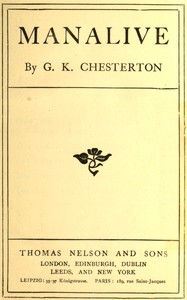
Manalive — Context and Discussion

(6 User reviews)   800
In Category - Mystery Collections
Chesterton, G. K. (Gilbert Keith), 1874-1936 Project Gutenberg 1999 Not confirmed
Humorous stories; Attempted murder -- Fiction; Mystery fiction; False arrest -- Fiction Readers of public-domain and historical texts
Project Gutenberg digital edition en

Edition facts

Words 62,098
Reading time 270 min
Text sections 11

The catalog record for Manalive — Context and Discussion provides practical reading context through 62,098 words, 4 hr 30 min estimated reading time, and 11 detected text sections.

The text analysis averages about 19.2 words per sentence, while the detected sections provide another way to judge how the source is divided.

Project Gutenberg metadata also associates the work with “Humorous stories,” connecting these edition facts with the source record’s subject description.

Chesterton's novel opens with a personified wind that invades London, bringing chaos and joy. The narrative voice shifts between exuberant description and philosophical dialogue, as seen in the contrast between the wind's 'unreasonable happiness' and the 'melancholy Smith's' pessimistic reflections on starlight and puddles.
Share
Editorial Edition Score 4.8/5

Calculated from edition completeness, EPUB availability, text structure and catalogue metadata. Not a user rating.

How this score is calculated
  • Description quality20 pts
  • Title & short description10 pts
  • Source metadata20 pts
  • Text length15 pts
  • Chapters / structure15 pts
  • EPUB file integrity20 pts

Total of 100 points, scaled to a 2.5-5.0 range. Editions with an empty description or a missing EPUB file are not scored.

Edition quality

Read the Text

more from the sundering clouds, filled the room with soft fire and painted the dull walls with ruby and gold.

“Somebody once told me,” said Rosamund Hunt, “that it’s easier to keep one’s head when one has lost one’s heart.”

“Oh, don’t talk such rubbish,” said Diana with savage sharpness.

Outside, the garden was clad in a golden splendour; but the wind was still stiffly blowing, and the three men who stood their ground might also have considered the problem of hats and heads. And, indeed, their position, touching hats, was somewhat typical of them. The tallest of the three abode the blast in a high silk hat, which the wind seemed to charge as vainly as that other sullen tower, the house behind him. The second man tried to hold on a stiff straw hat at all angles, and ultimately held it in his hand. The third had no hat, and, by his attitude, seemed never to have had one in his life. Perhaps this wind was a kind of fairy wand to test men and women, for there was much of the three men in this difference.

The man in the solid silk hat was the embodiment of silkiness and solidity. He was a big, bland, bored and (as some said) boring man, with flat fair hair and handsome heavy features; a prosperous young doctor by the name of Warner. But if his blondness and blandness seemed at first a little fatuous, it is certain that he was no fool. If Rosamund Hunt was the only person there with much money, he was the only person who had as yet found any kind of fame. His treatise on “The Probable Existence of Pain in the Lowest Organisms” had been universally hailed by the scientific world as at once solid and daring. In short, he undoubtedly had brains; and perhaps it was not his fault if they were the kind of brains that most men desire to analyze with a poker.

The young man who put his hat off and on was a scientific amateur in a small way, and worshipped the great Warner with a solemn freshness. It was, in fact, at his invitation that the distinguished doctor was present; for Warner lived in no such ramshackle lodging-house, but in a professional palace in Harley Street. This young man was really the youngest and best-looking of the three. But he was one of those persons, both male and female, who seem doomed to be good-looking and insignificant. Brown-haired, high-coloured, and shy, he seemed to lose the delicacy of his features in a sort of blur of brown and red as he stood blushing and blinking against the wind. He was one of those obvious unnoticeable people: every one knew that he was Arthur Inglewood, unmarried, moral, decidedly intelligent, living on a little money of his own, and hiding himself in the two hobbies of photography and cycling. Everybody knew him and forgot him; even as he stood there in the glare of golden sunset there was something about him indistinct, like one of his own red-brown amateur photographs.

The third man had no hat; he was lean, in light, vaguely sporting clothes, and the large pipe in his mouth made him look all the leaner. He had a long ironical face, blue-black hair, the blue eyes of an Irishman, and the blue chin of an actor. An Irishman he was, an actor he was not, except in the old days of Miss Hunt’s charades, being, as a matter of fact, an obscure and flippant journalist named Michael Moon. He had once been hazily supposed to be reading for the Bar; but (as Warner would say with his rather elephantine wit) it was mostly at another kind of bar that his friends found him. Moon, however, did not drink, nor even frequently get drunk; he simply was a gentleman who liked low company. This was partly because company is quieter than society: and if he enjoyed talking to a barmaid (as apparently he did), it was chiefly because the barmaid did the talking. Moreover he would often bring other talent to assist her. He shared that strange trick of all men of his type, intellectual and without ambition—the trick of going about with his mental inferiors. There was a small resilient Jew named Moses Gould in the same boarding-house, a man whose negro vitality and vulgarity amused Michael so much that he went round with him from bar to bar, like the owner of a performing monkey.

The colossal clearance which the wind had made of that cloudy sky grew clearer and clearer; chamber within chamber seemed to open in heaven. One felt one might at last find something lighter than light. In the fullness of this silent effulgence all things collected their colours again: the gray trunks turned silver, and the drab gravel gold. One bird fluttered like a loosened leaf from one tree to another, and his brown feathers were brushed with fire.

“Inglewood,” said Michael Moon, with his blue eye on the bird, “have you any friends?”

Dr. Warner mistook the person addressed, and turning a broad beaming face, said,—

“Oh yes, I go out a great deal.”

Michael Moon gave a tragic grin, and waited for his real informant, who spoke a moment after in a voice curiously cool, fresh and young, as coming out of that brown and even dusty interior.

“Really,” answered Inglewood, “I’m afraid I’ve lost touch with my old friends. The greatest friend I ever had was at school, a fellow named Smith. It’s odd you should mention it, because I was thinking of him to-day, though I haven’t seen him for seven or eight years. He was on the science side with me at school— a clever fellow though queer; and he went up to Oxford when I went to Germany. The fact is, it’s rather a sad story. I often asked him to come and see me, and when I heard nothing I made inquiries, you know. I was shocked to learn that poor Smith had gone off his head. The accounts were a bit cloudy, of course, some saying that he had recovered again; but they always say that. About a year ago I got a telegram from him myself. The telegram, I’m sorry to say, put the matter beyond a doubt.”

“Quite so,” assented Dr. Warner stolidly; “insanity is generally incurable.”

“So is sanity,” said the Irishman, and studied him with a dreary eye.

“Symptoms?” asked the doctor. “What was this telegram?”

“It’s a shame to joke about such things,” said Inglewood, in his honest, embarrassed way; “the telegram was Smith’s illness, not Smith. The actual words were, ‘Man found alive with two legs.’”

“Alive with two legs,” repeated Michael, frowning. “Perhaps a version of alive and kicking? I don’t know much about people out of their senses; but I suppose they ought to be kicking.”

“And people in their senses?” asked Warner, smiling.

“Oh, they ought to be kicked,” said Michael with sudden heartiness.

“The message is clearly insane,” continued the impenetrable Warner. “The best test is a reference to the undeveloped normal type. Even a baby does not expect to find a man with three legs.”

“Three legs,” said Michael Moon, “would be very convenient in this wind.”

A fresh eruption of the atmosphere had indeed almost thrown them off their balance and broken the blackened trees in the garden. Beyond, all sorts of accidental objects could be seen scouring the wind-scoured sky—straws, sticks, rags, papers, and, in the distance, a disappearing hat. Its disappearance, however, was not final; after an interval of minutes they saw it again, much larger and closer, like a white panama, towering up into the heavens like a balloon, staggering to and fro for an instant like a stricken kite, and then settling in the centre of their own lawn as falteringly as a fallen leaf.

“Somebody’s lost a good hat,” said Dr. Warner shortly.

Almost as he spoke, another object came over the garden wall, flying after the fluttering panama. It was a big green umbrella. After that came hurtling a huge yellow Gladstone bag, and after that came a figure like a flying wheel of legs, as in the shield of the Isle of Man.

But though for a flash it seemed to have five or six legs, it alighted upon two, like the man in the queer telegram. It took the form of a large light-haired man in gay green holiday clothes. He had bright blonde hair that the wind brushed back like a German’s, a flushed eager face like a cherub’s, and a prominent pointing nose, a little like a dog’s. His head, however, was by no means cherubic in the sense of being without a body. On the contrary, on his vast shoulders and shape generally gigantesque, his head looked oddly and unnaturally small. This gave rise to a scientific theory (which his conduct fully supported) that he was an idiot.

Inglewood had a politeness instinctive and yet awkward. His life was full of arrested half gestures of assistance. And even this prodigy of a big man in green, leaping the wall like a bright green grasshopper, did not paralyze that small altruism of his habits in such a matter as a lost hat. He was stepping forward to recover the green gentleman’s head-gear, when he was struck rigid with a roar like a bull’s.

“Unsportsmanlike!” bellowed the big man. “Give it fair play, give it fair play!” And he came after his own hat quickly but cautiously, with burning eyes. The hat had seemed at first to droop and dawdle as in ostentatious langour on the sunny lawn; but the wind again freshening and rising, it went dancing down the garden with the devilry of a _pas de quatre_. The eccentric went bounding after it with kangaroo leaps and bursts of breathless speech, of which it was not always easy to pick up the thread: “Fair play, fair play... sport of kings... chase their crowns... quite humane... tramontana... cardinals chase red hats... old English hunting... started a hat in Bramber Combe... hat at bay... mangled hounds... Got him!”

As the wind rose out of a roar into a shriek, he leapt into the sky on his strong, fantastic legs, snatched at the vanishing hat, missed it, and pitched sprawling face foremost on the grass. The hat rose over him like a bird in triumph. But its triumph was premature; for the lunatic, flung forward on his hands, threw up his boots behind, waved his two legs in the air like symbolic ensigns (so that they actually thought again of the telegram), and actually caught the hat with his feet. A prolonged and piercing yell of wind split the welkin from end to end. The eyes of all the men were blinded by the invisible blast, as by a strange, clear cataract of transparency rushing between them and all objects about them. But as the large man fell back in a sitting posture and solemnly crowned himself with the hat, Michael found, to his incredulous surprise, that he had been holding his breath, like a man watching a duel.

While that tall wind was at the top of its sky-scraping energy, another short cry was heard, beginning very querulous, but ending very quick, swallowed in abrupt silence. The shiny black cylinder of Dr. Warner’s official hat sailed off his head in the long, smooth parabola of an airship, and in almost cresting a garden tree was caught in the topmost branches. Another hat was gone. Those in that garden felt themselves caught in an unaccustomed eddy of things happening; no one seemed to know what would blow away next. Before they could speculate, the cheering and hallooing hat-hunter was already halfway up the tree, swinging himself from fork to fork with his strong, bent, grasshopper legs, and still giving forth his gasping, mysterious comments.

“Tree of life... Ygdrasil... climb for centuries perhaps... owls nesting in the hat... remotest generations of owls... still usurpers... gone to heaven... man in the moon wears it... brigand... not yours... belongs to depressed medical man... in garden... give it up... give it up!”

The tree swung and swept and thrashed to and fro in the thundering wind like a thistle, and flamed in the full sunshine like a bonfire. The green, fantastic human figure, vivid against its autumn red and gold, was already among its highest and craziest branches, which by bare luck did not break with the weight of his big body. He was up there among the last tossing leaves and the first twinkling stars of evening, still talking to himself cheerfully, reasoningly, half apologetically, in little gasps. He might well be out of breath, for his whole preposterous raid had gone with one rush; he had bounded the wall once like a football, swept down the garden like a slide, and shot up the tree like a rocket. The other three men seemed buried under incident piled on incident— a wild world where one thing began before another thing left off. All three had the first thought. The tree had been there for the five years they had known the boarding-house. Each one of them was active and strong. No one of them had even thought of climbing it. Beyond that, Inglewood felt first the mere fact of colour. The bright brisk leaves, the bleak blue sky, the wild green arms and legs, reminded him irrationally of something glowing in his infancy, something akin to a gaudy man on a golden tree; perhaps it was only a painted monkey on a stick. Oddly enough, Michael Moon, though more of a humourist, was touched on a tenderer nerve, half remembered the old, young theatricals with Rosamund, and was amused to find himself almost quoting Shakespeare—

“For valour. Is not love a Hercules, Still climbing trees in the Hesperides?”

Even the immovable man of science had a bright, bewildered sensation that the Time Machine had given a great jerk, and gone forward with rather rattling rapidity.

He was not, however, wholly prepared for what happened next. The man in green, riding the frail topmost bough like a witch on a very risky broomstick, reached up and rent the black hat from its airy nest of twigs. It had been broken across a heavy bough in the first burst of its passage, a tangle of branches in torn and scored and scratched it in every direction, a clap of wind and foliage had flattened it like a concertina; nor can it be said that the obliging gentleman with the sharp nose showed any adequate tenderness for its structure when he finally unhooked it from its place. When he had found it, however, his proceedings were by some counted singular. He waved it with a loud whoop of triumph, and then immediately appeared to fall backwards off the tree, to which, however, he remained attached by his long strong legs, like a monkey swung by his tail. Hanging thus head downwards above the unhelmed Warner, he gravely proceeded to drop the battered silk cylinder upon his brows. “Every man a king,” explained the inverted philosopher, “every hat (consequently) a crown. But this is a crown out of heaven.”

And he again attempted the coronation of Warner, who, however, moved away with great abruptness from the hovering diadem; not seeming, strangely enough, to wish for his former decoration in its present state.

“Wrong, wrong!” cried the obliging person hilariously. “Always wear uniform, even if it’s shabby uniform! Ritualists may always be untidy. Go to a dance with soot on your shirt-front; but go with a shirt-front. Huntsman wears old coat, but old pink coat. Wear a topper, even if it’s got no top. It’s the symbol that counts, old cock. Take your hat, because it is your hat after all; its nap rubbed all off by the bark, dears, and its brim not the least bit curled; but for old sakes’ sake it is still, dears, the nobbiest tile in the world.”

Speaking thus, with a wild comfortableness, he settled or smashed the shapeless silk hat over the face of the disturbed physician, and fell on his feet among the other men, still talking, beaming and breathless.

“Why don’t they make more games out of wind?” he asked in some excitement. “Kites are all right, but why should it only be kites? Why, I thought of three other games for a windy day while I was climbing that tree. Here’s one of them: you take a lot of pepper—”

“I think,” interposed Moon, with a sardonic mildness, “that your games are already sufficiently interesting. Are you, may I ask, a professional acrobat on a tour, or a travelling advertisement of Sunny Jim? How and why do you display all this energy for clearing walls and climbing trees in our melancholy, but at least rational, suburbs?”

The stranger, so far as so loud a person was capable of it, appeared to grow confidential.

“Well, it’s a trick of my own,” he confessed candidly. “I do it by having two legs.”

Arthur Inglewood, who had sunk into the background of this scene of folly, started and stared at the newcomer with his short-sighted eyes screwed up and his high colour slightly heightened.

“Why, I believe you’re Smith,” he cried with his fresh, almost boyish voice; and then after an instant’s stare, “and yet I’m not sure.”

“I have a card, I think,” said the unknown, with baffling solemnity—“a card with my real name, my titles, offices, and true purpose on this earth.”

He drew out slowly from an upper waistcoat pocket a scarlet card-case, and as slowly produced a very large card. Even in the instant of its production, they fancied it was of a queer shape, unlike the cards of ordinary gentlemen. But it was there only for an instant; for as it passed from his fingers to Arthur’s, one or another slipped his hold. The strident, tearing gale in that garden carried away the stranger’s card to join the wild waste paper of the universe; and that great western wind shook the whole house and passed.

Chapter II The Luggage of an Optimist

We all remember the fairy tales of science in our infancy, which played with the supposition that large animals could jump in the proportion of small ones. If an elephant were as strong as a grasshopper, he could (I suppose) spring clean out of the Zoological Gardens and alight trumpeting upon Primrose Hill. If a whale could leap from the sea like a trout, perhaps men might look up and see one soaring above Yarmouth like the winged island of Laputa. Such natural energy, though sublime, might certainly be inconvenient, and much of this inconvenience attended the gaiety and good intentions of the man in green. He was too large for everything, because he was lively as well as large. By a fortunate physical provision, most very substantial creatures are also reposeful; and middle-class boarding-houses in the lesser parts of London are not built for a man as big as a bull and excitable as a kitten.

The first chapter of Manalive introduces a wind that is both literal and symbolic, described as a 'wave of unreasonable happiness' that tears across England. Chesterton’s prose is energetic and personifying, attributing to the wind the power to 'carry the trump of crisis across the world.' This opening sets a tone of exuberant disruption, contrasting sharply with the later, more introspective passages where the character Smith contemplates the 'cruel' stars and the 'puddles' of academic thought.

The Wind as Narrative Engine

The wind in the opening pages is not merely a weather event but an active force that transforms mundane scenes: it fills shirts on a clothesline 'as if five fat imps had sprung into them,' lifts a hammock 'like a balloon,' and clatters poplars 'like a wreath or salutation of seraphic wings.' Chesterton uses the wind to inject drama into 'undramatic lives,' a technique that recurs throughout the novel. The language is deliberately hyperbolic, with similes that veer toward the fantastical, yet grounded in domestic imagery. This juxtaposition of the ordinary and the extraordinary is a hallmark of Chesterton’s style, and the wind serves as a narrative device that propels characters into unexpected situations.

Shifts in Pace and Voice

The excerpts reveal a marked shift in pace between the opening chapter and the later sections. The wind-driven first chapter is swift and cinematic, with long, rolling sentences that mimic the wind’s movement. In contrast, the passage describing Smith’s walk to Brakespeare College slows to a meditative crawl, with Smith’s 'sullen fancy' and the 'hollow' skies. The narrative voice also changes: the omniscient, almost gleeful tone of the opening gives way to a more ironic, philosophical register when the text mocks the 'pessimists' who think 'starlight was atrocious because it was true.' This tonal shift suggests a deliberate alternation between action and reflection.

Recurring Motifs of Light and Water

Two motifs recur across the excerpts: light and water. The wind brings 'frosty scent of forests' and 'cold intoxication of the sea,' while Smith’s environment is filled with 'glittering pools,' 'stripes of canal,' and 'rainy gutters.' Light appears as both literal starlight and metaphorical 'light' of academic reflection. Chesterton contrasts the 'glittering pools below' with the 'glittering skies,' and later uses the image of a 'peacock-green curtain' as a focal point. These motifs are not merely decorative; they underscore the novel’s thematic tension between surface and depth, as when the text notes that a puddle 'reflects infinity' by being 'shallow and standing still.'

Readers should attend to how Chesterton modulates his prose between the boisterous and the contemplative. The wind that opens the novel is a character in its own right, and its return in the final chapter title suggests a structural symmetry. Pay attention to the way the narrative voice shifts from exuberant description to ironic commentary, often within the same paragraph, as this is central to the novel’s effect.

Reading about that wind shaking London’s gloom, I remembered a gray afternoon when a sudden downpour turned our street into mirrors. The melancholy Smith’s puddles felt familiar then. I found that same strange comfort in the quiet pacing of The queen of the isle — A Closer Reading, where light on water does its own slow, unruly work.

Sofia Baker
3 weeks ago

Luke Sanchez
1 week ago

Ava Nguyen
1 month ago

Wyatt Hernandez
1 week ago

Matthew Jones
3 weeks ago

5
5 out of 5 (6 User reviews )

Add a Review

Your Rating *
  • ...
    Peter Johnson - 1 month ago
    An invigorating read with a unique protagonist. The first half is brilliant, but the latter part becomes repetitive as Smith's antics grow tiresome. Still, its core message about embracing life is uplifting.

  • ...
    Jeffrey Harris - 1 month ago
    Manalive is a burst of pure joy and energy. Chesterton's protagonist, Innocent Smith, is a delightfully eccentric character who challenges conventionality. The book is a philosophical romp that makes you rethink what it means to be truly alive. Packed with wit, humor, and profound insights—it's impossible not to smile while reading.

  • ...
    Patrick Ochoa - 1 week ago
    This is chaotic and unfocused. The story jumps from one absurd scenario to another without a clear narrative thread. The characters are caricatures, and the 'profound' moments feel forced. I couldn't connect with the protagonist's childish behavior. A disappointment from a usually brilliant author.


Reader reflection

How will you remember this book?

Save your reaction, strongest insight, and memorable passage.

Your progress 0 / 10
1

Which reading stage best describes you?

2

Did this book hold your interest?

3

Would you pass this book on to a friend?

4

What was the reading difficulty like?

Related eBooks