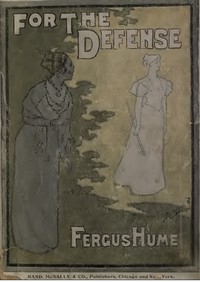
For the Defence — Story, Setting & Ideas
Edition facts
For For the Defence — Story, Setting & Ideas, the stored edition analysis reports 60,084 words, 4 hr 22 min estimated reading time, and 7 detected text sections.
The text analysis averages about 13.5 words per sentence, while the detected sections provide another way to judge how the source is divided.
Project Gutenberg metadata also associates the work with “England -- Fiction,” connecting these edition facts with the source record’s subject description.
Calculated from edition completeness, EPUB availability, text structure and catalogue metadata. Not a user rating.
How this score is calculated
- Description quality20 pts
- Title & short description10 pts
- Source metadata20 pts
- Text length15 pts
- Chapters / structure15 pts
- EPUB file integrity20 pts
Total of 100 points, scaled to a 2.5-5.0 range. Editions with an empty description or a missing EPUB file are not scored.
Read the Text
CHAPTER I. THE MAJOR AND HIS HOUSEHOLD. II. THE ASHANTEE DEVIL-STICK. III. DIDO. IV. VOODOO! VOODOO! V. DR. ETWALD'S WARNING. VI. A STRANGE OCCURRENCE. VII. THE RIVALS. VIII. A CRY IN THE NIGHT. IX. AFTER THE DEED. X. FURTHER MYSTERY. XI. MAJOR JEN, DETECTIVE. XII. THE STRANGE PERFUME. XIII. ISABELLA. XIV. LADY MEG. XV. CROSS-EXAMINATION. XVI. THE EVIDENCE OF JAGGARD. XVII. THE STORY OF THE NIGHT. XVIII. THE DEVIL-STICK THIEF. XIX. FURTHER EVIDENCE. XX. A STRANGE REQUEST. XXI. A NINE DAY'S WONDER. XXII. FOR THE DEFENSE. XXIII. THE RESULT OF THE TRIAL. XXIV. A FINAL SURPRISE. XXV. THREE LETTERS.
AUTHOR OF "MYSTERY OF A HANSOM CAB," "HARLEQUIN OPAL," ETC.
CHICAGO AND NEW YORK: RAND, McNALLY & COMPANY, PUBLISHERS.
Copyright 1897, by Fergus Hume. Copyright, 1898, by Rand McNally & Co.
CHAPTER I. THE MAJOR AND HIS HOUSEHOLD.
Laurence Jen was a retired major, a bachelor, and the proprietor of a small estate at Hurstleigh, in Surrey. On leaving the service, he decided--not unwisely--that it was better to be a Triton in the country than a minnow in town; and acting upon this theory he purchased "Ashantee" from a ruined squire. Formerly the place had been called Sarbylands, after its original owners; but Jen had changed the name, in honor of the one campaign in which he had participated.
He had been present at the downfall of King Koffee; he had contracted during the expedition an ague which tormented him greatly during his later life, and he had received a wound and a medal. In gratitude, it is to be presumed, for these gifts of fortune, the major, with some irony, had converted the name Sarbylands into the barbaric appellation of a West African kingdom; and here, for many years, he lived with his two boys.
These lads, named respectively Maurice Alymer and David Sarby, were in no way related to the major, who, as has been stated before, was a bachelor; but they had entered into his life in rather an odd fashion. Alymer was the son of a beautiful girl with whom Jen had been passionately in love, but she did not return his affection, and married one of his brother officers, who was afterward killed in the Ashantee war. On returning to England Jen cherished a hope that she would reward his love by a second marriage, but the shock of her husband's death proved too much for the fragile widow. She died within a week after receiving the terrible news, and left behind her a wailing infant, which was consigned to the cold charity of indifferent relatives.
It was then that the major displayed the goodness of his heart and the nobility of his character. Forgetting his own sorrows, he obtained permission from the relatives to adopt the child, and to take charge of the trifle of property coming to the lad. Then he bought Sarbylands; set estate and house in order under the name "Ashantee," and devoted his life to cherishing and training the lad, in whose blue eyes he saw a look of his dead love. This Platonic affection begotten by the deathless memory of the one passion of his life, filled his existence completely and rendered him entirely happy.
With regard to David Sarby, he had passed with the estate to Jen. The boy's father, a libertine, a drunkard and a confirmed gambler, had been forced, through his vices, to sell his ancestral home; and within a year of the sale he had dissipated the purchase money in debauchery. Afterward, like the sordid and pitiful coward he had always proved himself to be, he committed suicide, leaving his only son, whose mother had long since been worried into her grave, a pauper and an orphan.
The collateral branches of the old Sarby family had died out; the relatives on the mother's side refused to have anything to do with a child who, if heredity went for anything, might prove to be a chip of the old block; and little David might have found himself thrown on the parish, but that Major Jen, pitying the forlorn condition of the child, saved him from so ignominious a fate. His heart and his house were large enough to receive another pensioner, so he took David back to the old deserted mansion, and presented him to Maurice as a new playfellow. Henceforth the two boys grew to manhood under the devoted care of the cheerful old bachelor, who had protected their helpless infancy.
The major was fairly well-to-do, having, besides his pension, considerable private property, and he determined in the goodness of his heart, that "the boys," as he fondly called them, should have every advantage in starting life. He sent them both to Harrow, and when they left that school, he called upon them to choose their professions. Maurice, more of an athlete than a scholar, selected the army, and the delighted major, who highly approved of his choice, entered him at Sandhurst. Of a more reflective nature and studious mind, David wished to become a lawyer, with a possible idea of ending as Lord Chancellor; and accordingly his guardian sent him to Oxford.
Both lads proved themselves worthy of Jen's goodness, and were soon in active exercise of the professions which they had chosen. Maurice joined a cavalry regiment and David was admitted to the bar. Then the major was thankful. His boys were provided for, and it only remained that each should marry some charming girl, and bring their families to gladden an old bachelor's heart at "Ashantee." The major had many day dreams of this sort; but alas! they were destined never to be fulfilled. In the summer of '95 Fate began her work of casting into dire confusion the hitherto placid lives of the two young men.
Frequently the young barrister and the soldier came to visit their guardian, for whom they both cherished a deep affection. On the occasion of each visit Jen was accustomed to celebrate their presence by a small festival, to which he would ask two or three friends. With simple craft, the old man would invite also pretty girls, with their mothers; in the hope that his lads might be lured into matrimony.
The major, owing to circumstances heretofore related, was a confirmed bachelor, but he did not intend that his boys should follow so bad an example. He wished Maurice to marry Miss Isabella Dallas, a charming blonde from the West Indies; and David he designed as the husband of Lady Meg Brance, daughter of Lord Seamere. But Jen was mistaken in thinking that he could guide the erratic affections of youth, as will hereafter be proved. Sure enough, the lads fell in love, but both with the same woman, a state of things not anticipated by the major, who was too simple to be a matchmaker.
On this special occasion, however, no ladies were present at the little dinner, and besides Jen and his two boys. Dr. Etwald was the only guest. About this man with the strange name there is something to be said.
He was tall, he was thin, with a dark, lean face, and fiery watchful dark eyes. For three years he had been wasting his talents in the neighboring town of Deanminster; when, if intellect were in question, he should have been shouldering his way above the crowd of mediocrities in London. The man was dispassionate, brilliant and persevering; he had in him the makings not only of a great physician, but of a great man; and he was wasting his gifts in a dull provincial town. He was unpopular in Deanminster, owing to the absence of what is termed "a good bedside manner," and the invalids of the cathedral city and Hurstleigh, for he had patients in both places, resented his brusque ways and avoidance of their scandal-mongering tea parties. Also he was a mystery; than which there can be no greater sin in provincial eyes. No one knew who Etwald was, or whence he came, or why he wasted his talents in the desert of Deanminster; and such secret past which he declined to yield up to the most persistent questioner, accentuated the distrust caused by his sombre looks and curt speeches. Provincial society is intolerant of originality.
Etwald had become acquainted with Jen professionally, and having cured the major of one of his frequent attacks of ague, he had passed from being a mere medical attendant into the closer relationship of a friend. The boys had met him once or twice, but neither of them cared much for his sombre personality, and they were not overpleased to find that the major had invited the man to meet them on the occasion of this special dinner.
But Jen, good, simple soul, was rather taken with Etwald's mysticism, and, moreover, pitied his loneliness. Therefore he welcomed this intellectual pariah to his house and board; and on this fine June evening Etwald was enjoying an excellent dinner in the company of three cheerful companions.
Outside, the peaceful landscape was filled with a warm amber light, and this poured into the oak-paneled dining-room through three French windows which opened onto a close-shaven lawn. Dinner was at an end; Jaggard, the major's valet, butler and general factotum, had placed the wines before his master, and was now handing around cigars and cigarettes. All being concluded to his satisfaction--no easy attainment, for Jaggard, trained in military fashion, was very precise--he departed, closing the door after him. The warm light of the evening flashed on the polished table--Major Jen was sufficiently old-fashioned to have the cloth removed for desert--and lighted up the four faces around it with pale splendor. This quartette of countenances is not unworthy of a detailed description.
Major Jen's calls for least. His face was round and red, with a terrific blonde mustache fiercely curled. He had merry blue eyes, sparse hair, more than touched with gray, and an expression of good-humor which was the index to his character. Man, woman and child trusted Jen on the spot, nor was it ever said that such trust was misplaced. Even the most censorious could find no fault with the frank and kindly major, and he had more friends and more pensioners and fewer enemies than any man in the shire. Can any further explanation be required of so simple and easily understood a character?
Lieutenant Maurice Alymer was also blonde, and also had blue eyes and a jaunty mustache, somewhat smaller than his senior's. His hair was yellow and curly, his features were boldly cut, and his six foot of flesh and muscle was straight and lithe. Athlete was stamped strongly on his appearance, and if not clever, he was at least sufficiently good-looking and good-natured to make him almost as popular as the major. Jen always maintained that Maurice was the living image of himself when a dashing young officer, out in Ashantee; but as the good major was considerably under the middle height and Maurice considerably over it, this statement must be accepted with some reserve. It passed as one of Jen's jokes, for a mild quality of which he was noted.
The other two men had dark and strong faces, which differed entirely from the Saxon simplicity and good looks of the major and Maurice. David was clean-shaven and almost as swart as Etwald, and his expression was that of a being with powerful passions, held in check by sheer force of will. He was broad and strongly built; and his smooth black hair, parted in the middle, was brushed carefully from a bold and rather protuberant forehead. The young barrister was somewhat of a dandy, but no one who once looked at his face thought of his dress affectations or dapper appearance. They saw intellect, pride and resolute will stamped upon the pale countenance. Men with such faces end usually in greatness; and it seemed unlikely that David Sarby, barrister and ambitious youth, would prove an exception to the rule.
Lastly Etwald. It is difficult to describe the indescribable. He was austere in face, like Dante, with hollow cheeks, and a pallid hue which told of midnight studies. If he had passions, they could not be discerned in his features. Eye and mouth and general expression were like a mask. What actually lay behind that mask no one ever knew, for it was never off. His slightly hollow chest, his lean and nervous hands, and a shock of rather long, curling hair, tossed from a high forehead, gave Etwald the air of a student. But there was something sinister and menacing in his regard. He looked dangerous and more than a trifle uncanny. Physically, mentally, morally he was an enigma to the bovine inhabitants of Deanminster and Hurstleigh.
Major Jen sustained the burden of conversation, for Maurice was absent-minded, and David, physiognomically inclined, was silently attempting to read the inscrutable countenance of Etwald. As for this latter, he sat smoking, with his brilliant eyes steadily fixed upon Maurice. The young man felt uneasy under the mesmeric gaze of the doctor, and kept twisting and turning in his seat. Finally he broke out impatiently in the midst of the major's babble, and asked Etwald a direct question.
"Does my face remind you of anyone?" he demanded rather sharply.
"Yes, Mr. Alymer," replied Etwald, deliberately, "it reminds me of a man who died."
"Dear me!" said Jen, with a sympathetic look.
"Was he a friend of yours, doctor?"
"Well, no, major, I can't say that he was. In fact," added Etwald, with the air of a man making a simple statement, "I hated him!"
"I hope you don't hate me?" said Maurice, rather annoyed.
"No, Mr. Alymer, I don't hate you," replied the doctor, in a colorless tone. "Do you believe in palmistry?" he asked, suddenly.
"No!" said Maurice, promptly,
"All rubbish!" added the major, selecting a fresh cigar.
"What do you say, Mr. Sarby?" asked Etwald, turning to the lawyer.
"I am a skeptic, also," said David, with a laugh. "And you?"
Here Etwald rose and crossed over to where Maurice was sitting. The young man, guessing his errand, held out his left hand with a smile. Etwald scrutinized it closely, and returned to his seat.
"Life in death!" he said calmly. "Read that riddle, Mr. Alymer. Life in death."
CHAPTER II. THE ASHANTEE DEVIL-STICK.
"Life in death!" repeated Maurice, in puzzled tones. "And what do you mean by that mystical jargon, doctor?"
"Ah, my friend, there comes in the riddle."
"Paralysis?" suggested David, in a jesting manner, but with some seriousness.
"No; that is not the answer."
"Catalepsy?" guessed Major Jen, giving his mustache a nervous twist.
Maurice, whose nerves were proof against such fantasies, laughed disbelievingly.
"I don't believe you know the answer to your own riddle," he said calmly.
Etwald shrugged his shoulders.
"I don't know for certain, Mr. Alymer, but I can guess."
"Tell us your guess, doctor; as it interests me so nearly, I have a right to know."
"Bad news comes quickly enough in the telling," said the doctor, judicially, "so I shall say nothing more. Life in death is your fate, Mr. Alymer; unless," he added, with a swift and penetrating glance, "you choose to avert the calamity."
"Yes, and in an easy manner. Never get married."
Maurice flushed crimson, and, resenting the mocking tone of Etwald, half rose from his seat; but without moving a finger, Etwald continued in a cold tone:
"You are in love with a young lady, and you wish to marry her!"
"Quite right, quite right!" broke in Major Jen, heartily. "I want Maurice to marry."
"Then you want him to meet his fate of life in death!" said Etwald, curtly.
The others stared at him, and with the skepticism of thoroughly healthy minds refused to attach much importance to Etwald's mysticism. Jen was the first to speak, and he did so in rather a stiff way, quite different from his usual jovial style of conversation.
"My dear Etwald, if I did not know you so well, I should take you for a charlatan."
"I am no charlatan, major," rejoined Etwald, coolly. "I ask no money for my performance."
"So it is a performance, after all?" said David, carelessly.
"If you choose to call it so. Only I repeat my warning to Mr. Alymer. Never get married."
"I am afraid it is too late for me to take your advice, doctor," he said, merrily. "I am in love."
"I know you are, and I admire your taste."
"Pardon me, doctor," said Maurice, stiffly. "I mention no names."
"Neither do I, but I think of one name, my friend."
Here David, who had been fidgeting with his cigar, broke in impatiently.
"Now you are making a mystery out of a plain, common-sense question," he said, irritably. "We all know that Maurice is in love," here he raised his eyes suddenly, and looked keenly at his friend, "with Lady Meg Brance."
Major Jen chuckled and rubbed his hands together in a satisfied manner. Etwald bent his sombre looks on Maurice, and that young man, biting his lip, took up the implied challenge in Sarby's remark, and answered plainly:
"I am not in love with Lady Meg, my dear fellow," said he, sharply; "but if you must know, I admire"--this with emphasis--"Miss Dallas."
The brow of Sarby grew black, and in his turn he rose to his feet.
"I am glad to hear it is only 'admire,'" he remarked, slowly, "for had the word been any other I should have resented it."
"You! And upon what grounds?" cried Alymer, flushing out in a rage.
"That is my business."
"And mine, too," said Maurice, hotly. "Isabella is--"
"I forbid you to call Miss Dallas by that name," declared David, in an overbearing manner.
"You--you--you forbid me!"
"Come, come, boys!" said Jen, annoyed at this scene between two hot-headed young men, who were not yet gifted with the self-restraint of experience.
"Don't talk like this. You are at my table. There is a stranger" (here he bowed ceremoniously to Etwald) "or shall I say a friend, present!"
"Say a friend," observed Etwald, calmly, "although I am about to say that which may cause these two young gentlemen to look upon me as an enemy."
"What do you mean?" asked Maurice, turning his still frowning face toward this strange and enigmatic man.
"What I say, Mr. Alymer! You--admire Miss Dallas?"
"Why bring her name into the question? Yes, I admire Miss Dallas."
"And you, Mr. Sarby, I can tell from your attitude, from your look; you love Miss Dallas."
David was taken aback by this strange speaking.
"Yes. I--I--I do love Miss Dallas."
"I guessed as much," resumed Etwald, with a cold smile. "Now, it is strange--"
"It is strange that a lady's name should be thus introduced," said Jen, annoyed at the tone of the conversation. "Let us drop the subject. Another cigar, Maurice. David, the wine is with you. Dr. Etwald--"
"One moment, major. I wish we three to understand one another"--here the doctor hesitated, then went on in an impressive voice--"about Miss Dallas!"
"Why do you speak of her?" asked Maurice, fiercely, while David looked loweringly at Etwald.
"Because I love her!"
The two young men burst out simultaneously with the speech in tones of sheer astonishment, and stared at Etwald as at some strangle animal. That this elderly man--Etwald was midway between thirty and forty, but that looked elderly to these boys of twenty-five--should dare to love Isabella Dallas, was a thing unheard of. She so young, so beautiful, so full of divine youth and diviner womanhood; he so sombre, pale and worn with intellectual vigils; with a mysterious past, a doubtful present and a problematic future.
Maurice and David, divided one against the other by their passion for the same woman, united in a feeling of rage and contempt against this interloper, who dared to make a third in their worship of Isabella. They looked at Etwald, they looked at one another, and finally both began to laugh. Jen frowned at the sound of their mirth, but Etwald, in nowise discomposed, sat unsmiling in his seat waiting for further developments.
"Oh, it is too absurd!" said Maurice, resuming his seat.
Etwald put the question with the greatest calmness, stared steadily at the young man, and waited for the reply, which he knew would be difficult to make.
"Oh, because--because--"
"Never mind explaining, Mr. Alymer. I can guess your objection. I am too old, too plain, too poor for this charming young lady. You, on the contrary, are young, passing well off, and handsome--all the gifts of fortune are on your side. Decidedly," added the doctor, "you hold the best hand. Well, we shall see who will win this game--as we may call it."
"And what about me?" said David. "You forget that I am a third player. Come, Etwald, you have prophesied about Maurice; now read my fate."
The first chapter of For the Defence introduces Major Laurence Jen, a retired bachelor who has renamed his Surrey estate ‘Ashantee’ after the West African campaign where he fought. He has adopted two unrelated boys: Maurice Alymer, son of the woman he loved, and David Sarby, whose origins are not yet explained. The domestic setup is orderly, yet the chapter’s title—‘The Major and His Household’—hints at hidden tensions. The Ashantee devil-stick, a carved wand associated with the king’s palace, appears early as a stolen object, and the narrative quickly moves toward a murder trial. The excerpts show a story that balances colonial adventure, courtroom drama, and a mysterious perfume that may be a poison.
A Household Founded on Loss
The opening establishes Major Jen as a man shaped by unrequited love and war. He adopts Maurice after the boy’s mother dies of shock following her husband’s death in the Ashantee campaign. The major’s decision to rename his estate after a ‘barbaric’ kingdom is described with ‘some irony,’ suggesting a complex attitude toward his military past. The two boys, Maurice and David, are not related to him, and their presence creates an unusual family dynamic. The text notes that Jen ‘devoted his life to cherishing and training’ Maurice, but David’s role is left unclear. This asymmetry may drive later conflicts. Readers should note how the household’s origins—rooted in death and disappointment—set a somber tone that contrasts with the sensational crime to come.
The Devil-Stick and Its Poison
The devil-stick, also called the ‘wand of sleep,’ is a carved object from the Ashantee king’s palace. Major Jen once owned one, but it was stolen. The excerpts reveal that the stick can be filled with a poison that becomes active when water is added. A character named Dido, a Black servant, is suspected of stealing it and using it to kill Maurice. She denies this, claiming the poison was already dried up. The perfume used on a handkerchief is linked to Voodoo practices: Dido says it is meant to ‘drib away de evil spirit,’ but a scratch from the poison can kill. The weapon’s exotic origin and the supernatural language around it—‘Obi,’ ‘Voodoo’—give the mystery a colonial Gothic flavor. Readers should watch how the stick’s physical properties are verified or debunked as the trial proceeds.
Isabella’s Evasive Testimony
Isabella Dallas, the woman who loved Maurice, is a key witness. In Chapter XIV, Major Jen questions her about how Dr. Etwald came to use her mother’s handkerchief. She claims she overheard the doctor apologize, but her answers are ‘suspiciously prompt’ and she hesitates when pressed. Jen notes that her conduct ‘suggested … that she knew more than she cared to talk about’ and that her knowledge might implicate her mother. The dialogue is clipped, with Isabella leaving the major’s side abruptly. This scene shows how the narrative uses cross-examination to reveal character: Isabella’s love for Maurice is stated, but her evasiveness undercuts her reliability. Readers should compare her account with Dido’s later explanation of the perfume and the stick.
Dido’s Accusation and Denial
Dido, the Black servant, is confronted by Major Jen about the devil-stick and the perfume. She responds with a mix of scorn and defiance, repeating his suspicions back to him: ‘You say I took de debble-stick … and dat I kill wid him massa.’ She denies each point, insisting the poison was in the stick but that she did not take it or kill anyone. Her speech is rendered in dialect, and she claims the perfume is merely to drive away evil spirits. The scene is tense, with Dido turning the major’s questions back on him. Her role as a practitioner of ‘Obi’ marks her as an outsider in the English setting, and the narrative leaves open whether she is a scapegoat or a genuine suspect. Readers should note that her denial is the only direct account of the poison’s origin.
These excerpts show a novel that weaves together domestic drama, colonial artifacts, and courtroom procedure. The devil-stick and the perfume are not mere props; they carry cultural weight and are central to the murder method. Pay attention to how each character’s knowledge of these objects is revealed or concealed. The trial chapters likely test the evidence presented in these earlier scenes, and the final surprise mentioned in the contents may hinge on a detail that seems minor now.
I remember the strange perfume in Hume’s trial, how the devil-stick’s shadow fell across every testimony, a lingering unease. It reminds me of another quiet book, one where a hill’s wind carries old secrets between cousins. Both have that patient way of letting a house and its history speak for themselves. The Windy Hill — Context and Discussion rests beside it in my memory, like two old friends acknowledging a familiar weight.
Leo Campbell
2 weeks agoHenry Adams
3 weeks agoJames Sanchez
2 weeks agoWhat was your reading experience?
Capture what you thought, learned, and would like to remember.
Aria Clark
3 weeks ago