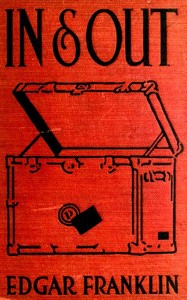
In and Out — A Reader’s Guide
Edition facts
This digital edition of In and Out — A Reader’s Guide is described by source-level measurements including 57,949 words, 4 hr 12 min estimated reading time, and 6 detected text sections.
The text analysis averages about 14.0 words per sentence, while the detected sections provide another way to judge how the source is divided.
Project Gutenberg metadata also associates the work with “Detective and mystery stories,” connecting these edition facts with the source record’s subject description.
Calculated from edition completeness, EPUB availability, text structure and catalogue metadata. Not a user rating.
How this score is calculated
- Description quality20 pts
- Title & short description10 pts
- Source metadata20 pts
- Text length15 pts
- Chapters / structure15 pts
- EPUB file integrity20 pts
Total of 100 points, scaled to a 2.5-5.0 range. Editions with an empty description or a missing EPUB file are not scored.
Read the Text
Horrigan was having things much his own way with the smaller person billed as the Bronx Tornado.
It was the wont of Kid Horrigan to step forward lightly, to rap the Tornado smartly on the bridge of the nose, and thereafter to step back as lightly and wait until the few wild blows had fanned the air and the Tornado had returned to his meaningless and somewhat bewildered crouch.
Thereupon, in almost preoccupied fashion, the Kid stepped forward once more--and when he had done it again and again the performance began to grow monotonous and, down in Box B at the ringside, Johnson Boller yawned aloud.
The yawn finished, he leaned over wearily and addressed Anthony Fry.
"If that little wheeze had the pep of a dead mosquito," said Johnson Boller disgustedly, "he'd take that big stiff when his hands are up like that and slip him an uppercut that would freeze him solid!"
Anthony Fry's intellectual features relaxed in a faint smile.
"He's had several chances, hasn't he?" he mused.
"Several? He's had fifty! He gets three a minute and--well, look at that!"
"Yes, he missed another opportunity then, didn't he?" said Anthony. "Curious!"
Johnson Boller's cigar rolled to the other side of his mouth and he hunched down farther in his chair.
"And nine more rounds of it to go!" he sighed.
Anthony Fry merely smiled more pensively and nodded, removing his nose-glasses and tapping his teeth reflectively--and, among other things, causing the red-faced, partially alcoholized trio behind them in Box B to wonder what he was doing at a prize fight anyway.
As externals go, there was some ground for the wonder. Anthony Fry at forty-five was very tall, very lean in his aristocratic way, and very, very dignified, from the crown of his high-held head to the tips of his toes. In dress he was utterly beyond criticism; in feature he was thin, austere, and impressive. At first glance one might have fancied him a world-famous surgeon or the inscrutable head of the Steel Trust, but the fact of the matter was that Anthony, these fifteen years gone, had inherited Fry's Imperial Liniment, with all that that implied.
It implied a good deal in the way of income, yet even among his friends Anthony did not care to have the liniment phase of his quietly elegant existence dwelt upon too insistently. Not that he regarded the business--run by a perfect manager and rarely visited--as a secret shame exactly, but unquestionably Anthony would have preferred that his late father and his two dead uncles, when starting their original pursuit of wealth, had corraled the world's diamond supply or purchased Manhattan Island at a bargain.
Just now, perhaps, Anthony's more striking features were emphasized by the nearness of Johnson Boller, one of his few really intimate friends.
Johnson Boller's age was just about the same, but there the similarity between them stopped short.
Johnson Boller was plump, one might almost say coarse. Where Anthony walked with slow dignity, Johnson swaggered. Where Anthony spoke in a measured undertone and smiled frigidly, Johnson thumped out the words and laughed with a bark. About most things except food he was inclined to be gloomy and pessimistic, and this evening the gloom within was even thicker than usual, because Johnson Boller's wife had left him.
She was a new wife and his first--a beautiful and spirited wife, all of fifteen years younger than Johnson Boller. She was in love with him and he with her, tremendously--and now she was gone. After only six months of unalloyed happiness in the five-thousand-dollar apartment on Riverside Drive, Mrs. Johnson Boller had left for her annual visit of one month to the sister whose accursed husband owned great chunks of Montreal, Quebec, and insisted on living on one of them.
One vast hour Johnson Boller had roamed the vacuum that had been their ideal home; then he had packed his grip and gone to stay with Anthony Fry, in that utter ultimate of everything impeccable and expensive in the way of bachelor apartments, the Hotel Lasande--and even the sight of the fight tickets, when Anthony's invaluable Wilkins had returned with them, had failed to bring more than a flitting smile to Johnson Boller.
Now they were watching the second preliminary bout, and could he but have traded one thousand of these bouts for a single hour with his beloved Beatrice, Johnson Boller would have gladly.
"In the main," said Anthony Fry, "that absurd little chap up there typifies my whole conception of opportunity."
"Huh?" Johnson Boller said.
"The chance for that fatal uppercut is there--it was there a minute ago and it will be there a minute hence, and probably two minutes hence. Our Tornado hasn't seen it yet; he may go to the end of the ten rounds and never see it, and yet, unless this Horrigan chap changes his tactics, it will be repeated again and again. Would he see it if the bout ran twenty rounds?"
"How the dickens should I know?" Johnson Boller muttered.
"I'd be quite willing to wager," Anthony smiled thoughtfully, "that he _would_ see it!"
Johnson Boller surveyed his friend narrowly. It was obvious that Anthony's attention had strayed from the alleged battle--and small wonder! It was equally obvious that Anthony's mind was wandering off into the abstract; and not infrequently these little journeys--provided they went not too far--were quite entertaining.
Johnson Boller, therefore, with an impulse he was to regret bitterly in the very near future, gave a prod to discussion by smiling in his own unhappy way and saying:
"What's the idea, Anthony? You're wrong, but--what is it?"
"My idea," said the proprietor of Fry's Imperial Liniment slowly, "is merely this, Johnson: that the whole proposition of the man who is a dire failure, the man who is a tremendous success, is vastly exaggerated."
"That failure does not of necessity imply incapacity or ineptitude--or success any tremendous capability, in many cases, for that matter. Taken by and large, we are all made of much the same stuff, you know. The trouble lies in the failure of the plain, average, reasonably stupid citizen to recognize opportunity's one solitary knock!" Anthony smiled, growing himself more interested by the second. "Now, if opportunity were but decent enough to knock twice, at least double the number of striving humans would recognize her nearness and grasp her. If she could bring herself to knock three times, say, our successes would be tripled. If----"
"And if she knocked a thousand times in succession, everybody'd be a millionaire," Johnson Boller suggested.
"Something like that," smiled Anthony. "The chap who does know opportunity, recognizes her mainly by accident, I honestly believe. Now, if we could but take each man and place opportunity before him and hold her there until he fully understood that she was present, the word failure would be omitted from the dictionaries a generation hence."
Anthony Fry winked rapidly, which in itself was rather a bad sign because it indicated that the theorizing portion of his cultured brain was growing quite rapt. At another time, very likely, Johnson Boller would have heeded the warning and turned Anthony's attention gently back to the fight; but to-night Boller sought refuge from the haunting loneliness that Beatrice had left behind.
"I don't agree with you!" he said flatly.
"Nix!" said Johnson Boller. "Any guy who can come face to face with a regular honest-to-goodness opportunity, Anthony, and not know her inside of one second, could have her tied to his right leg for two hundred years and never know she was there."
"You really believe that?"
"Oh, I know it!" said Johnson Boller. "I have several millions of years of human experience to prove that I'm right."
Anthony leaned closer, causing the largest of the red-faced trio behind to growl senselessly as he was forced to shift for a view of the ring.
"Let us assume, Johnson, the individual A," said Anthony. "A wished to become a lawyer; he had his chance and missed it. We will assume him to be peculiarly stupid; we will say that he had opportunity for the second time--and again failed to grasp her. Can you think that, deliberately led up to his third opportunity of becoming a lawyer, A will turn his back for the third time?"
"Certainly," said Johnson Boller, without thought and solely because Anthony's precise driveling interested him a little more than the affair of the ring.
"Pah!" Mr. Fry said angrily.
Just here Mr. Horrigan slipped while making his --nth jab at the Tornado's nose--slipped and fell upon the Tornado's fist and thereafter reeled about for a few seconds. Johnson Boller emitted his first real laugh of the evening; Anthony Fry, who had not seen the incident, failed even to smile.
"It would be interesting," he said crisply, "to select a subject, Johnson, and try the experiment."
"That of learning just how many times opportunity must be presented to the average individual to secure full recognition of her presence and her beauties."
"Wouldn't it?" mused Johnson Boller absently.
"I mean, to reach haphazard into the six millions that go to make up New York, to pick just one individual and segregate him, and then show him--_opportunity_! To take him aside, where there is nothing else to distract him, and thrust opportunity in his very face--the opportunity, whatever it might be, that he has always desired. It seems to me, Johnson, that watching that experiment might be distinctly worth while!"
"Aha!" yawned Johnson Boller.
"So, therefore," Anthony said placidly, "we will find our subject and make the experiment."
This time, and with a considerable jar, Johnson Boller awoke to the fact that danger was at his elbow!
He sat bolt upright and stared at Anthony Fry, and in the queerest way his flesh crawled for a moment and his hands turned cold, for he knew that expression of Anthony's all too well. Intent, wholly absorbed, that expression indicated that, however ridiculous the proposition might be, its fangs had fastened in Anthony's very soul!
This was the expression which recalled--oh, so clearly--the dread time when Anthony Fry had become obsessed with the idea that crime is a matter of diet and external impression, when he had secured the two yeggmen and established them where he could watch and feed them; when, eventually, he had been forced to pay for their crowning crime or go to jail as an accomplice!
This was the expression that brought back the period in which Anthony had cherished the theory that music's true germ lay in the negro race, properly guided and separated from all outside influences and--well, this was the expression, fast enough, and Boller's throat tightened. He had not even found words of protest when Anthony pursued:
"And upon my soul! See how the thing has been prearranged for us!"
"Look here, Johnson," the owner of Fry's Liniment hurried on, quite excitedly. "Have you noticed how packed the house is to-night?"
"Every seat in the place is sold--_except this one seat in our box_!"
"It's fate!" chuckled Mr. Fry. "It is fate and nothing else, Johnson. Out of all the millions in New York, one man--absolutely unknown to, unsuspected by, either you or me--is coming to take this seat, doubtless for the star bout."
"To that man," said Anthony, "I shall offer opportunity!"
"What d'ye mean? Money?" Johnson Boller asked incredulously.
"It will involve money, doubtless; I can afford a little."
"Well, you go and poke a handful of bills into a man's face and all you're going to prove is that----"
"I have no idea of doing anything of the sort," Anthony said impatiently. "What I purpose doing is simply this: I shall----"
Johnson Boller had recovered from the first shock. He drew a long, deep breath, and, leaning over to his old friend, placed a firm, strong hand on his knee and looked soothingly into his kindled eye.
"Listen, Anthony!" said he. "_Don't!_"
"Eh? You've no notion of what I mean to do," Anthony said briefly.
"No, but I can guess enough to dope it out pretty well, and--don't do it!" Johnson Boller said earnestly. "This theory stuff is all right, Anthony; I like to sit and chatter about it as much as you do. On the level, I do! I like to talk with you about these things, and wonder what would happen if this was thus and the other thing was otherwise. But when you come to pulling it on a perfect stranger at a prize fight, Anthony, try to remember that everybody may not understand you as well as I do."
"My dear chap!" Anthony laughed.
"Don't laugh; I know what I'm talking about," Mr. Boller went on, feverishly almost. "You wait till we get home, Anthony, and we'll talk over all this about opportunity and get it settled. For the matter of that, I can see now that you're dead right!" Johnson Boller said, and there was something almost pathetic in his voice. "You're dead right, Anthony! All you have to do is to stick opportunity before a man long enough and he's bound to chuck a hammerlock into her and slam her down to the mat for keeps! So that's settled, and we don't have to do any experimenting with human subjects. Or if you do have to have a live one to work on, wait till we get home and we'll take Wilkins, Anthony! That'd be better, anyway."
He paused, eying his old friend with deep anxiety. Anthony Fry, having thrown back his head, laughed heartily.
"Johnson," said he, "the whole trouble with that poor old head of yours is that it is absolutely without the power of visualization! It knows the wool business; it makes thousands and thousands of dollars out of the wool business; but to save its very life it cannot reach out into the abstract!"
"It doesn't want to reach into the abstract!"
"Well, it should, because it will grow more and more stodgy if it doesn't," Mr. Fry said complacently. "Good gracious, Johnson! Coming to life! Just consider what may be coming to this seat!"
"I don't dare!" Johnson Boller said honestly.
"An old man, perhaps--one who fancies his opportunities all past and done for. What more vitally interesting than thrusting opportunity upon such a man, Johnson?"
"So far as I'm concerned, anything under the sun and----"
"Or perhaps a middle-aged failure," Anthony rambled on. "A man just past the age when hope is richest--a man who has seen his chances come and go. I don't know, Johnson, but I rather believe that I'm hoping for a middle-aged man."
"Yes, one that's weak enough to gag before he can yell for the police," Johnson Boller grunted. "Now, Anthony, before you----"
"Or best of all, perhaps, an average young man," smiled the experimenter. "That would really be the most interesting sort of subject, Johnson--just a plain chap, not fully matured, not soured by disappointment nor rendered too sophisticated by contact with the world. On the whole, I really hope that a young man is coming!"
And now, for a time, Johnson Boller said nothing at all. There was always the chance that Anthony might work it out of his system in talk--there was the other chance, growing rosier and rosier by the minute, that the odd chair had not been sold at all.
It was rather queer, when one considered that seats for this particular star bout had been at a premium for a week, but it was nevertheless the fact that the preliminary arguments were over and the announcer spinning his megaphoned tale for the big battle, and the seat still unoccupied. To Johnson Boller it even hinted at the existence of a special Providence designed to watch the doings of such as Anthony Fry.
The minutes were wearing along, too. The cheering was done with and the megaphone had left the ring. Seconds and trainers were climbing down through the ropes, and the principals were listening boredly to the final words of instruction. And now the gong had struck and they were at it--and still the odd chair in Box B remained unoccupied.
"Opportunity!" mused Anthony Fry. "The Great Unrecognized!"
"The Great Unrecognized," Anthony repeated complacently. "Not a bad term for her, eh?"
Johnson Boller made a last survey of the neighborhood, permitted himself a sigh of relief, and grinned broadly at his old friend.
"Great term, Anthony!" he agreed genially. "He isn't coming!"
"He'll be here yet," Anthony smiled.
"Not now," Boller chuckled. "No man gives up ten or fifteen dollars for one of these seats and then stays away for any reason save death. Your victim was hit by a motor-truck on the way here--and at that he may be getting off easier than if you'd caught him and tried some psychological experiments on him."
And here Mr. Boller stretched and removed his cigar, so that his grin might spread from ear to ear.
"It only goes to show you, Anthony, that there's some power watching over people like you and governing their affairs, that is past our understanding. Now, if that poor unknown devil had ever turned up and----"
In Anthony Fry's eye the blue-white fire of enthusiasm glinted out suddenly. Half rising, Mr. Fry gazed down the vast place, and then, with a smile, sat back again and eyed his friend.
"Something's wrong with your power, Johnson," said he. "Here he comes now!"
Johnson Boller looked. And, looking, the pleased grin which had so lately suffused his features faded out swiftly--because the unknown really seemed to be with them.
Far down the mob, an attendant of the place was indicating their general direction to a shortish man in a long storm-coat; and now he of the coat had nodded and was pushing his way down the narrow aisle toward them, staring at the sea of faces as he moved along slowly and seeming a little uncertain in his movements.
"Anthony!" Johnson Boller said suddenly.
"Don't speak to this guy! I don't like his looks!"
"And this gang behind us is doing everything but watch the fight," Mr. Boller whispered on. "If you try anything funny on this fellow that's coming, he's likely to put up a yell of some kind--and once a fight starts in this box these three behind are coming in."
"Johnson, don't be absurd," Anthony smiled. "Get over in the odd seat; I want the chap next to me so that I can have a good look at him."
"Will you remember that I said you were going to start trouble?" Johnson inquired hotly.
"I'll remember anything you like, only get over into that odd seat," Mr. Fry muttered, as the stranger came closer. "Ah, he's hardly more than a boy."
"Yes, he's a young thug!" Johnson Boller informed him in parting. "He's a young gang-leader, Anthony--look at the walk! Look at the way he has that cap pulled down over one eye! Look at----"
Anthony Fry, obviously, would have heard him as well had he been seated on the steps of Colorado's State capitol. Intellectual countenance alight, the mildly eccentric Anthony--really the sanest and most delightful of men except when these abstract notions came to him--was wholly absorbed in the newcomer.
Rather than stare directly he turned toward the ring as the young man in the long coat crowded into the box and settled down with a little puff, but one who knew him as well as Johnson Boller could feel Anthony's eyes looking past his lean right cheek and taking in every detail of theory's prospective victim.
Not that he was a particularly savage-looking creature on closer inspection, however. The cheap cloth cap and the shabby long coat--heavy enough for a typhoon when there was the merest suggestion of drizzle outdoors--gave one that impression at first, but second examination showed him to be really rather mild.
He seemed to be about twenty. His clothing, from the overcoat to the trousers and the well-worn shoes, indicated that he came from no very elevated plane of society. His features, which seemed decidedly boyish among some of the faces present, were decidedly good. His hair needed cutting and had needed it, for some time, and he was tremendously interested in the star bout. Elbows on the rail, cap pulled down to shade his eyes, the youngster's whole excited soul seemed centered in the ring.
So at a rather easy guess Mr. Boller concluded that he was a mechanic or a janitor's assistant or an elevator boy or something like that. The buyer of his seat, finding himself unable to come at the last moment, had given the kid his ticket and he was having the time of his life.
Edgar Franklin's In and Out (1917) begins not with a corpse but with a boxing match, where the wealthy Anthony Fry and his friend Johnson Boller critique the lackluster performance of Kid Horrigan. Fry, described as 'very tall, very lean in his aristocratic way,' is an unlikely ringside figure, and his detached, analytical manner—removing his nose-glasses and tapping his teeth—immediately marks him as a man who observes rather than participates. The early chapters establish a tone of wry humor and social observation, as Boller's blunt commentary contrasts with Fry's pensive replies.
A Murderer's Cross and a Hidden Woman
By the middle excerpts, the story has shifted from the boxing ring to Fry's apartment, where a tense conversation reveals that Bob Vining, a mutual acquaintance, bears a 'murderer's cross' at the base of his thumb—a mark Boller claims appears on virtually every executed murderer in the state. This detail, presented with hushed gravity, introduces a supernatural or folkloric element into an otherwise realistic narrative. Simultaneously, a woman named Mary emerges from hiding, having apparently disappeared from Vining's life. She sits calmly at Fry's table, sipping coffee and asking, 'Well, have you determined how I'm to leave?' The juxtaposition of the ominous mark and Mary's composed domesticity creates a puzzle: is Vining a killer, and what is Mary's connection to him?
The Amateur Detective Arrives
The tension escalates when Hobart Hitchin, an amateur detective, enters Fry's apartment unannounced, catching Mary at the table. The narrative notes that Hitchin is in 'a high state of nervous tension,' and his arrival forces Fry to improvise. The scene is built on a series of near-misses and whispered conversations, with Fry's servant Wilkins playing a reluctant gatekeeper. Franklin uses the confined setting—a bachelor apartment—to heighten the claustrophobic sense of secrets about to be exposed. The reader, like Fry, must gauge how much Hitchin knows and whether Mary's presence will be discovered. The chapter titles—'The Web,' 'The Other Lady,' 'The Crash'—suggest a plot that thickens through misdirection and sudden revelations.
Voice and Structure: Dialogue as Driver
Franklin relies heavily on dialogue to advance the plot and reveal character. Fry's speech is measured and ironic ('If that little wheeze had the pep of a dead mosquito'), while Boller's is blunt and colloquial. Mary's lines are direct and practical, cutting through Fry's evasions. The narrative voice is third-person but often adopts a wry, observational tone, as when it notes that the trio behind Fry in Box B 'wondered what he was doing at a prize fight anyway.' The structure alternates between action (the boxing match, Hitchin's entrance) and extended conversations that lay out theories and suspicions. This pattern suggests a mystery that unfolds through argument and deduction rather than physical clues.
Recurring Details and Their Implications
Several details recur across the excerpts: Fry's nose-glasses, which he removes when thinking; the 'murderer's cross' as a physical mark; and the motif of watching and being watched. The boxing match is described in terms of missed opportunities—the Tornado fails to land an uppercut—which mirrors the characters' own failures to act decisively. Boller's observation that Vining 'will never take any account of the circumstances; he'll just snatch out the gun and let fly' hints at a violent resolution. The excerpts do not reveal whether the cross is real or imagined, or whether Mary is a victim or a perpetrator. Readers must attend to these recurring motifs as potential keys to the mystery.
Franklin's novel rewards attention to its layered dialogue and the subtle shifts in power between characters. The excerpts offer a cross-section of the book's method: a slow build of suspicion, punctuated by sudden entrances and revelations. Readers should note how each character's speech patterns reflect their role in the unfolding drama, and how the setting—from the boxing ring to the apartment—serves as a stage for psychological maneuvering. The incomplete excerpts leave many questions open, but the patterns established in the opening chapters provide a reliable guide to the novel's concerns.
Thinking back on the boxing match in Franklin’s novel, I was struck by how easily wealth hides a person, even in plain sight—and that same quiet thought followed me to Mrs. Vanderstein's jewels — Themes and Context. There’s a particular loneliness in those guarded rooms, a kind of silence that still lingers with me. Strange, how two old stories can share one shadow.
There are no reviews for this eBook.
How did this book work for you?
Your answers remain private and are stored only in this browser.