1

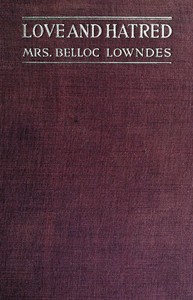
Love and hatred — Reading Notes
(0 User reviews)
213
Project Gutenberg
2011
Not confirmed
Detective and mystery stories; Man-woman relationships -- Fiction; Murder -- Fiction
Readers of public-domain and historical texts
Project Gutenberg digital edition
en
Edition facts
Words
97,351
Reading time
424 min
Text sections
10
For Love and hatred — Reading Notes, the stored edition analysis reports 97,351 words, 7 hr 4 min estimated reading time, and 10 detected text sections.
The text analysis averages about 16.9 words per sentence, while the detected sections provide another way to judge how the source is divided.
Project Gutenberg metadata also associates the work with “Detective and mystery stories,” connecting these edition facts with the source record’s subject description.
Source:
Project Gutenberg record #36079
An editorial note on Marie Belloc Lowndes's 'Love and Hatred' (1917), focusing on its narrative structure, recurring imagery of confinement and release, and the movement between intimate and public spaces.
Read the complete public-domain text at its original source.
Read on Project GutenbergThe novel opens with a charged scene in a summer-house, where a man's avowal of love draws from Laura Pavely a low, protesting cry. The setting—a narrow path among trees leading to a secluded structure—immediately establishes a pattern of movement between open and enclosed spaces. Lowndes uses the summer-house as a threshold where private emotions break into speech, a motif that recurs throughout the excerpts.
Thresholds and Confessions
The summer-house scene in Chapter I is a masterclass in controlled revelation. The man stands just within the door, looking away, while Laura sits; their physical positions mirror the imbalance of the confession. Lowndes delays the actual words—'I love you'—through a series of pauses and indirect thoughts, building tension from the mundane detail of a child's need for a sea change. The phrase 'Oh, but this is terrible' becomes a refrain that echoes later in the narrative, suggesting that such thresholds are not crossed without consequence.
Money as a Silent Currency
In the later excerpt, Katty's relationship with Godfrey is mediated through sums of money: two hundred pounds, followed by two fifty-pound notes. Lowndes presents these transactions without overt commentary, yet they accumulate meaning. Katty's awareness that Godfrey is 'ashamed of giving her that money' and 'ashamed of his increasing fondness for her' reveals a moral economy where generosity and guilt are intertwined. The purchase of a costly cut-glass pendant in York further literalizes this exchange of objects for affection.
The City as a Stage
The York episode shifts the action from the domestic sphere of Rosedean to a public, historic city. Lowndes uses the Minster and curiosity shops as backdrops for a performance of normalcy: the pair 'wandered about the old city' and 'lingered awhile' without saying anything the world might not overhear. Yet the scene is punctuated by a near-kiss in an empty waiting-room, a moment of potential exposure that Katty courts and Godfrey resists. The city becomes a space where secrets are both hidden and nearly revealed.
Recurring Images of Cutting and Release
Katty's determination to 'cut the cable, and start a new life elsewhere' introduces a metaphor of severance that resonates with the novel's title. The image of cutting—whether a cable, a tie, or a thread—appears alongside references to 'juggling with the law' and 'explosive energy.' Lowndes associates these motifs with characters who seek liberation from marriages or obligations, yet the excerpts suggest that such cuts are never clean. The pendant bought in York, an object of beauty and cost, becomes a tangible link that binds rather than frees.
Readers attentive to Lowndes's craft will note how she builds suspense through the accumulation of small, telling details—a glance, a sum of money, a piece of jewelry. The novel's structure, moving between intimate confessions and public performances, invites scrutiny of what is said and what remains unspoken. The excerpts offer a glimpse into a world where love and hatred are not opposites but entangled forces, each shaping the other in ways that are only gradually revealed.
I finished the notes on Love and Hatred late last night, and what stayed with me was that quiet ache of rooms closing in, then suddenly opening. It reminded me of another story where walls feel alive, and escape is never quite where you left it: The Quest of the Sacred Slipper — Key Ideas to Explore. Some books just sit beside you afterwards, like a held breath.
There are no reviews for this eBook.
There are no comments for this eBook.
Reader reflection
What was your reading experience?
Capture what you thought, learned, and would like to remember.
Your progress
0
/
10
2
Was reading this book enjoyable?
3
Would you recommend this book to another reader?
4
What was the reading difficulty like?
5
Could you apply anything you learned?
6
Did you relate to its people, ideas, or situations?
7
Did the book deliver what you hoped for?
8
What was the strongest part of the book?
9
What did this book teach you most?
10