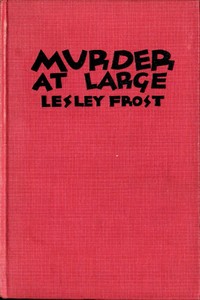
Murder at Large — Background and Themes
Edition facts
This digital edition of Murder at Large — Background and Themes is described by source-level measurements including 48,147 words, 3 hr 30 min estimated reading time, and 6 detected text sections.
The text analysis averages about 13.2 words per sentence, while the detected sections provide another way to judge how the source is divided.
Project Gutenberg metadata also associates the work with “Detective and mystery stories,” connecting these edition facts with the source record’s subject description.
Calculated from edition completeness, EPUB availability, text structure and catalogue metadata. Not a user rating.
How this score is calculated
- Description quality20 pts
- Title & short description10 pts
- Source metadata20 pts
- Text length15 pts
- Chapters / structure15 pts
- EPUB file integrity20 pts
Total of 100 points, scaled to a 2.5-5.0 range. Editions with an empty description or a missing EPUB file are not scored.
Read the Text
-odd, but didn’t look it; tall, handsome, with a firm mouth, burning brown eyes, and thick, lustrous black hair. His muscles were steel-hard; and his skin always deeply bronzed, winter and summer alike, for he was one of those elusive and self-styled members of the Long Beach nature club. He enjoyed motoring down on brilliant days even in January to nurse a driftwood fire in the shelter of a shallow dune, basking himself in fire heat and violet ray.
Sun-bathing is the habit of a solitary; but then, Belknap _was_ a solitary in more ways than one. He loved the slow, indolent afternoons, apparently wasted, and with no words spoken. He relished the mingled smell of olive oil, wood smoke and salt; and the sight, through more than half-shut eyes, of gulls, and a ship moving up the horizon like the large hand of a clock, invisibly moving yet seen to have moved. Rodney Drake would periodically rise like an elongated Pict out of the waste of sand and gesticulate against the sky. On the open beach the hardy little Egyptian, name unknown, would squat motionless on his heels over a tin firebox.
So it may well have been these lonely watches that fostered the thing in Belknap that his acquaintances, even friends, called ‘queer.’ The world in general certainly considered him puzzling, enigmatic. It found him definitely uncommunicative, or, when communicative, ironic, which is a turn of speech that leaves the hearer not much the wiser. His friends claimed for him a sensitive, reserved nature that shed humankind with reluctant cynicism for lack of a better method, a cynicism sharpened and brought to a point through years of close association with the evils and corruption, hypocrisy and injustice of the courts. He had a way of never overlooking an opportunity to be bitter at the expense of law and order as practiced in this enlightened twentieth century.
And it was the hopelessness of the struggle to keep a modicum of honesty in the legal system that, Belknap said, had driven him out to play a lone wolf game tracking the criminal. Too frequently, he claimed, the innocent paid, or no one paid, while the guilty sat in full view of the Bench. He was at least determined to give the eager public a few real captures, if not convictions. In his two most famous cases he had managed the convictions as well.
His first, that of Maria Monroe, strangled in her closed Riverside Drive apartment when it was supposed she herself was in Honolulu, followed immediately on his resignation from office. In fact what he considered the bungling of this case had been the last straw that made him yield to a temptation of long standing. And he was miraculously successful. With every investigating agency in the City against him, and with an apparently impregnable alibi to break down, he saw his man through to the chair.
But it was the Stanton-Mowbray affair the next winter that saw Belknap’s amazing and unreasonable technique developed to its greatest power. Stanton was shot at the Villa Bella Night Club in Forty-eighth Street, West, toward the daybreak closing of an exceptionally wild night. No gun was found, although the few remaining guests were searched within a few moments by the police; and even the general direction from which the shot was fired could not be determined. Some said it had come through a window, others from close range. The case had lain dormant for months when Belknap took an interest in it. The chief suspect had been a certain Colonel Blake, a man of great personal magnetism, strong political associations and influential friends. The feeling had become current that he was guilty and that it was being ‘hushed up,’ that the law was once more proving inadequate. But in this instance Belknap was able to give the law a clean slate. Jumping to insane conclusions in the intuitive manner that was his strongest claim to distinction, he put his finger on little Violet Mowbray, a musical comedy dancer, who had had a last-minute invitation as an ‘extra’ for Stanton’s party. Although it was believed that she and Stanton had thereby met for the first time, Belknap discovered a weird series of events that put Stanton in the most blasting light and gave poor Violet a dozen motives for murder. Violet took her sentence of from ten to twenty years with a quiet protestation of innocence that moved the courtroom to tears and hysteria. No one seeing her frail figure led away that dull December day would have said she could live to see a year of it served.
Since the weeks when he had kept his name and face headlined, together with Stanton’s and Violet Mowbray’s, Belknap had had several months of comparative quiet. He had given the police some assistance in a few minor matters, but had really fastened his teeth into nothing worth the candle. And at the moment he felt particularly in need of violent distraction. He was surfeited with a week of burning sun; weary of women; stale with an overdose of detective fiction; and disturbed by a tendency on the part of his thoughts to take a gloomier turn than usual.
Yet for some odd reason Whittaker’s ring, following the words of their last meeting, gave him pause. He knew Whittaker as a dangerous person, _friend_ or enemy, often even more dangerous as the former. Their relationship had of late been strained. Belknap had all but come to the conclusion that any intercourse between them, kindly or unkindly, had been dropped. Then why this matter of life and death? Oh well, curiosity had killed more than cats. He reached for the receiver.
“Yes? Oh, Whittaker? Good to hear your voice.” (a little overdone that. Rang false) “Of course, old boy.” (Now why was he calling him ‘old boy’?) “I’d be delighted, more than delighted.” (Good God, I don’t even mean delighted) “Something thrilling for me to do? You’re going to put me wise? Oh, I see: give me an opportunity to _get_ wise. Of course. Any old thing for a change.... No, I don’t exactly catch your meaning. You’re pleasantly mysterious as usual.” (Diabolically so, is what I want to say, and I will say it one of these days.) “A house full of criminals? Since when have you been on week-end terms with Sing Sing? They’ve never been in Sing Sing? You want me to help you put them there, is that it? You bet your sweet life. Anything to do with what you let fall to my ear last week? It has? When do you want me? Dinner tonight. Thanks most awfully. I’ll be there.”
He hung up; but failed to return to the Audubon which lay open on his knees, an original Folio, given him with relief and gratitude by Colonel Blake. Instead he relapsed into a brown study and considered a rather sinister possibility from several angles and in varied lights.
Belknap made the distance to Whittaker’s Long Island mansion at Blue Acres in something under an hour. His Dusenberg, long and low-slung, colored to please his own eye, and fitted with special gadgets for defence and utility, was also a demon for speed, and even in traffic had broken many records, largely its own to be sure. He had always driven himself, and he had often reflected that if he had not been a lawyer or a sleuth he would have been ticking off mileage at Daytona. Such was his love of the power and beauty of line of a splendid machine. And he admired as much as he admired any work of art his brown, thin, muscular hand on the wheel, one mahogany, the other coffee.
As he turned into the wide, sweeping drive of Thorngate, he slowed the car to a crawl, and savored for a moment the view of the Sound, the lemon and orange sunset beyond it, the peace of the trees and shrubs and flowers on either side. He listened with one ear to the swish of the tires in the traprock gravel roadbed, and with the other to the cicadas making the mad sound of a semi-anæsthetized brain among the oaks.
Black John, alert and loquacious, opened the door to him, and showed him immediately to a large, luxurious room on the second floor. Belknap stood at the long windows, looking down, and shedding, with the deafness characteristic of his general indifference, John’s flow of well-intentioned chatter as he unpacked and laid out Belknap’s week-end wardrobe. Belknap was so far removed from it as to be unaware of John’s withdrawal. Unaware also of Bertrand Whittaker’s entrance.
“You made the trip in short order, I imagine. How are you, Belknap?”
“Splendid, thanks. Yes, I came down fast enough. There is nothing to warrant a leisurely drive on Long Island—until after Shinnecock Hills perhaps. Before that the sooner it’s over the better. You know I am still forever being surprised that there can be such charming and secluded spots as this within a stone’s throw of these atrocious main highways. And yours is one of the best, Bertrand.”
“_Isn’t_ it, Belknap!” Whittaker’s face lighted with pleased vanity. But it died on the instant. “I shall hate to leave it. More than I shall hate to leave anything else, I assure you.”
Belknap paused with their lighted cigarette match arrested between them, and quickly met the eyes he had been studiously avoiding.
“Leave? Why, when, and where for? Going abroad?”
Whittaker’s immediate answer was a cold smile. He accepted his light and crossed to a chair. Belknap regarded him intently through puffs of his own smoke, and being a keen student of men when he cared to be, or found it necessary, he remarked a new hardness in the hard grey face. Whittaker was a grey man: iron-grey hair, granite skin, grey-blue eyes, gun-metal suits, and plenty of grey matter. He was a man too able, too willfully brilliant, for the cramped position in which he had to work. So he put the extra energy into deviltry. “That’s just what he is doing now,” thought Belknap, “and God help somebody. Somehow I think it’s God help him for a change.” But he wasn’t prepared for being quite as right as he proved to be.
“Not exactly abroad. Though perhaps yes, in a very broad sense. Sit down, Belknap, and we’ll talk, if you don’t mind being serious on an empty stomach. The drinks will be up shortly.”
“Fire away, man, by all means. You are now making things sound, not only mysterious, but rather important. What’s it _to_ you?”
“It’s a great deal to me, I’m afraid. It seems I have short shrift, Belknap. I’m sentenced to death. The doctors have given me six months—or ‘with luck,’ as they put it, an extra one or two.”
“Good Lord! Why I’ve always thought you one of the fittest. What _is_ wrong? Whittaker, I’m sorry—too terribly sorry. Is there a thing I can do?”
“Yes, there is.” A flare of wicked humor came and went in Whittaker’s eyes. “But we’ll come to that in a moment. I’m dying of cancer. In a bad spot. I’m in for pain and a great deal of it; more than I can quite bear to put up with, I guess. ‘Six months to live.’ It may sound short enough to you, but to me it sounds an eternity. Six _weeks_, yes; I might have kept a stiff upper lip for six weeks. But that’s about my limit.”
“You mean—it’s suicide?” Belknap asked, and did his level best, in respect to the situation, not to show a fierce impatience that he should have been asked in at the death.
“No-o, not strictly speaking. Though I’ve always contended suicide is justifiable in such circumstances. And I purchased a very pretty little Colt last week for the purpose. But I reconsidered. I’ve been a man who made himself felt going and coming; you can testify to that, Belknap. Then why make this particular exit dull and unromantic, with nothing more said of it than, ‘Mr. Bertrand Whittaker had been suffering from ill health, and it is thought—etc., etc.’ You know the line. So, as I’ve said, I didn’t shoot. For here was the perfect opportunity to go the limit with life and death, nothing to lose that wouldn’t be gain. In other words I could leave a bit of a pother behind me—in commemoration. And, my dear fellow, I’ve hit on an idea that I doubt even you could match.”
Belknap’s face was a mosaic of varying expression: sympathy of a kind, eager curiosity, distrust and threatening disapprobation. A man of Whittaker’s evil propensities could do considerable damage if he was driven, as now, to turn at bay.
“Think twice, Whittaker,” Belknap warned him quietly, “before you mention your idea even to me. We can drop it here and now. I promise to ask no questions. Remember a doctor’s judgement has been as often reversed as a judge’s! Don’t be rash under the first shock.”
“I’m not being rash. This is a certainty, born witness to by my flesh and bones. The doctors didn’t surprise me, to tell you the truth. But I had rather banked on being tabled, so to speak, and dying under the knife. No such luck. So it’s my six months or my week-end, and I’m going to make it the week-end. If that fails me I can always fall back on the pistol. Putting two and two together, do you begin to get my drift?”
“I can’t say I do in the least. I suppose I’m stupid.”
“For a detective I think you are. Well, to call a spade a spade, I intend to be murdered—with you in attendance to get the murderer. Is that clear enough?” Belknap, without the flicker of an eye-lash, darkly concentrated on a point somewhere between himself and the ceiling. Whittaker examined him secretly and furtively from under overhanging brows. The atmosphere had a tendency to thicken before Belknap drew himself back to the necessities of speech.
“Thanks most awfully,” he said with a hard, ironic twist of the lips, “for this amazing opportunity. It quite takes my breath away. Undoubtedly I should make a drastic effort to turn your intention, as one is expected to withhold a man about to leap from the Brooklyn Bridge. But I admit I’m frankly curious as to details. So before I seize you around the neck, metaphorically speaking, let’s hear more.”
Whittaker’s body, from a slight stiffening, yielded to the shape of his chair.
“I’m delighted that your first reaction _is_ curiosity, Belknap; for in that case I feel sure I can eventually enlist your interest in the bizarre and dramatic elements of the situation. I feared you’d mount the pulpit, or the bench, or the stand of mere friendship, deliver me a moral lecture, and ring up your pet specialist for an appointment. In which event,” he added with faint mockery, “I should have resorted to your rival, Silas Berry. So you see I _am_ determined. And so far so good. I swear it’s been good fun making arrangements.”
“Well, for one thing, putting in what I call my supply of ammunition. Although I have a fair handful of erstwhile, and therefore potential, murderers on my visiting list, it was another matter to bring enough of the right sort together to insure a pleasant week-end, and a week-end that, as you can see for yourself, may be indefinitely prolonged—for _them_! Several of my favorite respectable killers are in foreign parts. But I’ve managed at least eight. Do you want a brief synopsis? Of course certain of them are familiar to you.”
Belknap tried matching casualness with casualness. He leaned over and lit a table lamp.
“May I enquire how many of them are in the house? And how soon we may expect action? There may easily be a brace of us, Whittaker, before we’re through. A more or less famous detective left floating around on the scene of the crime might be considered rather a serious handicap.”
And at that moment John, entering with a tray, was responsible for the startled movement of both men. Whittaker remarked on it as he poured them each a highball.
“Apparently certain death hasn’t yet quenched my instinct of self-preservation. Naturally one can’t destroy in a week fifty years of vital energy and will to live.”
“Listen, old timer, are you sure even now that this is the best way out for you? What about repentance and the Church? Go in for it thoroughly, I mean, and try for the Heavenly Choir. You’re too good a tenor to waste.”
“Too good a devil to waste, Belknap. Better devil than tenor I think. No, I’m going out in a sputter of fire and brimstone—no candles for me.... Aha! I hear someone arriving. Possibly Blake. He was motoring in from Southampton.”
Standing at the windows, Belknap looking over Whittaker’s shoulder, they saw Blake spring lightly from the seat of his Ford convertible, throw out his bags from the rumble, spring back, and “zoom” around the corner to the garage.
Putting a hand on Whittaker’s arm, Belknap brought him roughly about.
“Why ring Blake in on this?” he asked, and his voice took a deadly level. His lips also leveled to a straight line, and his teeth showed white in the slit between. “After all he’s _too_ good a friend, isn’t he, of yours, _and_ mine? What’s the big idea?”
“He _is_ a friend, old man, true enough.” Whittaker quietly brushed Belknap’s hand from his sleeve, and turned away. “But what are friends, true or false, to me now? ‘Less than the dust.’ Besides, Blake is a crack shot—and a sportsman to boot. Even though you proved so brilliantly that he didn’t shoot Stanton, it was just the kind of shooting he might have done, you know that. He gives no quarter to men who run out on debts, or dishonor women. Sort of a knight errant—goes about saving situations in the nick of time. That he finds it convenient to use a gun in most cases is not _his_ fault. I can even see him doing me what he would call ‘a good turn,’ taking me out after a whiskey and soda, and putting a hole through me against the garden wall with a Sorrell-and-Son generosity, ‘We mustn’t let the poor devil suffer.’ Yes, Belknap, you must admit he’s a splendid prospect from my point of view. I can’t help it that you have scruples against sleuthing him.”
“By all that’s holy, you are beyond me, Whittaker.”
“If you mean by that that I am beyond the pale, I am. And beyond caring. There may or may not be a life in death, but that there is death in life I’m finding out. So what the Hell!”
“Enough said, Whittaker. We’ll leave it at that. I begin to see that it _is_ ‘what the Hell’ and then some.” Belknap was pacing the floor, his hands thrust deep in his pockets. He stopped before Whittaker to ask, “I have a question before we go further. What’s the match, that lights the fuse, that blows up the house that Bertrand built?”
“A good match, Ordway, soaked in tar, pitch, and turpentine. I publish my Diary. It’s a substantial, well-filled, truthful Diary, packed with sensations. In a period when confessions and revelations are in such demand, it seemed a pity not to keep abreast of the times. Hearst gives me a small fortune for mine, sight unseen, and it goes, in my will, with whatever else I possess, to my niece Joel—unless, of course, this week-end makes it useless to her; in which case—”
“Joel Lacey! See here, Whittaker, you’re insane! I’ve cared for Joel, and you know it, since she was too young to know the meaning of the word love. She is incapable of murder. But if she _had_ committed a crime, and you were letting her down, you would have me to reckon with.”
Lesley Frost's Murder at Large opens with a portrait of its detective, ex-Judge Ordway Belknap, that is as much about atmosphere as action. Belknap lounges in his penthouse den on Gracie Square, attended by a silent, precise valet named James. The narrative voice is unhurried, savoring details: the deep-napped carpet, the cotton-wool voice, the way James sinks from view 'with the smooth precision of the Roxy Orchestra being lowered.' This is a mystery that takes its time, letting character and setting breathe before the crime intrudes.
A Detective of Solitary Habits
Belknap is introduced as a man of fifty-odd, 'tall, handsome, with a firm mouth, burning brown eyes, and thick, lustrous black hair.' But his most defining trait is his solitude. He is a member of the 'Long Beach nature club,' motoring down even in January to nurse a driftwood fire, basking in 'fire heat and violet ray.' The narrative lingers on these solitary afternoons: the mingled smell of olive oil, wood smoke, and salt; the sight of gulls and a ship moving 'like the large hand of a clock.' This habit, the text suggests, fostered the 'queer' quality that acquaintances find puzzling. Belknap is 'definitely uncommunicative, or, when communicative, ironic.' His irony leaves the hearer 'not much the wiser.' Frost establishes a detective who is as much an observer of his own moods as of clues, a man whose methods may be as enigmatic as the crimes he investigates.
The Interrogation: Voices Under Pressure
The excerpts from the interrogation scene showcase Frost's ear for dialogue and tension. The questioning is sharp, with Sergeant Stebbins pouncing on inconsistencies: 'You found Blake?' 'And why didn't you notify someone immediately?' The responses are evasive or fragmented. Nadia Mdevani, the 'lone lady' who carries a pistol, deflects with a smile and a mention of a rat in the library walls whose teeth 'turn out to have been a tool called a gimlet.' Joel Lacey, in contrast, is 'terrified and incoherent,' her terror alternating 'moments of intense shivering with a rigid paralysis of movement.' The contrast between Nadia's cool composure and Joel's stark fear creates a layered dynamic. Belknap, meanwhile, interjects with suave contempt, insisting on the figure of Milton Dorn seen on the terrace. The dialogue reveals not just facts but character: Berry's kindness, Stebbins's aggression, and Belknap's calculated provocations.
Setting as Suspense: The House and Its Secrets
The murder takes place in a house where the geography of rooms and balconies becomes crucial. Belknap notes seeing a pistol on Nadia's dresser 'not later than one-thirty, or two,' and her window open to the balcony. He swears he saw the figure of Dorn on the terrace. The house itself is a labyrinth of alibis: 'the way trails didn't cross last night beats everything.' Frost uses the setting to create a sense of claustrophobia and hidden connections. The library, the terrace, the balcony—each space is a potential stage for the crime. The rat in the walls, dismissed as a trivial detail, becomes a clue when its teeth are identified as a gimlet. The house holds its secrets, and the investigation must map its spaces as carefully as its inhabitants' stories.
Readers should attend to the interplay between Belknap's detached irony and the raw emotions of the suspects. Frost's prose rewards attention to small details—the gimlet, the driftwood fire, the clock-like ship—that may echo in the larger puzzle. The incomplete excerpts leave the resolution unknown, but the groundwork is laid for a mystery that is as much about character as deduction.
Sometimes a mystery stays with you less for the puzzle than for the quiet loneliness of its detective, like Belknap in the Long Island sun. I found that same ache in The Red Room — Text and Context, where the shadows feel personal. It reminded me how a locked room can hold more than a secret—sometimes it holds a person’s whole quiet heart.
There are no reviews for this eBook.
Before you leave, reflect on the book
Use these questions to collect your thoughts before moving on.