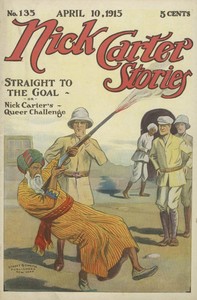
Nick Carter Stories No. 135. April 10, 1915; Straight to the Goal; Or, Nick Carter's Queer Challenge — Reading Notes

(1 User reviews)   303
In Category - Crime Investigation
Carter, Nicholas (House name) Project Gutenberg 2021 1915
India -- Fiction; Detective and mystery stories; Attempted murder -- Fiction; Millionaires -- Fiction; Dime novels; Kidnapping -- Investigation -- Fiction Readers of public-domain and historical texts
Project Gutenberg digital edition en

Edition facts

Words 38,521
Reading time 168 min
Text sections 25

Nick Carter Stories No. 135. April 10, 1915; Straight to the Goal; Or, Nick Carter's Queer Challenge — Reading Notes can be approached with a clearer sense of reading commitment from its source measurements: 38,521 words, 2 hr 48 min estimated reading time, and 25 detected text sections.

The text analysis averages about 13.6 words per sentence, while the detected sections provide another way to judge how the source is divided.

Project Gutenberg metadata also associates the work with “India -- Fiction,” connecting these edition facts with the source record’s subject description.

This editorial note examines the authorial choices in Nick Carter's 1915 dime novel, focusing on the controlled diction of the detective, the mechanical precision of the Golden Scarab's poison apparatus, and the rapid, action-driven dialogue that propels the plot without psychological depth.
Share
Editorial Edition Score 4.7/5

Calculated from edition completeness, EPUB availability, text structure and catalogue metadata. Not a user rating.

How this score is calculated
  • Description quality20 pts
  • Title & short description10 pts
  • Source metadata20 pts
  • Text length15 pts
  • Chapters / structure15 pts
  • EPUB file integrity20 pts

Total of 100 points, scaled to a 2.5-5.0 range. Editions with an empty description or a missing EPUB file are not scored.

Edition quality

Read the Text

THE MESSAGE OF THE SPEAR.

A spear shot into the midst of the camp, and stuck, quivering, in the ground!

Patsy Garvan and Chick jumped to their feet, rifle in hand, and looked inquiringly at Nick Carter.

The detective had not moved. He was sitting with his back against a rock, a cigar in his mouth, and silently contemplating the small fire that he had consented to have made.

When the spear came sailing over the bluff, at the foot of which was the little camp, he merely glanced at it, as if it were a rather curious visitor, but not one to cause untoward agitation.

There were other persons around the camp fire besides Nick Carter and his two assistants.

Jefferson Arnold, the millionaire shipowner of New York and Calcutta; Jai Singh, the high-caste Hindu, who had proved himself so valuable an ally to Nick Carter, and Adil, also an East Indian, the body servant of Jefferson Arnold’s son, Leslie, all were sitting there.

The men started up when the spear came sailing over the rocks and buried its heavy metal head in the ground just before them.

“That thing might have hit some of us,” cried Jefferson Arnold. “Better look out! There may be others.”

“I hardly think so,” was Nick Carter’s calm response. “That is a message only, unless I am much mistaken. Don’t you see there is something tied around the wooden shaft just below the head. Looks like a bit of cloth.”

He stepped forward, and, with a sharp tug, drew the spear from the hard earth. Then he unwound from it a silk necktie of a rather unusual pattern.

“It is Leslie’s!” shouted Jefferson Arnold wildly, as he held out his hand for the tie. “I never saw one like it except on my son. He had it on when we were in that city yonder.”

“I remember it,” answered Nick, looking at the curious combination of colors thoughtfully. “It struck me as unique, and yet in perfect taste. Still, probably there are others like it in the world.”

“Perhaps. But it isn’t likely others would have these initials embroidered on the back of it,” rejoined Jefferson. “See! ‘L.A.’ No, Carter, this is my boy’s necktie, and he is in the hands of those rapscallions over there.”

The father buried his face in his hands, and rocked to and fro convulsively.

“Well, even so, what is the meaning of the spear coming over the rocks like this?” asked Patsy.

“There can be only one meaning,” returned Nick Carter. “Calaman, the high priest of that strange city, Shangore, sends us this necktie to let us know he has Leslie Arnold a prisoner.”

“Why did we ever come away without making sure he was safe?” groaned Jefferson Arnold. “It was my fault. My boy will think we have deserted him.”

“No,” contradicted Nick. “He will know better than that. He will understand just how it was. In the darkness, when we escaped from that city, we thought he was with us. You will remember we had quite a tussle on the drawbridge, and got off only just in time. It looks now as if Leslie must have been caught when they pulled up the bridge.”

“I suppose so,” assented the millionaire. “But what are we going to do?” he wailed. “What do you suppose this message means? Do you think the necktie was sent just to taunt us?”

The agony of this usually self-contained man was pitiful.

An answer came in an unexpected way at this moment. Another spear dropped upon the rocks a little way off and lay flat. It had not been so skillfully discharged as the first one, but it also bore its message—this time in writing.

The characters were more like those of ancient Greece than the letters used by English-speaking people to-day, and the spelling was phonetic. But it was possible to make them out, with a little study.

“This says ‘You are all invited to Shangore,’” announced Nick Carter, after examining the note for a few minutes. “Here is a small sketch of the head and face of Calaman in the corner. In lieu of a signature, I suppose. It is written on some kind of parchment. Probably the people of Shangore have not mastered the art of making paper.”

“Many letters are written on skin of this kind,” remarked Jai Singh quietly, as he took the scrap of material from Nick Carter’s hand and rubbed it between his fingers. “And yet paper is made in many parts of India, too.”

“That is all unimportant,” interrupted Jefferson Arnold impatiently. “What are we going to do about it? How are we going to save my boy?”

“What do you want to do?” asked Nick.

“Go,” was the prompt reply.

“That’s what I say,” put in Patsy. “If Leslie is in that heathen city, we’ve got to get him out.”

“It may mean death, remember, Patsy!” suggested Nick Carter.

His impulsive young assistant actually jumped in the air and cracked his heels together, as one of his ancestors might have done at Donnybrook Fair, generations before, when a challenge was thrown out to them.

“What do we care for that?” howled Patsy. “We’ll make it hot for them first. Anyhow, I don’t think it would mean death or anything like that. But we’ve got to get Leslie Arnold.”

Jefferson Arnold reached across to shake hands with Patsy.

“Well, let us look over the situation dispassionately before we take action,” suggested Nick. “We cannot hide from ourselves that Calaman is a cunning and powerful personage, and that his control of the people of that city, where they worship the Golden Scarab, is complete.”

“I just want to get my fingers on that old geezer’s throat if he has hurt Leslie,” muttered Patsy.

“When we went into Shangore yesterday with Calaman and his guards, it was as his guest,” continued Nick. “We found the rascal Pike, who had stolen a hundred thousand dollars from the Arnold Company in Calcutta, and who had taken refuge in Shangore, because he did not think any one could trace him there.”

“That was reasonable enough for him to think,” commented Chick. “Shangore, the capital city of Bolongu, is right over here, in the Himalayas, in a region where few white men have penetrated in many centuries.”

“I don’t believe any have been here till now,” put in Jai Singh, as he looked up from polishing his spearhead with a cloth he had taken from his garments. “At least, not for more than two or three hundred years.”

“That’s as it may be,” observed Nick Carter. “Anyhow, we all know that it was the intention of Calaman to hold us as prisoners, and perhaps to kill us all eventually. That was why we got out.”

“The only thing there was for us to do,” growled Jefferson Arnold.

“Now he is trying to entice us in again,” said Chick. “How do we know Leslie Arnold is in the city?”

“Here is his necktie, sent over to us on a spear,” Nick reminded him.

“Well, what of that? Leslie may have dropped it.”

“No,” interposed Jefferson Arnold. “I saw that necktie tightly knotted around his neck as we came over the drawbridge. It could not have come off accidentally. The only way old Calaman could have got hold of it was by having it taken from the boy’s neck. Leslie is a prisoner in Shangore.”

“That is my reading of it,” agreed Nick Carter. “We shall have to go and get him out.”

“I don’t see how we’re going to do that, even if we get into the city,” remarked Jai Singh. “Those thick walls and the gates that no one can pass must be kept in mind.”

Arnold looked at the tall, dignified Hindu resentfully.

“What are you croaking about, Jai Singh? It isn’t like you to hold back when there is to be some fighting. Why do you oppose our going back to Shangore?”

“I do not oppose it, sahib,” replied Jai Singh, with dignity. “I need not tell that I am ready to fight. My spear is sharp and my arm strong. Besides, I have learned to use the revolver I carry in my sash. But I know of the danger that is behind the walls of Shangore, and it is not well that you should forget it, either.”

“We do not forget it,” put in Nick Carter. “But we have to bring Leslie Arnold away, and we must take whatever risks there are. Jai Singh, will you make them understand that we will go back?”

Jai Singh bowed in acquiescence, and, picking up his spear, was about to go down the pass through the rocks that led to the valley, on the opposite side of which the towers and roofs of Shangore glistened in the early-morning sun.

“Wait,” ordered Nick. “Where are you going?”

“To the cliff beyond, where the men in the valley can see me.”

“I understand. You will give them a sign that they will understand. Well, tell them we will come at once.”

Jai Singh bowed again, and disappeared, while Nick Carter turned to give a few last words of advice to those with him.

“We have been here all night,” he began, “and we are rested. We have had a good breakfast, and are strong enough to fight.”

“You bet!” threw in Patsy Garvan energetically.

“It isn’t likely we shall be called on to do anything of the kind at first,” went on Nick. “But we shall have to use our brains if we are to come through this enterprise in safety, and also bring Leslie Arnold with us.”

“We put a lot of their soldiers out of business in that scrap we had with them last night,” observed Chick. “It would be bad if Calaman decided to revenge himself upon us for their loss.”

“No fear of that,” put in Adil, the young Hindu, speaking for the first time. “Calaman thinks nothing of the lives of his men. As he has said to us, they are his slaves, and he can do what he likes with them. He may be sorry to lose their services, but he never would think of avenging them. They are not important enough, in his eyes.”

“There’s truth in that, Adil,” assented Nick Carter. “We have seen how he caused the death of one of his guards just because he stumbled and dropped a package he was carrying. No, I dare say he will pretend to be friendly with us, as if there never had been a fight.”

“He’s a sly old rascal,” snorted Jefferson Arnold. “But we’ll beat him yet. We’ve got to do it. We shall be taking a big chance going into that walled city of his, but I’ve got to save my boy, at any risk.”

“We will start,” announced Nick Carter. “Jai Singh has delivered our answer by this time.”

There was no particular preparation required before they went on. The rifles they had laid by their sides were picked up, and the few fragments of biscuits that had not been devoured were placed in their pockets with the whole ones that Nick Carter’s forethought had caused them all to carry with them.

“We have no ammunition,” observed Nick. “But we must get hold of some of those cartridges of ours that they took from us as soon as we are well within Shangore. I will get the old fellow to let me show him how we use these ‘death sticks,’ as he calls them.”

They marched through the crooked pass between the towering walls of rocks, and came suddenly upon Jai Singh, who was waving his spear about so that a number of men who stood in the valley, looking up, could see his movements without difficulty.

“I have told them,” said Jai Singh coolly. “We can go down at once.”

“Very well, Jai Singh,” returned the detective. “Come on, everybody. And remember, Patsy,” he added to his second assistant, “I will do the talking.”

When they walked across the drawbridge at the nearest of the four great gates of the city, and passed under the portcullis, escorted by a dozen of the guards of the high priest Calaman, the latter came forward with a smile and bade them welcome.

“Isn’t he the limit?” muttered Patsy. “Any one would think we were friends of his.”

Nick Carter gave Patsy a warning look, and addressed Calaman in calm, firm tones:

“Whether we are welcome or not, Calaman, is not of so much importance as to know whether you are prepared to deliver to us the white man you have in Shangore.”

“My son!” broke in Jefferson Arnold. “That’s whom we want.”

Calaman held up his hands with a deprecating gesture, as he smiled.

“My white brothers might know that I would not ask them to come back unless I had something to offer that would please them,” he exclaimed. “We did not understand each other before, and that was why there was fighting and death, when all I desired was peace and good feeling.”

“Old liar!” murmured Chick.

“Your former apartments in the palace are ready for you,” continued the priest. “Will you honor me by taking possession? I will send you food and wine. You need them after your journey. After that, we will go to the public square.”

“Why?” asked the detective.

“This is the day of the Festival of the Golden Scarab,” was the reply. “We ask you to take part in the celebration by showing us again how the death sticks do their work. Will you not do it?”

“Where is the white man we want—he who is the son of my friend, here?”

Nick Carter was resolved not to be turned aside from the main purpose of their coming, persistently as the wily priest endeavored to lead the conversation into other channels.

“He shall be delivered to you in good time,” answered Calaman. “In the meanwhile, you have my assurance that he is well and enjoying treatment such as you would desire.”

They had to be content with this for the time being.

“We shall be ready in half an hour,” Nick Carter announced abruptly, as he walked away to the apartments they had occupied before.

Calaman was as good as his word in reference to the meal he had mentioned, and though they had had a frugal breakfast already up in the rocks, they were quite willing to attack the well-served repast provided for them now.

In exactly half an hour two soldiers came to the door and made deep salaams.

“Very well!” was Nick Carter’s response to this silent notification. “Lead on!”

As they filed out of the room, Chick remarked, in a low tone, as he glanced back at the remains of the meal on the table:

“We’ve got to hand it to the old man for the square meal he puts up. I don’t know what we’ve been eating, but it was as good as anything I ever got in New York.”

Jai Singh snorted rather derisively.

“In my part of the country,” he boomed, “when we feed guests, we provide fat sheep, which are roasted over a very hot fire, and put before those who eat, with rice, raisins, and many fruits that are gathered for the occasion.”

“It looks to me as if these people intend us to be the sheep this time,” smiled Nick Carter. “They intend to roast us over a hot fire—if we let them.”

“That’s right,” chuckled Patsy. “If we let them. Gee! There’s going to be a hot time in their old town to-day, and we’ll be fixing the fire.”

Nothing could repress Patsy Garvan’s bubbling spirits at the prospect of a battle. He liked fighting for its own sake.

The possibility of his being beaten never occurred to Patsy. That was the reason he was nearly always on the winning side.

The two tall guards, carrying their spears in military fashion, and never looking behind, were several yards in front. Nick Carter turned and addressed all the members of his little band:

“Don’t overlook the odds against us. Our four coolies—who could be depended on to keep up their end in a mêlée when told to drive ahead—are prisoners somewhere in this place. Then Calaman has all our cartridges. We can’t do much for ourselves or for Leslie till we get hold of our ammunition.”

“We’ll get it,” declared Patsy, with his usual confidence.

“We’ve got to do it,” added Chick. “We are inside the walls of Shangore, and there is nothing for us but to fight. We got out before, and we can do it again. But, as you say, chief, we must find the cartridges.”

When they reached the courtyard of the palace, they found Calaman waiting for them, surrounded by more than a score of his saturnine guards.

“I am glad to see you have brought your death sticks with you,” was the priest’s greeting. “We will go to the public square, where you may show me again how the sticks kill at a distance.”

They marched through the streets of the city, and the white men were struck by the large numbers of people who were moving about, evidently in holiday dress.

Their garments were all of Eastern style, of course, but there was so many different cloths, cut into such varied designs, that Nick Carter told himself he had never seen a more striking sartorial display even on Fifth Avenue on a bright afternoon.

“You will not kill men for me with your stick, I suppose?” asked the priest, rather wistfully. “I could have three or four of them tied to those stakes over there, and your death sticks could be tried on them.”

This cold-blooded suggestion made Patsy grind his teeth.

Nick Carter shook his head, and answered that he certainly could not consent to do murder in that way.

“Well, I felt sure of that,” returned the priest. “So I have something else for you. Look!”

Nick Carter shuddered as he gazed at the gruesome object at which Calaman pointed.

Between two stakes driven into the ground was strung a long rope. In the middle of the rope was a cord hanging down a little way, and on the end of it was the shriveled head of a human being.

The head had been embalmed, dried, and treated in the secret way known to the people of this strange country, and was not bigger than a good-sized orange.

There it hung, swaying gently to and fro in the slight breeze, occasionally spinning around, as if it were inspecting everything in the square in its own mysterious, grim way.

“Can you hit that with your death stick?” asked the priest.

“Yes,” was Nick’s prompt reply.

“Even while it moves a little?”

“Gee! I wouldn’t have said that,” grumbled Patsy, in a low tone. “You might as well have had it as easy as you could get it.”

“Then let my white brothers raise their sticks and do it,” directed Calaman, stepping back a little.

“One moment!” called out the detective. “Before we can use our sticks, we must have those little brass cases that you took from us when we were here before.”

Two of the heavy boxes containing cartridges which had come into possession of the priest when Nick and his party had been in the city on the previous day were on the ground, and Nick had seen them.

“Break open that box!” ordered Calaman, pointing to the one he meant.

One of the guards, with his spear, pried off the lid. Nick Carter at once took one of the smaller boxes in the outer case and stuffed it into one of his outside pockets.

The small box contained two hundred and fifty cartridges.

“Get some!” he directed his comrades laconically.

Chick, Patsy, Jefferson Arnold, Adil, and Jai Singh all obeyed. Each was soon well supplied with cartridges, while the big box was practically empty.

Calaman regarded them suspiciously as they grabbed the cartridges. But he did not say anything. Doubtless he felt that he had the whole party in his power, and he could afford to let them have all of these little brass things they wanted.

“First trick to us!” mumbled Jefferson. “And my rifle magazine is plumb full, as well. We’ll make the old scalawag sit up before we’re through with him. Let ’er go, Carter!”

The detective dropped to one knee, and seemingly without taking careful aim, sent three shots at the swinging head.

The opening of Straight to the Goal; or, Nick Carter's Queer Challenge establishes a signature calm in the face of sudden violence. When a spear lands quivering in the camp, Nick Carter does not flinch; he merely glances at it 'as if it were a rather curious visitor.' This deliberate understatement sets the detective apart from his alarmed companions and signals a narrative voice that prizes composure over panic. The authorial choice to have Carter remain seated, cigar in mouth, while others spring to action, immediately defines his character through physical stillness and laconic speech.

Diction of Control

Nick Carter's dialogue consistently employs short, declarative sentences that convey authority without explanation. When Jefferson Arnold warns of more spears, Carter replies, 'I hardly think so. That is a message only, unless I am much...' The trailing off suggests a mind already analyzing, not reacting. This verbal economy contrasts with the more excitable lines of Patsy Garvan and Chick, who 'jumped to their feet, rifle in hand.' The narrator rarely describes Carter's internal thoughts; instead, his calm words and actions serve as the primary indicators of his deductive process. The effect is a protagonist who seems to operate on a plane above the chaos around him.

Mechanical Horror of the Golden Scarab

The description of the Golden Scarab's mechanism is rendered with clinical precision. The horns are 'hollow, and jointed, like those of a lobster,' with knives 'gilded to look like part of the Scarab's claws.' The poison is 'concealed in the handles of the knives, the blades of which were hollow, so that the deadly stuff would run through and empty into a wound.' This technical detail, far from being sensationalized, is presented as a puzzle to be solved. The narrative lingers on the craftsmanship—'the skill that marked everything done under the guidance of Calaman'—treating the murder device as an object of grim admiration rather than horror.

Action-Driven Dialogue

Dialogue in the excerpts serves primarily to advance action and coordinate movement, not to reveal character. Lines like 'Beat them back, boys! It's only a bluff!' and 'Lend me a gun, somebody!' are functional, stripped of introspection. Even when Chick wonders about a widow's knowledge, the exchange is cut short by Nick: 'We won't tell her, at all events.' The rapid back-and-forth mimics the pace of a fight scene, with each utterance triggering a physical response. This style prioritizes momentum over emotional depth, fitting the dime-novel format where plot velocity is paramount.

Setting as Threat

The camp setting is sketched with minimal detail—'a rock,' 'a small fire'—but the environment is immediately hostile. The spear arrives 'sailing over the bluff,' and later the 'sound of tramping feet on the sand' signals an ambush. The natural landscape is not described for atmosphere but as a stage for sudden intrusion. The Scarab itself is a fusion of animal and machine, its 'hollow horns' and 'poisoned knives' blurring the line between organic and artificial. This treatment of setting as a source of threat, rather than backdrop, reinforces the story's focus on immediate physical danger.

Readers approaching this dime novel should attend to how the author uses restraint—in Carter's dialogue, in the technical descriptions of weapons, and in the sparse setting—to create a tone of controlled menace. The story does not dwell on motive or morality; it moves from one violent set piece to the next. The pleasure lies in watching a detective who never raises his voice solve puzzles that others find terrifying.

The rain blurred the window that afternoon, and I kept returning to how Carter’s clipped, mechanical speech mirrored the poison scarab’s cold precision—no wasted words, just motion. That stark efficiency stayed with me, a quiet counterweight to something warmer, more human. When I finally set the dry pages aside, I drifted toward The Black Bag — Inside the Classic, almost without thinking. It felt less like a next step and more like a slower exhale.

John Brown
1 month ago

4
4 out of 5 (1 User reviews )

Add a Review

Your Rating *
There are no comments for this eBook.

Reader reflection

What was your reading experience?

Capture what you thought, learned, and would like to remember.

Your progress 0 / 10
1

How far have you progressed with this book?

2

Was reading this book enjoyable?

3

Would you encourage someone else to read it?

4

How easy was the book to follow?

Related eBooks