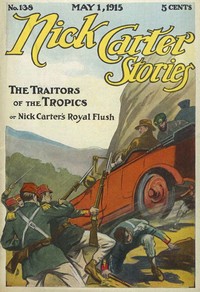
Nick Carter Stories No. 138 May 1, 1915; The Traitors of the Tropics; or, Nick Carter's Royal Flush — Context and Discussion
Edition facts
For Nick Carter Stories No. 138 May 1, 1915; The Traitors of the Tropics; or, Nick Carter's Royal Flush — Context and Discussion, the stored edition analysis reports 39,111 words, 2 hr 51 min estimated reading time, and 20 detected text sections.
The text analysis averages about 13.9 words per sentence, while the detected sections provide another way to judge how the source is divided.
Project Gutenberg metadata also associates the work with “Detective and mystery stories,” connecting these edition facts with the source record’s subject description.
Calculated from edition completeness, EPUB availability, text structure and catalogue metadata. Not a user rating.
How this score is calculated
- Description quality20 pts
- Title & short description10 pts
- Source metadata20 pts
- Text length15 pts
- Chapters / structure15 pts
- EPUB file integrity20 pts
Total of 100 points, scaled to a 2.5-5.0 range. Editions with an empty description or a missing EPUB file are not scored.
Read the Text
“You say he cannot travel to-day, doctor?”
“Impossible, Mr. Carter!”
“He would be in a drawing-room on the Pullman, and every care would be taken to make the journey easy for him.”
The surgeon shook his head.
“He would have his own servant, Phillips, to attend him,” persisted Nick Carter. “This is Prince Marcos, you know, Doctor Sloane. You’ve heard of him, and I’ve explained that it is essential for him to be in the country of which he is the ruler by the eighteenth of this month. He has only five days now.”
“I am sorry, but----”
“He could make it in the five days, by continuous traveling,” still pressed the detective. “I realize that he would be taking some risk. But when it is considered that the very existence of his country depends on his getting there by a certain date, I doubt whether any one has the moral right to stop him.”
Doctor Sloane shrugged his shoulders. He was one of the distinguished surgeons in New York, and he was accustomed to being obeyed. Even a prince was not important enough in his eyes to dispute his professional commands.
“As to the moral right, Mr. Carter,” intoned the doctor, in his most impressive manner, “that, it seems to me, is beside the matter. I tell you, as a surgeon, that a man who has just been shot in the chest, and has narrowly escaped a puncture of the pericardium, must lie still for a more or less protracted period, if he intends ever to get up at all.”
“I feel quite well,” suddenly interposed the man in the bed. “I can travel easily, Mr. Carter. Make the doctor understand that.”
“Very well, Mr. Marcos,” answered Nick Carter, as he held up a hand of warning to the patient not to talk. “I think the doctor does understand our position.”
“I understand that if you let this Mr. Marcos get up to-day, or this week, or next, I will not be responsible for his life,” interrupted Doctor Sloane. “His temperature is nearly a hundred and rising, and he is too weak to talk, to say nothing of his getting up.”
There could be no doubt that the surgeon spoke the truth. Prince Marcos, ruler of Joyalita, the Caribbean principality, was in bad physical condition.
He had been preparing to go home, to take part in an important gathering of the officers of his government, when somebody had fired a shot at him from ambush as he strolled in the grounds of his temporary home, Crownledge, on the Hudson River, and had brought him down.
If there had been anybody with Prince Marcos when his hidden enemy tried to kill him, the miscreant might have been captured. But the prince was alone. Naturally, nothing could be found of the would-be assassin when the grounds were searched, for it was then half an hour after the shooting, and Marcos was in bed.
Phillips, his valet, had heard the shot, and knowing that the prince’s cousin, Prince Miguel, with Don Solado, prime minister of Joyalita, had made attempts on his life before, in New York, he had suspected these men again.
Nicholas Carter, the famous detective, had been telephoned for. He had come racing up in his high-powered motor car soon after the eminent surgeon--with the aid of one of much less note, as well as a trained nurse--had extracted the bullet.
Doctor Sloane had just given his decision now that the patient must stay in bed for two weeks at least--perhaps much longer.
To the surgeon’s disgust, the patient insisted that he must get up at once. He had to take a long journey into Central America, he said.
Strangely enough, Nicholas Carter, the famous detective--whose knowledge of medicine and surgery was great enough to have made him a successful practitioner if he had cared to follow a doctor’s career--had backed up Prince Marcos in his wild purpose.
“I’ve no doubt that, according to all precedent, a man in my condition should stay in bed,” conceded Marcos. “But I shall have to go down to Joyalita at once, nevertheless.”
The surgeon turned away, with his favorite shrug.
“Well, I can say no more,” he declared, in an offended tone. “I’ve given you my honest professional opinion. It is more than an opinion--it is a conviction. If you choose to commit suicide, it is no affair of mine.”
Doctor Sloane was not accustomed to people flying in his face. So he vouchsafed Prince Marcos merely a curt nod of farewell, and stalked out of the bedchamber.
Nick Carter followed him to the hall and closed the door.
“Really, doctor, I know it is important for Mr. Marcos to go down to Central America at once. He should have started already, and would have done so but for this unfortunate accident.”
“Accident?” ejaculated Doctor Sloane, with a smile.
“We will call it that for the present,” returned Nick Carter. “Anyhow, the fact that he has enemies who would shoot him down in cold blood in his own home indicates that it is imperative for him to go. If it were not, men would not be trying to kill him to keep him back.”
“That may all be,” conceded the doctor. “No doubt it is, when you say so, Mr. Carter. But that is entirely outside of my province. I came here to save his life, and I have told you what will happen if he gets up now.”
“He has a strong constitution,” pleaded Nick Carter.
“Of course he has, or he wouldn’t be alive now,” snapped Sloane. “But if he moves before next week, at the earliest--well, the consequences be on his own head.”
Without waiting for a reply, Doctor Sloane marched out of the house to his motor car, and was gone.
Nick Carter went back to the sick room and gazed thoughtfully at the flushed face and tossing head on the pillow. As he looked, a thought revolved in his mind which he admitted to be audacious, but which would not be banished, no matter how outrageous it might seem.
“What do doctors know about affairs of state?” suddenly burst from the injured man’s impatient lips, as he turned his eyes, bright with fever, upon the detective. “If I start on that nine-o’clock train to-night, I can make good connections, and get down to Joyalita in time to beat those wretches. You will help me, Carter, won’t you?”
“I will certainly try to bring to justice the men who tried to murder you,” replied Nick Carter. “Don Solado, your prime minister of state----”
“A treacherous old rascal!” put in Marcos.
“Of course he is,” assented Nick. “And your cousin, Prince Miguel, who would like to step into your shoes as ruler of your country. He and Solado are both interested in preventing your reaching Joyalita. Whether they would kill you to keep you away remains to be seen.”
“I am convinced they would. I feel sure that one of them fired that shot at me. Or, if he did not actually do it himself, he hired one of those thugs, who can be procured in any large city, to do it for him.”
“It comes to the same thing,” remarked Nick Carter.
“But that is nothing, after all,” went on Marcos hurriedly. “The thing is that the revolutionary party in Joyalita are to hold a meeting on the eighteenth of this month, at which they will practically give the country into the hands of our neighbor, Carita. That is the scheme. If I am there, I must sign the reply to Carita’s proposition, and, of course, it will be in the negative.”
“And if you are not there?”
“Then the president of the council, who is a secret enemy of mine--as I have just found out--will sign it for me, and he will accept the other side’s proposal.”
“It is a difficult situation,” murmured Nick.
“Difficult or not, it must be solved,” broke in Marcos. “I intend to go. The capital of Joyalita is Penza, and I must be there at twelve noon on the eighteenth.”
He forced himself to a sitting posture and threw aside the bedclothes.
“Mr. Marcos!” protested Nick.
“Don’t try to stop me, Carter! My mind is made up!”
But Marcos’ body was not as strong as his will.
As he swung himself out of bed and put his feet to the floor, the pallor of faintness came over his face, and he would have pitched forward in a heap had not the detective caught him.
Lifting the insensible man upon the bed again, and pulling the clothes over him, Nick Carter applied remedies which soon brought him back to consciousness, although his disappointment was pitiful.
“What shall I do?” he wailed. “What shall I do? The scoundrels have beaten me, after all.”
Nick gave him a spoonful of stimulant, and, as the color came back increasingly into his face, Marcos continued:
“I don’t care for myself. But it breaks my heart to see my little country sold into bondage for the benefit of a handful of rascals who would sell their own mothers if they got their price. What can I do, Carter?”
He held out his hot hand appealingly to the strong, cool detective at the side of his bed, and Nick Carter, taking the hand in his, resolved to carry out the audacious purpose already referred to, let the result be what it might.
Nick strode up and down the room for some minutes, turning over in his mind the scheme that had come to him. Once he stopped before the mirror on the dresser and contemplated his own face steadily for several seconds.
As he turned away, there was a confident smile softening his resolute lips, and he nodded as if inwardly assenting to some suggestion unheard by anybody but himself.
“Listen to me, your highness!” he said, stopping at the side of Prince Marcos’ bed.
“Drop ‘your highness,’ Carter,” begged Marcos impatiently. “Call me ‘Mr. Marcos,’ if you like, but leave out the royalty. We are in New York, and I am quite content to be a plain ‘Mr.’ while here. But what were you going to say?”
“Just this,” replied the detective, bending over the bed, so that the trained nurse, who had just come into the room, should not overhear. “There is one way in which we can save your country. It will mean trickery--a fraud, if you will.”
The trained nurse left the room, and Nick Carter quietly turned the key in the lock.
“What is it?” asked Marcos.
“Look at me. Don’t you think many people would say I was Prince Marcos if I declared that to be my name?”
“Of course they would. No one could tell the difference, and----”
Marcos stopped, and a wild expression of hope came into his fever-brightened eyes.
“You mean that you would----” he went on, and stopped again.
“I would go in your place to Penza, in Joyalita, and do for Prince Marcos what his enemies have prevented his doing for himself,” declared Nick Carter firmly.
THE DEPARTURE FOR PENZA.
There was no other word spoken for an appreciable space of time. Prince Marcos could hardly comprehend the possibility of the plan, and was silent. Nick waited for him to say something.
“I should think it could not be done if it were any one but you, Carter,” were the broken words that came from Marcos at last. “But I can see only success if you undertake the thing.”
“There must be success,” returned Nick gravely.
“Of course. Now let me tell you what you must do. When I left Joyalita I wore a small mustache. I shaved it off before I got to New York. Will you kindly hand me my coat--or take the small packet of letters, fastened by a band, in the inside pocket? That will be better.”
Nick obeyed, and Marcos took from one of the envelopes a photograph of himself as he had appeared before taking off the mustache.
“You see, Carter,” he said, “I looked a little different when wearing that. Could you not put one on like that? It would make your disguise absolutely perfect.”
“I will do that, of course,” answered the detective. “Will you lend me this photograph? I will get a mustache, and make up my face with the photo as a guide. That is a common method with professional actors when they are to represent some well-known personage--such as President Lincoln, Disraeli, or _Taffy_, in ‘Trilby.’ They generally ‘make-up’ from a portrait of the original. I can get myself exact, I know.”
“You can have the photo. And you’d better take Phillips with you. He will be a great help, because he knows Joyalita and its people as well as I do.”
“Certainly. I could hardly undertake it without Phillips,” answered the detective. “I intended to ask you for him.”
“Who else will you have with you?”
“I shall take my principal assistant, Chick, in the guise of a medical attendant, and my second man, Patrick Garvan, in place of your late servant, Jason, who managed to get burned to death during the last attempt of the gentle Miguel to keep you away from Joyalita.”
“So you will have three people with you,” observed Marcos. “That will make four in the party, and it ought to be strong enough to throw off Solado and Miguel, if they should try any tricks on you as you go along.”
“Which they are likely to do,” said Nick.
Marcos fumbled under his pillow and brought out a chamois leather bag which he had worn around his neck under his clothing, but had taken off when his valet had undressed him.
Phillips knew that his employer always had this bag under his pillow. He often had assisted him to remove the cord from his neck without making any comment. Any well-trained valet would do that.
“Here is something you must take, Carter,” said Marcos.
He fumbled in the bag, and took out a richly jeweled watch and diamond fob. Laying them on the counterpane, he regarded the fire and luster of the precious stones admiringly.
“This watch is known as the Seal of Gijon,” he remarked quietly. “It has been handed down in my family through a dozen generations, and is the insignia of the reigning house of Joyalita. You see that it is old-fashioned in design. But it is an accurate timekeeper, and its value, merely as gold and gems, is several thousand dollars.”
“I know that,” nodded the detective. “I’ve seen the watch before, you will remember.”
“Yes, I remember. But here is something that perhaps you have not seen,” continued Marcos, as he pressed a spring. “This is the great seal of Joyalita, and it must be used on all official documents. You will perceive that it is in the form of a double-headed dragon, with the letter ‘J’ twisted about it like a rope.”
Nick Carter bent over the watch and admired the ingenuity with which the seal--almost as large around as the watch case itself, but fitting just inside--would stand forth when the spring was pressed, so that it could be used on sealing wax.
He put the Seal of Gijon carefully in an inside waist-coat pocket, and went away, after promising to come back before he started on his long journey to Penza, in Joyalita.
It was a quarter to nine that night when two taxicabs arrived at the Grand Central Terminal in New York. Five persons left the cabs and crossed the great concourse, on their way to the express train ready to leave.
Three of the four men in the party carried hand baggage of various descriptions. The fourth was wrapped in a large overcoat, and only his eyes, nose, and mustache could be easily distinguished between the two points of the large upturned collar as he walked along.
He was conversing with a very pretty, dark-eyed girl, expensively dressed and bearing all the marks of good breeding so easily to be distinguished when present, and quickly missed otherwise.
The man in the big overcoat was Nick Carter; the young lady, Miss Claudia Solado, niece of the villainous prime minister of Joyalita, Don Solado, and cousin of Prince Marcos.
Claudia was a warm champion of her Cousin Marcos, and her greatest regret was that Don Solado was the brother of her dead father.
“I am sure you will get there safely, Mr. Carter,” she was saying, as they crossed over to the train gate. “Poor Marcos! He would be lost if it were not for you.”
“Not a bit of it,” laughed the detective. “So long as he has such an earnest and faithful cousin as Miss Claudia, he could not fail to win out at last. Will you see me into the train, so that you can report to him?”
“Yes. If they will let me pass the gate,” she answered.
“I’ll attend to that,” returned the detective confidently. “They will let you through.”
So they did. She walked up the platform to the Pullman car by the side of him, talking in low, earnest tones all the way.
Immediately behind came Chick, with a pointed beard, dark spectacles, and carrying a black leather medical case in his gloved hand. In his dark clothing and high hat, he was the very picture of a well-to-do physician, and, when he coughed a sonorous “Hem!” as he passed the gate, was as impressive as Doctor Sloane himself.
Patsy Garvan wore a light check suit and leather leggings, with a cap of the same material as his suit. In his pockets were a pair of handcuffs and the automatic revolver which he always carried when out on business.
Incidentally, it may be said that both Nick Carter and Chick were provided with similar useful implements.
The drawing-room which had been reserved for Mr. Marcos and his physician, “Doctor Fordham,” was ready, and Nick Carter and Chick went in at once, accompanied by Claudia.
Patsy Garvan and Phillips were to ride in the Pullman in ordinary seats, and they busied themselves in placing the baggage that had not been stowed in the drawing-room. Everything was done in the regulation manner, and no one could doubt that the wealthy gentleman in the drawing-room was all he appeared to be, with his two servants in attendance.
“You have not seen anything of our friends the enemy, have you, Miss Solado?” asked Nick, when they were shut in.
“I cannot be sure,” she answered. “I did not see Miguel or my uncle, Don Solado, anywhere about the station. But I saw one face I thought I recognized--only I know he is dead.”
“Jason, who used to be Marcos’ undervalet.”
“Do you think you saw his face?” asked Nick Carter thoughtfully.
“I saw a face like his. But, as you know he is dead, of course I must have been mistaken.”
“Of course,” agreed Nick. “Did you see what became of this man who looks like Jason?”
“I missed him near the gate. He may be on this train.”
“That’s possible,” put in Chick. “It’s a long train, and there might be a score of people on it whom we know without our ever seeing one of them.”
“I wish I could come with you, Mr. Carter,” said the girl. “But my mother does not want to leave New York just yet. She does not go out much, but she likes to be near the bustle of this big city. It is just a notion, but it is insistent, too. I do not care to leave her, although she would not mind, for both she and I are used to traveling alone.”
“You will be safer here, with your mother,” returned the detective. “So long as I have Phillips to give me a hint now and then, I shall be able to act the part of your cousin satisfactorily, I am sure. Then, if I need any other kind of help, I have my two assistants, and----”
The cry of “All aboard!” came echoing along the platform at this moment.
With a hasty “good-by, and thank you, Mr. Carter!” Claudia Solado left the drawing-room and was helped down to the platform by Chick.
In another minute the train was softly gliding away, without noise or fuss, as the electric motor got to work. Claudia was left on the platform watching the red tail lights as they glimmered smaller and smaller, and finally disappeared.
The story opens not with action but with a tense argument over medical authority. Nick Carter presses a surgeon to allow the wounded Prince Marcos to travel, while the doctor insists on rest. The dialogue is clipped and repetitive—'I am sorry, but—'—underscoring the clash between detective pragmatism and professional caution. The prince's interjection, 'I feel quite well,' is quickly silenced by Carter's raised hand, establishing a hierarchy of control that will persist throughout the narrative.
This initial scene is static, confined to a sickroom, yet the language is already forward-looking: 'essential,' 'risk,' 'moral right.' The pace is deliberate, each objection met with a counterargument. The excerpt then jumps to a later sequence where the car coasts silently downhill, engine off, to evade sentries. The contrast is stark—from verbal sparring to wordless, high-speed tension. The narrative voice shifts from reasoned persuasion to terse commands: 'We'll coast down this one.' The change in pace mirrors the shift from planning to execution.
Dialogue as a Tool of Authority
The opening chapter relies heavily on dialogue to establish character and conflict. Nick Carter's persistence is shown through repeated attempts to override the surgeon's judgment: 'You say he cannot travel to-day, doctor?' / 'Impossible, Mr. Carter!' The exchange is almost a ritual, with each party restating their position. The surgeon's 'I am sorry, but—' is cut off, suggesting Carter's impatience. Later, in the car, dialogue becomes sparse and functional. Patsy's 'Bully! Tear into them!' contrasts with Phillips's quiet 'I will fight if you go on.' The valet's simple declaration carries weight because it is understated. The narrative voice uses dialogue to reveal character without explicit description: Patsy's eagerness, Phillips's reluctant courage, Carter's calm authority.
Shifts in Pace: From Sickroom to Speed
The narrative pace changes abruptly between the opening sickroom scene and the later car chase. In the first excerpt, time is measured in days and medical opinions; the pace is slow, almost legalistic. In the second, time compresses into seconds: 'Faster and faster it shot along, until, as they reached a speed of more than a mile a minute, the immense body began to sway.' The description of the car's silent approach—'no noise from the big machine save for the faint rasp of the wide nonskid tires'—heightens tension. The sentry's shout 'The car! Here it is!' breaks the quiet. The shift is not just in speed but in sensory detail: from the doctor's 'most impressive manner' to the physical sensation of swaying and chattering teeth.
Recurring Details: The Gold Coin and the Telescope
Two small objects recur in the excerpts, each marking a change in pace. The gold coin appears when Carter gives it to a boy who warns them of soldiers. The boy 'literally fell off the running board in astonishment and delight.' The coin is a quick gesture, a reward for information, and it signals a momentary pause in the action. Earlier, the boy uses a telescope to spot the hidden soldiers: 'Two of them were watching the road when I looked through the telescope a little while ago.' The telescope represents observation and planning, while the coin represents decisive action. These objects are not symbolic but functional; they anchor the narrative in concrete details that the reader can visualize.
Readers should attend to how the narrative voice modulates between formal dialogue and terse action. The story's pace is not uniform; it accelerates and decelerates in response to obstacles. The excerpts suggest a structure where planning scenes alternate with sudden bursts of movement. The language remains plain and direct, with few metaphors. The focus is on what characters say and do, not on interior states. This editorial note is based solely on the provided excerpts; the full story may contain additional shifts in voice and pace.
There’s a particular silence in that mountain-pass chase, the kind where every held breath matters. It reminded me of the quieter ache in A Point of Testimony — A Reader’s Guide, where the suspense is less about action and more about what’s left unspoken between people. Both linger long after the final page turns, in their own ways.
-
John Ramirez - 3 weeks ago
This issue of Nick Carter Stories provides an entertaining read with a decent plot, though it's not the best in the series. The action is well-paced, but the characters are somewhat flat, and the resolution feels rushed. Still, it's a good way to spend an afternoon if you're a fan of vintage pulp fiction. Fairly enjoyable but not exceptional. -
Antonio Lopez - 2 weeks ago
Nick Carter Stories No 138 is a thrilling addition to the series, packed with action and suspense. The story 'The Traitors of the Tropics' delivers exactly what fans expect: a fast-paced adventure with clever deductions and a daring rescue. The vivid descriptions of tropical settings and the villain's schemes keep you on edge. A must-read for any Nick Carter enthusiast! -
Angela Reid - 1 week ago
Nick Carter Stories No 138 is a disappointing entry. The plot is predictable and stale, with cardboard villains and a lackluster mystery. The tropical setting is underutilized, and the action sequences feel repetitive. While it's a short read, it fails to deliver the excitement promised. Only for hardcore completists who need every issue.
What was your reading experience?
Capture what you thought, learned, and would like to remember.
Samuel Sanchez
3 weeks ago