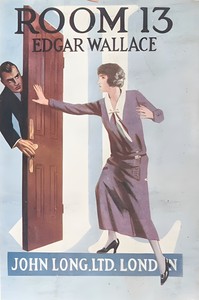
Room 13 — Themes and Context

(1 User reviews)   244
In Category - Mystery Collections
Wallace, Edgar, 1875-1932 Project Gutenberg 2025 Not confirmed
Detective and mystery stories; England -- Fiction; Ex-convicts -- Fiction; Detectives -- Fiction; Reeder, J. G. (Fictitious character) -- Fiction Readers of public-domain and historical texts
Project Gutenberg digital edition en

Edition facts

Words 64,863
Reading time 283 min
Text sections 6

Room 13 — Themes and Context can be approached with a clearer sense of reading commitment from its source measurements: 64,863 words, 4 hr 43 min estimated reading time, and 6 detected text sections.

The text analysis averages about 12.2 words per sentence, while the detected sections provide another way to judge how the source is divided.

Project Gutenberg metadata also associates the work with “Detective and mystery stories,” connecting these edition facts with the source record’s subject description.

Edgar Wallace's 1924 crime novel follows ex-convict Johnny Gray and detective J.G. Reeder. The excerpts show prison life at Dartmoor, a cryptic rabbit parable, and the tension between criminals and law. Catalog subjects include ex-convicts and detectives, but the text emphasizes moral ambiguity and psychological games.
Share
Editorial Edition Score 4.7/5

Calculated from edition completeness, EPUB availability, text structure and catalogue metadata. Not a user rating.

How this score is calculated
  • Description quality20 pts
  • Title & short description10 pts
  • Source metadata20 pts
  • Text length15 pts
  • Chapters / structure15 pts
  • EPUB file integrity20 pts

Total of 100 points, scaled to a 2.5-5.0 range. Editions with an empty description or a missing EPUB file are not scored.

Edition quality

Read the Text

and he had taken the style and responsibility of bricklayer’s labourer. He liked the work because you can talk more freely on a job like that, and he wanted to hear all that Lal Morgon had to say about the Big Printer.

“Not so much talking to-day,” said the warder in charge, seating himself on a sack-covered brick heap.

He was a wizened man of fifty and a lifer, and he had one ambition, which was to live long enough to get another “lagging.”

“But not burglary, Gray,” he said as he leisurely set a brick in its place; “and not shootin’, like old Legge got his packet. And not faking Spider King, like you got yours.”

“I didn’t get mine for faking Spider King,” said Johnny calmly. “I didn’t know that Spider King had been rung in when I took him on the course, and was another horse altogether. They framed up Spider King to catch me. I am not complaining.”

“I know you’re innocent--everybody is,” said Lal soothingly. “I’m the only guilty man in boob. That’s what the governor says. ‘Morgon,’ he says, ‘it does my heart good to meet a guilty man that ain’t the victim of circumstantiality. Like everybody else is in boob,’ he says.”

Johnny did not pursue the subject. There was no reason why he should. This fact was beyond dispute. He had known all about the big race-course swindles that were being worked, and had been an associate of men who backed the “rung in” horses. He accepted the sentence of three years’ penal servitude that had been passed without appeal or complaint. Not because he was guilty of the act for which he was charged--there was another excellent reason.

“If they lumbered you with the crime, it was because you was a mug,” said old Lal complacently. “That’s what mugs are for--to be lumbered. What did old Kane say?”

“I didn’t see Mr. Kane,” said Johnny shortly.

“He’d think you was a mug, too,” said Lal with satisfaction--“hand me a brick, Gray, and shut up! That nosey screw’s coming over.”

The “nosey screw” was no more inquisitive than any other warder. He strolled across, the handle of his truncheon showing from his pocket, the well-worn strap dangling.

“Not so much talking,” he said mechanically.

“I was asking for a brick, sir,” said Lal humbly. “These bricks ain’t so good as the last lot.”

“I’ve noticed that,” said the warder, examining a half-brick with a professional and disapproving eye.

“Trust you to notice that, sir,” said the sycophant with the right blend of admiration and awe. And, when the warder had passed:

“That boss-eyed perisher don’t know a brick from a gas-stove,” said Lal without heat. “He’s the bloke that old Legge got straightened when he was in here--used to have private letters brought in every other day. But then, old Legge’s got money. Him and Peter Kane smashed the strong-room of the _Orsonic_ and got away with a million dollars. They never caught Peter, but Legge was easy. He shot a copper and got life.”

Johnny had heard Legge’s biography a hundred times, but Lal Morgon had reached the stage of life when every story he told was new.

“That’s why he hates Peter,” said the garrulous bricklayer. “That’s why young Legge and him are going to get Peter. And young Legge’s hot! Thirty years of age by all accounts, and the biggest printer of slush in the world! And it’s not ord’nary slush. Experts get all mixed up when they see young Legge’s notes--can’t tell ’em from real Bank of England stuff. And the police _and_ the secret service after him for years--and then never got him!”

The day was warm, and Lal stripped off his red and blue striped working jacket. He wore, as did the rest of the party, the stained yellow breeches faintly stamped with the broad arrow. Around his calves were buttoned yellow gaiters. His shirt was of stout cotton, white with narrow blue stripes, and on his head was a cap adorned with mystic letters of the alphabet to indicate the dates of his convictions. A week later, when the letters were abolished, Lal Morgon had a grievance. He felt as a soldier might feel when he was deprived of his decorations.

“You’ve never met young Jeff?” stated rather than asked Lal, smoothing a dab of mortar with a leisurely touch.

“I’ve seen him--I have not met him,” said Johnny grimly, and something in his tone made the old convict look up.

“He ‘shopped’ me,” said Johnny, and Lal indicated his surprise with an inclination of his head that was ridiculously like a bow.

“I don’t know why, but I do know that he ‘shopped’ me,” said Johnny. “He was the man who fixed up the fake, got me persuaded to bring the horse on to the course, and then squeaked. Until then I did not know that the alleged Spider King was in reality Boy Saunders cleverly camouflaged.”

“Squeaking’s hidjus,” said the shocked Lal, and he seemed troubled. “And Emanuel Legge’s boy, too! Why did he do it--did you catch him over money?”

Johnny shook his head.

“I don’t know. If it’s true that he hates Peter Kane he may have done it out of revenge, knowing that I’m fond of Peter, and… well, I’m fond of Peter. He warned me about mixing with the crowd I ran with----”

“_Stop that talking, will you!_”

They worked for some time in silence. Then:

“That screw will get somebody hung one of these days,” said Lal in a tone of quiet despair. “He’s the feller that little Lew Morse got a bashing for--over clouting him with a spanner in the blacksmith’s shop. He was nearly killed. What a pity! Lew wasn’t much account, an’ he’s often said he’d as soon be dead as sober.”

At four o’clock the working party fell in and marched or shuffled down the narrow road to the prison gates.

Johnny looked up and winked at the grim jest, and he had the illusion that the archway winked back at him. At half-past four, he turned into the deep-recessed doorway of his cell, and the yellow door closed on him with a metallic snap of a lock.

It was a big, vaulted cell, and the colour of the folded blanket ends gave it a rakish touch of gaiety. On a shelf in one corner was a photograph of a fox terrier, a pretty head turned inquiringly toward him.

He poured out a mugful of water and drank it, looking up at the barred window. Presently his tea would come, and then the lock would be put on for eighteen and a half hours. And for eighteen and a half hours he must amuse himself as best he could. He could read whilst the light held--a volume of travel was on the ledge that served as a table. Or he could write on his slate, or draw horses and dogs, or work out interminable problems in mathematics, or write poetry… or think.

That was the worst exercise of all. He crossed the cell and took down the photograph. The mount had worn limp with much handling, and he looked with a half-smile into the big eyes of the terrier.

“It is a pity you can’t write, old Spot,” he said.

Other people could write, and did, he thought as he replaced the photograph. But Peter Kane never once mentioned Marney, and Marney had not written since… a long time. It was ominous, informative, in some ways decisive. A brief reference, “Marney is well,” or “Marney thanks you for your inquiry,” and that was all.

The whole story was clearly written in those curt phrases, the story of Peter’s love of the girl, and his determination that she should not marry a man with the prison taint. Peter’s adoration of his daughter was almost a mania--her happiness and her future came first, and must always be first. Peter loved him--Johnny had sensed that. He had given him the affection that a man might give his grown son. If this tragic folly of his had not led to the entanglement which brought him to a convict prison, Peter would have given Marney to him, as she was willing to give herself.

“That’s that,” said Johnny in his rôle of philosopher.

And then came tea and the final lock up, and silence… and thoughts again.

Why did young Legge trap him? He had only seen the man once; they had never even met. It was only by chance that he had ever seen this young printer of forged notes. He could not guess that he was known to the man he “shopped,” for Jeff Legge was an illusive person. One never met him in the usual rendezvous where the half-underworld foregather to boast and plot or drink and love.

A key rattled in the lock, and Johnny got up. He forgot that it was the evening when the chaplain visited him.

“Sit down, Gray.” The door closed on the clergyman, and he seated himself on Johnny’s bed.

It was curious that he should take up the thread of Johnny’s interrupted thoughts.

“I want to get your mind straight about this man Legge… the son, I mean. It is pretty bad to brood on grievances, real or fancied, and you are nearing the end of your term of imprisonment, when your resentment will have a chance of expressing itself. And, Gray, I don’t want to see you here again.”

“You won’t see me _here_!” he emphasised the word. “As to Jeff Legge, I know little about him, though I’ve done some fairly fluent guessing and I’ve heard a lot.”

The chaplain shook his head thoughtfully.

“I have heard a little; he’s the man they call the Big Printer, isn’t he? Of course, I know all about the flooding of Europe with spurious notes, and that the police had failed to catch the man who was putting them into circulation. Is that Jeff Legge?”

Johnny did not answer, and the chaplain smiled a little sadly.

“‘Thou shalt not squeak’--the eleventh commandment, isn’t it?” he asked good-humouredly. “I am afraid I have been indiscreet. When does your sentence end?”

“In six months,” replied Johnny, “and I’ll not be sorry.”

“What are you going to do? Have you any money?”

The convict’s lips twitched.

“Yes, I have three thousand a year,” he said quietly. “That is a fact which did not come out at the trial, for certain reasons. No, padre, money isn’t my difficulty. I suppose I shall travel. I certainly shall not attempt to live down my grisly past.”

“That means you’re not going to change your name,” said the chaplain with a twinkle in his eye. “Well, with three thousand a year, I can’t see you coming here again.” Suddenly he remembered. Putting his hand in his pocket, he took out a letter. “The Deputy gave me this, and I’d nearly forgotten. It arrived this morning.”

The letter was opened, as were all letters that came to convicts, and Johnny glanced carelessly at the envelope. It was not, as he had expected, a letter from his lawyer. The bold handwriting was Peter Kane’s--the first letter he had written for six months. He waited until the door had closed upon the visitor, and then he took the letter from the envelope. There were only a few lines of writing.

_Dear Johnny, I hope you are not going to be very much upset by the news I am telling you. Marney is marrying Major Floyd, of Toronto, and I know that you’re big enough and fine enough to wish her luck. The man she is marrying is a real good fellow who will make her happy._

Johnny put down the letter on to the ledge, and for ten minutes paced the narrow length of his cell, his hands clasped behind him. Marney to be married! His face was white, tense, his eyes dark with gloom. He stopped and poured out a mugful of water with a hand that shook, then raised the glass to the barred window that looked eastward.

“Good luck to you, Marney!” he said huskily, and drank the mug empty.

Two days later, Johnny Gray was summoned to the Governor’s office and heard the momentous news.

“Gray, I have good news for you. You are to be released immediately. I have just had the authority.”

Johnny inclined his head.

“Thank you, sir,” he said.

A warder took him to a bathroom, where he stripped, and, with a blanket about him, came out to a cubicle, where his civilian clothes were waiting. He dressed with a queer air of unfamiliarity, and went back to his cell. The warder brought him a looking-glass and a safety-razor, and he completed his toilet.

The rest of the day was his own. He was a privileged man, and could wander about the prison in his strangely-feeling attire, the envy of men whom he had come to know and to loathe; the half madmen who for a year had been whispering their futilities into his ear.

As he stood there in the hall at a loose end, the door was flung open violently, and a group of men staggered in. In the midst of them was a howling, shrieking thing that was neither man nor beast, his face bloody, his wild arms gripped by struggling warders.

He watched the tragic group as it made its way to the punishment cells.

“Fenner,” said somebody under his breath. “He coshed a screw, but they can’t give him another bashing.”

“Isn’t Fenner that twelve-year man, that’s doing his full time?” asked Johnny, remembering the convict. “And he’s going out to-morrow, too!”

“That’s him,” said his informant, one of the hall sweepers. “He’d have got out with nine, but old Legge reported him. Game to the last, eh? They can’t bash him after to-morrow, and the visiting justices won’t be here for a week.”

Johnny remembered the case. Legge had been witness to a brutal assault on the man by one of the warders, who had since been discharged from the service. In desperation the unfortunate Fenner had hit back, and had been tried. Legge’s evidence might have saved him from the flogging which followed, but Legge was too good a friend of the warders--or they were too good friends of his--to betray a “screw.” So Fenner had gone to the triangle, as he would not go again.

He could not sleep the last night in the cell. His mind was on Marney. He did not reproach her for a second. Nor did he feel bitter toward her father. It was only right and proper that Peter Kane should do what was best for his girl. The old man’s ever-present fear for his daughter’s future was almost an obsession. Johnny guessed that when this presentable Canadian had come along, Peter had done all in his power to further the match.

Johnny Gray walked up the steep slope for the last time. A key turned in the big lock, and he stood outside the gates, a free man. The red-bearded head warder put out his hand.

“Good luck to you,” he said gruffly. “Don’t you come over the Alps again.”

“I’ve given up mountain climbing,” said Johnny.

He had taken his farewell of the Governor, and now the only thing to remind him of his association with the grim prison he had left was the warder who walked by his side to the station. He had some time to wait, and Johnny tried to get some information from another angle.

“No, I don’t know Jeff Legge,” said the warder, shaking his head. “I knew the old man: he was here until twelve months ago--you were here, too, weren’t you, Gray?”

“Mr. Jeff Legge has never been over the Alps, then?” he asked sardonically.

“No, not in this prison, and he wasn’t in Parkhurst or Portland, so far as I can remember. I’ve been at both places. I’ve heard the men talking about him. They say he’s clever, which means that he’ll be putting out his tins one morning. Good-bye, Gray, and be good!”

Johnny gripped the outstretched hand of the man, and, when he was in the carriage, took out his silk handkerchief and wiped his hand of the last prison contact.

His servant was waiting for him at Paddington when he arrived that afternoon, and with him, straining at a leash, a small, lop-eared fox terrier, who howled his greeting long before Johnny had seen the group. In another second the dog was struggling in his arms, licking his face, his ears, his hair, and whining his joy at the reunion. There were tears in Johnny’s eyes when he put the dog down on the platform.

“There are a number of letters for you, sir. Will you dine at home?”

The excellent Parker might have been welcoming his master from a short sojourn at Monte Carlo, so very unemotional was he.

“Yes, I’ll dine at home,” said Johnny. He stepped into the taxicab that Parker had hired, and Spot leapt after him.

“There is no baggage, sir?” asked Parker gravely through the open window.

“There is no baggage,” said Johnny as gravely. “You had better ride back with me, Parker.”

“It would be a very great liberty, sir,” he said.

“Not so great a liberty as I have had taken with me during the past year and nine months,” said Johnny.

As the cab came out into dismal Chapel Street, the greatly daring Parker asked:

“I hope you have not had too bad a time, sir?”

“It has not been pleasant, Parker. Prisons seldom are.”

“I suppose not, sir,” agreed Parker, and added unnecessarily: “I have never been in prison, sir.”

Johnny’s flat was in Queen’s Gate, and at the sight of the peaceful luxury of his study he caught his breath.

“You’re a fool,” he said aloud to himself.

“Yes, sir,” said the obliging Parker.

That night many men came furtively to the flat in Queen’s Gate, and Johnny, after admitting the first of these, called Parker into his small dining-room.

“Parker, I am told that during my absence in the country even staid men have acquired the habit of attending cinema performances?”

“Well, sir, I like the pictures myself,” admitted Parker.

“Then go and find one that lasts until eleven o’clock,” said Johnny.

“I mean I don’t want you here to-night.”

Parker’s face fell, but he was a good servant.

“Very good, sir,” he said, and went out, wondering sorrowfully what desperate plans his master was hatching.

At half-past ten the last of the visitors took his leave.

“I’ll see Peter to-morrow,” said Johnny, tossing the end of his cigarette into the hall fire-place. “You know nothing of this wedding, when it is to take place?”

“No, Captain. I only know Peter slightly.”

“Who is the bridegroom?”

“A swell, by all accounts--Peter is a plausible chap, and he’d pull in the right kind. A major in the Canadian Army, I’ve heard, and a very nice man. Peter can catch mugs easier than some people can catch flies----”

“Peter was never a mug-catcher,” said John Gray sharply.

“I don’t know,” said the other. “There’s one born every minute.”

“But they take a long time to grow up, and the women get first pluck,” said Johnny good-humouredly.

Parker, returning at 11.15, found his master sitting before a fire-place which was choked with burnt paper.

Johnny reached Horsham the next afternoon soon after lunch, and none who saw the athletic figure striding up the Horsham Road would guess that less than two days before he had been the inmate of a convict cell.

He had come to make his last desperate fight for happiness. How it would end, what argument to employ, he did not know. There was one, and one only, but that he could not use.

As he turned into Down Road he saw two big limousines standing one behind the other, and wondered what social event was in progress.

Manor Hill stood aloof from its suburban neighbours, a sedate, red-brick house, its walls gay with clematis. Johnny avoided the front gates and passed down a side-path which, as he knew, led to the big lawn behind, where Peter loved to sun himself at this hour.

The novel opens not with a crime but with a carved Latin motto over a prison gate: PARCERE SUBJECTIS. Johnny Gray, an inmate, translates it wryly as “Parky Subjects,” rejecting the official meaning “Spare the Vanquished.” This small act of defiance sets the tone for a story where language, interpretation, and hidden meanings matter as much as action. The excerpts show Gray working on a hand-cart with a lifer named Lal Morgon, discussing a past conviction for horse-switching—a “frame-up” he accepts without complaint. The setting is Dartmoor Prison, described in grim, specific detail: pitch-painted halls, broken asphalt, a garish church, and a graveyard for lifers. The catalog lists “Ex-convicts — Fiction” and “Detectives — Fiction,” but the opening chapters dwell less on detection than on the texture of incarceration and the quiet negotiations between prisoners.

Prison as a Landscape of Details

The excerpts devote unusual attention to the physical environment of Dartmoor. The narrator notes “the gaunt ‘halls,’ pitch painted against the Dartmoor storms,” the “low-roofed office,” the “gas house,” and the “big, barn-like laundry.” These are not generic prison descriptions; they are catalogued with the precision of someone who has memorized every building. The exercise yard has “broken asphalt,” the church is “garishly decorated,” and the benches have “raised seats for the warders.” Even the graveyard is specified: “where the happily released lifers rested from their labours.” This accumulation of concrete detail grounds the story in a real, oppressive place. The catalog subject “England — Fiction” is thus realized not as a vague setting but as a specific, almost documentary depiction of a notorious prison. The reader is given the sensory weight of confinement before any detective work begins.

The Rabbit Parable and Reeder’s Indirect Method

Detective J. G. Reeder appears in a later excerpt, and his method is anything but direct. He speaks to Jeffrey Legge in a series of oblique analogies. He asks, “Do you love rabbits?” and then explains that he buys caged rabbits and releases them into the wild, acknowledging it may be a “foolish kindness.” He warns, “Never be a rabbit in a cage.” This parable is a threat, but it is delivered with elaborate courtesy and literary quotation (“painted ships upon a painted ocean”). Reeder refers to a predecessor named Golden, who “could not stand this climate” and “suffered terribly from asthma, or it may have been sciatica.” The vagueness is deliberate. He never accuses Legge directly of forging banknotes (“slush”), but he describes exactly what a reformer would do: “burn his paper and his water-markers, dismiss all his agents.” The catalog subject “Detectives — Fiction” is accurate, but Reeder’s style—evasive, whimsical, menacing—is far from the hard-boiled or deductive archetype. He works by insinuation and parable.

Voice and the Criminal’s Perspective

The excerpts are narrated in a close third person that often adopts the vocabulary and attitudes of the prisoners. Johnny Gray thinks of the Latin motto in the “argot of his companions.” Lal Morgon speaks of getting another “lagging” (prison sentence) and refers to prison as “boob.” The dialogue is colloquial and specific: “They framed up Spider King to catch me. I am not complaining.” This voice gives the reader access to the criminal underworld without romanticizing it. The catalog subject “Ex-convicts — Fiction” is present, but the text does not treat Gray as a victim or a hero. He is matter-of-fact about his innocence and his acceptance of the frame-up. The lifer Morgon is wizened and cynical: “I’m the only guilty man in boob.” The excerpts do not reveal the full plot, but they establish a world where guilt and innocence are less important than survival and the codes of prison life. The narrative voice shifts seamlessly from Gray’s perspective to Reeder’s, creating a dual viewpoint that the catalog’s single “Detectives — Fiction” label does not fully capture.

Readers should pay attention to the way Wallace uses indirect speech and layered meanings. The prison scenes are not merely backdrop; they establish a vocabulary and a set of rules that carry into the outside world. Reeder’s parables and Gray’s quiet observations reward careful reading. The excerpts do not reveal whether Gray returns to crime or becomes Reeder’s ally, but the tension between the two perspectives—the inmate’s and the detective’s—is the engine of the novel. Approach the text as a study in how people talk around what they mean, and how cages can be made of words as well as stone.

That rainy afternoon, I kept returning to the rabbit parable in Room 13—how innocence gets framed by those who know the game. Johnny Gray’s quiet stoicism stayed with me, a weight I couldn’t shake. Later, idly, I opened Lucretia — Volume 05 — Background and Themes and found the same shadowed justice, but somewhere softer, more patient. One story just seemed to hand me the other.

Michael Harris
1 week ago

5
5 out of 5 (1 User reviews )

Add a Review

Your Rating *
  • ...
    Matthew Brooks - 1 month ago
    Room 13 offers a solid, spooky premise and maintains suspense throughout, but the pacing can be uneven, with some slow sections in the middle. However, the chilling climax makes it worth the read for fans of horror and mystery.

  • ...
    Alicia Brittney Quinn - 1 week ago
    Room 13 has a promising premise but fails to deliver. The characters are flat and the plot is predictable, with few genuine scares. The writing is average, and the story drags in places. If you're looking for a fresh, original horror, this isn't it.

  • ...
    Ryan Phillips - 6 days ago
    Room 13 is a gripping thriller that had me on the edge of my seat from the first page. The eerie atmosphere and well-developed characters make it a standout in the genre. The plot twists are clever and keep you guessing until the very end. If you're a fan of atmospheric horror with a psychological edge, this is a must-read. Highly recommended!


Reader reflection

Take a moment to reflect on this book

Create a short personal record of your experience with this book.

Your progress 0 / 10
1

Have you finished this book?

2

How did the book work for you overall?

3

Would you pass this book on to a friend?

4

What was the reading difficulty like?

Related eBooks