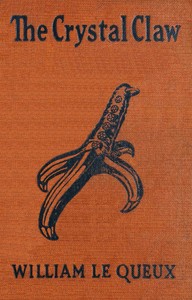
The crystal claw — Reading Notes

(0 User reviews)   107
In Category - Mystery Collections
Le Queux, William, 1864-1927, Gage, George W., 1887-1957 [Illustrator] Project Gutenberg 2024 Not confirmed
Detective and mystery stories; Mystery fiction Readers of public-domain and historical texts
Project Gutenberg digital edition en

Edition facts

Words 68,794
Reading time 300 min
Text sections 26

For The crystal claw — Reading Notes, the stored edition analysis reports 68,794 words, 5 hr estimated reading time, and 26 detected text sections.

The text analysis averages about 14.4 words per sentence, while the detected sections provide another way to judge how the source is divided.

Project Gutenberg metadata also associates the work with “Detective and mystery stories,” connecting these edition facts with the source record’s subject description.

In William Le Queux's 1924 mystery, narrator Yelverton investigates the disappearance of a newlywed husband amid Alpine snows and London drawing-rooms, while the enigmatic Dr. Feng and a web of acquaintances complicate the search.
Share
Editorial Edition Score 4.8/5

Calculated from edition completeness, EPUB availability, text structure and catalogue metadata. Not a user rating.

How this score is calculated
  • Description quality20 pts
  • Title & short description10 pts
  • Source metadata20 pts
  • Text length15 pts
  • Chapters / structure15 pts
  • EPUB file integrity20 pts

Total of 100 points, scaled to a 2.5-5.0 range. Editions with an empty description or a missing EPUB file are not scored.

Edition quality

Read the Text

self, living evidence of a man virile and rejuvenated in both body and mind. People stood astounded when they were told his actual age, and I, admiring him, was now endeavoring in my own way to follow his footsteps. The doctrine he urged with such compelling eloquence and powers had taken a deep hold of my mind--how deep I never realized until I found myself flung suddenly into dangers and temptations which were to try my physical and mental fortitude to their very depths.

It was the arrival of Stanley Audley and his bride that, suddenly and unexpectedly, changed the entire current of my life. And as I sit here placing on record this chronicle of bewildering events, I wonder that I came safely through the maze of doubt, mystery and peril in which I found myself so suddenly plunged. I can only believe that a man, profoundly influenced, as I very speedily was, by the splendid philosophy of Yogi and buoyed up by a consuming love for a pure and beautiful woman, will face dangers before which others might well quail,--will even, as the saying goes, “throw dice with the devil” if need be.

To make my story clear, I had better formally introduce myself. My name is Rex Yelverton, my age at present moment twenty-eight and the astounding incidents I am about to relate happened just over three years ago, so that I was under twenty-five at the time.

My father had died when I was twenty-three and had left me a small estate near Andover. I had been brought up to the law and had been admitted a solicitor just before my father’s death. I could not afford to live on the estate, so had cosy chambers on the top floor of an old-fashioned house in Russell Square and having entered into partnership with a solicitor named Hensman, practiced with him in Bedford Row.

Hensman’s hobby was golf and for that reason he took his holiday in the summer. I loved the winter life of Switzerland and for some years had made it my rule to get away in the winter. In addition to my music I was deeply interested in wireless, and had fitted up quite a respectable wireless station in a room in Russell Square. I had a transmitting license and with my two hobbies found my spare time so fully occupied that I mixed but little in ordinary society.

On that never-to-be-forgotten night when I first saw Stanley Audley and his handsome bride, the Doctor retired early, as was his habit. So, strolling into the ball-room of the Kürhaus opposite the hotel, I watched the pair dancing happily together, the cynosure of all eyes, of course, though the room was not very full, as the season had only just begun.

Like all other honeymoon couples, they were trying to pretend that they had been married for years and, like all other honeymoon couples, they were failing lamentably! The truth was, as ever, palpable to every onlooker. Like every one else I admired them, though like every one else, I smiled at their pretty pretense. As they had arrived by the night train from Calais, I guessed they had been married in London about thirty hours before and had come straight through to Mürren. This, in fact, proved to be the truth.

In my admiration of the beautiful young bride I was not alone, for a middle-aged, grey-bearded invalid, name Hartley Humphreys, with whom I often played billiards before going to bed, also remarked upon her beauty, and expressed wonder as to who they were. It was then that another man in the room, also evidently interested, told us that their name was Audley.

Next morning, on coming downstairs, I found little Mrs. Audley dressed in winter-sports clothes and looking inexpressibly sweet and charming.

She wore a pale grey Fair Isle jersey, with a bright jazzy pattern, with a saucy little cap to match, and over the jersey a short dark brown coat with fur collar and cuffs, and around her waist a leather belt. Brown corduroy breeches, and heavy well-oiled boots and ski-anklets completed one of the most sensible ski-outfits I have ever seen. That she was no novice at skiing was evident from the badge, a pair of crossed skis, she wore in her cap. It was the badge of the Swiss Ski Club--the same as that worn by the Alpine guides themselves.

Naturally I was surprised. I had, on the previous night, believed her to be simply a handsome young bride who had come to spend her honeymoon amid the winter gayety of Mürren, but now it was clear she was no beginner.

She had already breakfasted and was smoking a cigarette and laughing gayly with an American girl she had met on the previous night, and apparently awaiting her husband.

In a few moments the husband, in a wind-proof ski-suit and wearing one of those peaked caps of blue serge which nobody dare wear save the practiced ski-runner, came down with a word of apology.

“I broke my boot-lace, dearest. I apologize.”

“Oh! That’s all right, Stan,” she laughed, “John has got the food in his rucksack.”

Then I saw that John von Allmen, the intrepid and popular young guide, was waiting outside for them. They were going on a skiing excursion up the Schelthorn. Certainly they were no novices! I soon afterwards discovered they had both passed their “tests” in previous winters at Wengen and Pontresina.

The sun was shining brightly upon the newly fallen snow, although it was not yet nine o’clock, and as I watched the happy young couple adjust the ski-bindings to the boots and take their ski-sticks, those iron spiked poles of cherry wood with circular ends of cane to prevent sinking where the snow is soft, I noted how merry and blissful they were.

Suddenly the tall, lithe, young Alpine guide in his neat blue serge skiing suit drew on his leather mitts, hitched on his rucksack and the little party slid swiftly away over the snow.

It was clear the girl was an expert--her every movement showed it. Those who go skiing well know the difficulty of keeping their balance on the long, narrow planks turned up in front which constitute ski. But the bride had long ago passed through the initial stages. As I found out later she had been year after year to winter sports and had long passed the period when she practiced her “telemarks” and “stemmings” on the “Nursery Slopes.” Her lithe swift movements were delightful to watch and it was clear she was enjoying to the full the keen exhilaration born of the swift gliding over the crisp snow.

As I stood watching the swift progress of the Audleys and their guide, old Dr. Feng spoke behind me.

“A pretty sight, Yelverton. It is good, indeed, to be young. There’s an example of the fate lying before you: you’ll have to marry some day, you know.”

“No sign of it yet, doctor,” I laughingly replied.

As a matter of fact, matrimony had so far made no appeal to me: I had never met a girl who had stirred me deeply. I had many friends--or at least acquaintances--of my own sex, but I was deeply absorbed in my hobbies and, not seeking society for society’s sake, I had hardly any woman friends. Sometimes I fancied that the opposite sex found in me something antipathetic and uncongenial: at any rate, I made little progress with them and, perhaps for that reason, was quite content to remain a bachelor and keep my father’s old housekeeper, Mrs. Chapman, to “mother” me as she did when I was a boy and manage my flat in Russell Square.

I suppose I was no better and no worse than thousands of other fellows of my age. Men coming down from Oxford and flung into the whirl of London life are not usually Puritans or ascetics. I suppose I was much like them. Life was young in me, and fortune had been kind. If I had few friends, I had no enemies: I had an income ample for my wants and I enjoyed myself in my own way. My work kept me busy during the day: my evenings were filled with music, my “wireless,” an occasional dance, or theatre and I was always merry and happy. Nothing had occurred to make me, a careless youngster, realize that there was something in life deeper and dearer than anything I know. I was not given to self-analysis or overmuch introspection and that a storm of love might some day shatter my complacent existence to bits never crossed my mind. My music and my experiments in radio-telephony were about the only serious side of my life. So Dr. Feng’s good humored badinage left me quite unmoved.

We strolled together to the curling rink for a match.

Old Mr. Humphreys, a grey-faced financier from the near East, and a very charming and refined old fellow, sat in his invalid chair watching us. The ice was in perfect condition and very fast, so that the game was as good as could be obtained, even in Scotland itself. The orchestra was playing gay music for the skaters, some of whom were waltzing, laughter sounded everywhere and the bright sunny morning was most enjoyable.

We lost the match, mostly, I fear, through several very bad stones that I played, and our lack of energy in sweeping. Curling is a very difficult game to play well, for, unlike golf or tennis, one can get such little practice at home.

However, we all afterward retired to the bar, and over our cocktails old Mr. Humphreys who, being a confirmed invalid, wheeled himself about in his chair, chatted merrily. He had arrived about a week after I had come. He seldom, if ever, left his chair during the day. His guidance and management of the chair was wonderful and he could even play billiards while seated. He and the doctor were great friends and often joined a bridge party together, while I took my skis up the cable railway to the Allmendhubel and swept back down the slopes.

The following afternoon, while passing along the terrace of the big chalet which overlooks the rink, I found Major Harold Burton, here the secretary of the Mürren Bob-sleigh Club, and at home an officer in the Tank Corps, chatting with the Audleys.

“I say, Yelverton!” he exclaimed, “will you join us on a test on the bob-run presently? Mr. and Mrs. Audley are coming. Let me introduce you.”

I raised my ski-cap and bowed.

“Thanks,” I replied, “I’ll be delighted to make a fourth. You’re the only man I’d trust to take me down. It’s too fast for me!” I added with a laugh.

“Is it really a fast run?” asked the bride, smiling.

“Well, you will see for yourself,” I replied.

Laughing gayly we went over the snow, past the bend at the village shop where one can obtain anything from a Swiss cuckoo clock, to a paper of pins, and whose elderly proprietor is one of the best ski instructors in the canton. Paying our fare, we ascended by the rack-railway up the snowy heights of the Allmendhubel.

On the truck was our heavy “bob,” with its steel frame and runners, and its delicate controls. At the summit the attendants pushed it along the flat to the narrow entrance of the bob-run which a hundred hands had, a few weeks before, constructed in the snow, digging it all out and making many banked-up hair-pin bends down the side of the mountain for two and a half miles back into Mürren.

Those curves are scientifically calculated for speed, but it takes an expert to negotiate them successfully. The crew of a “big bob” must know the course, and be alert to the command of the driver to bend over “right,” “left,” or “up.” One’s first trip in a “bob” on a fast run is an experience never to be forgotten. But both the bride and bridegroom revealed that they had done such things before.

At the “gate” of the run--a narrow cut eight feet deep in the snow--a smiling Swiss stood beside the telephone, which gave “clear passage.” Burton, as an expert, who took no chances, had the “bob” turned over, and examined the brakes and controls, which sometimes get clogged with snow.

We all got in and set our feet forward on the rests, I being behind to act as brakesman, and to “brake” at the instant order of Burton.

“Everybody all right?” he asked, as we settled ourselves behind each other on the big bob.

We responded that we were, then four men pushed us off down the narrow icy slope.

Slowly we went at first. Then, suddenly gathering speed, we saw a dead end in front of us.

“Right!” cried Burton, and all of us leaned over to the right and thus negotiated the corner.

“Left!” was the order, and round we went every moment gathering speed.

“Careful!” he cried, “in a minute we shall have a right and left quickly. Now--! Right! Left! Up! Quick!”

By this time we were flying down the side of the mountain, showers of particles of ice every now and then being thrown up and cutting our faces. Now and again we swept through clouds of snow. We held our breath and screwed up our eyes until we could only just see.

“Left! Right! Up! Left--again! Right!” shouted Burton, and each of us alert and quick, obeyed. We were traveling at a furious speed and any fault might mean a serious accident, such as that in which one of the British Bob-sleigh team for the Olympic Sports broke both his legs during a run at Chamonix.

“Straight!” we heard Burton shout as we flew along, still down and down. “Right in a few moments,” he cried. “Be careful. Then a big bump and we’re down. Steady!--steady! Now-w-w! Right!--Look out! Bump! Good!” and he steered us down a straight path past where the watcher stood at the other end of the telephone.

“Well?” he shouted to the time-keeper, as he pulled up, “what is it?”

“Four minutes, eight and a half seconds, sir,” replied the tall, thin-faced Swiss peasant, speaking in French.

“Good! Fairly fast! But we’ll try to do it in better time tomorrow.”

I had sat behind little Mrs. Audley who, turning to me, her face reddened by the rush of frosty air, exclaimed,--

“Wasn’t it glorious! I’ve been to Switzerland three times before. I passed my third test in skiing two years ago, but have never been on a big bob-run. That last double turn was most exciting, wasn’t it?”

I agreed, and we all four strolled together back to the hotel to tea.

Afterward, as I walked in the twilight upon the snowy path leading to the station of the funicular railway, I found myself surrounded by groups of young men and girls returning from skiing on the Grütsch Alp, and other places. But even these cheerful greetings and joyous conversations could not remove from my mind a new and entirely strange feeling of fascination that I felt was exercised over me by pretty Mrs. Audley. It was something magnetic, something indescribable, and, to me, wholly weird and uncanny. I had only spoken to her a few casual words. Yet I knew instinctively that into my careless and care-free life a new and disturbing element had entered.

Though I was not, as a rule, fond of society, it was impossible to resist the infection of the merry-making spirit at Mürren and in consequence I joined heartily in all the fun that was going forward. The night of the bob-sleigh trip found me playing the drum in the amateur jazz band--a dance-orchestra formed among the visitors each year, to carry on the dancing after midnight. Mrs. Audley and her husband came into the dance-hall of the Kürhaus just as the merriment began, and they danced together while I sat behind the drum with a little comic, flat-brimmed hat in imitation of George Robey, upon my head.

“Really your amateur band is more amusing than the professional one,” declared Audley, during the interval. “Last night we watched you. It seems that the visitors wait until you start up.”

“Well,” I laughed. “We try and keep things humming along until two, or even three o’clock. We like to play and the others like to dance.”

“My wife loves it,” he declared. “She’s only just been saying that she would like to join you.”

“Right!” I said, laughing. “She shall be our pianist tomorrow--if she will.”

But the bride hesitated. “I’m afraid, Mr. Yelverton,” she said, “that I’m not so good as the American girl you’ve got. She’s a professional, surely.”

As a matter of fact she was studying the piano in Paris, and was in Mürren for the winter holiday.

And then we struck up again and the crowd danced merrily till nearly three o’clock.

The following day was a Saturday. I spent a large part of the morning gossiping with old Mr. Humphreys, whose chief pleasures as an invalid seemed to be to play bridge and to smoke his pipe. Though his was rather a thoughtful disposition, as his deep-sunken eyes and shaggy brows suggested, yet he was always a cheerful and entertaining companion.

“I sometimes stay with my sister at Weybridge, in Surrey,” he explained, as I walked beside him while he wheeled his chair over the snowy road which leads out of the village along the edge of the deep precipice overlooking Lauterbrunnen in the misty valley far below. While we were in the bright keen air high-up above the clouds, with the sun shining brilliantly over a white picturesque world, below, in the valley, it was dark dull winter. “Very soon,” added my friend, “very soon I’ll have to go back to Constantinople, where I have a good many interests. But I shall only be there a few weeks. All this political trouble makes things very difficult financially. Have you ever been in Turkey?”

I replied in the negative, but added that it had long been my desire to go there, and see the beauties of the Bosphorus.

“Yes,” he said, “You ought to go. You’d find lots to interest you. Life in the Turkish capital and Turkish life is quite different from life in Europe. The Turk is always a polished gentleman and, moreover, the foreigner is now better protected in every way than the Turk himself, thanks to the laws made years ago.”

“That, I suppose, is why Constantinople before the war was such a hot-bed of European sharks, swindlers and bogus concession-hunters,” I remarked, with a smile, for I had heard much of the “four-flush” crowd from a friend who had interests in the Ottoman Empire.

“Exactly,” he laughed. “It is true that in Pera we have a collection of the very worst crooks in all Europe. But it is hoped that, under the new conditions, Turkey will expel them and begin a new and cleaner regime.”

As he spoke we turned a sharp corner, and Stanley Audley and his pretty wife, smart in another sports suit of emerald green that I had not before seen her wearing, shouted simultaneously the warning, “_Achtung!_”

Next second, recognizing us, they greeted us cheerily as they slid swiftly past upon their skis.

“A very charming pair--eh?” remarked old Humphreys. “The more I see of them the more interesting they become. What do you think of the girl? You are young, and should be a critic of feminine beauty,” he added, with a smile.

“I agree. She is very charming,” I said, “Audley is, however, rather too serious, don’t you think?”

“Yes, I do. She’s too go-ahead for him--she’s a modern product as they call it. If a man marries he ought to have a comrade, not a cushion. A woman, to be a perfect wife, should not be too intellectual. A knowledge of literature, art and science does not necessarily make for domestic happiness. In a wife you want heart more than brains. Yet a giddy, brainless wife is even a worse abomination.”

“Do you mean Mrs. Audley,” I asked.

The novel opens high in the snow-clad Alps at Mürren, where the narrator Yelverton dines with the elderly Chinese Dr. Feng. Their attention is drawn to a honeymooning couple—a dark-haired girl in a flame-colored dance-frock and her handsome husband. Dr. Feng's remark, “Don’t inquire. When you marry, Yelverton, you won’t like people to be inquisitive,” immediately establishes a tension between curiosity and discretion that will drive the plot. The setting of silent snows and the funicular railway from Lauterbrunnen creates an isolated, almost theatrical backdrop for the mystery to come.

A Web of Acquaintances

The excerpts reveal a pattern of surprising connections among characters. Yelverton believes Dr. Feng and old Mr. Humphreys are mere hotel acquaintances, but later discovers they are “great friends.” Humphreys mentions a man named Ruthen, whom Yelverton knows as someone who “constantly pestered Thelma with his questions”—and Ruthen is also acquainted with Humphreys and Dr. Feng. Yelverton reflects, “Here was another surprise. I learned that three men whom I had believed to be practically strangers to each other were on terms of intimate friendship.” This layering of hidden relationships suggests a network of alliances and deceptions that Yelverton must navigate.

The Missing Husband and Warning Letters

The central mystery is the disappearance of the bridegroom, Audley, who has “not yet returned to her.” Yelverton is still “seeking for traces of the missing man.” The situation is complicated by two anonymous letters threatening Yelverton with death if he continues his search or his acquaintance with Mrs. Audley. Dr. Feng reports this to Humphreys, who dismisses it as a joke, but Yelverton says, “I think they are meant in earnest.” The letters introduce an element of danger and suggest that someone wants the truth buried. The bride, now back with her mother at Bexhill, is described as “poor broken-hearted,” and Yelverton admits he sees her “very rarely.”

Contrasts of Setting and Character

The narrative moves between the Alpine resort and London settings—from the Kürhaus hotel to Humphreys’s rooms and the Savoy restaurant. Dr. Feng is a striking figure: a Chinese man with a long white beard, abstemious (drinking only white curaçao), yet physically vigorous and active on ski expeditions. His age is ambiguous: “despite his seventy years, did not look a day more than sixty.” The bride’s description is also layered: “very handsome, with irregular features, and singularly expressive eyes, but hers was a nervous, restless physiognomy that rather chilled one at first sight.” These details hint at hidden depths and possible deceptions beneath pleasant surfaces.

Readers should attend to the small details of social interaction—who knows whom, who appears unexpectedly, and what is left unsaid. The excerpts offer glimpses of a puzzle where characters’ loyalties are uncertain, and the narrator’s own position may be more entangled than he admits. The title The Crystal Claw suggests a sharp, hidden grip; the text so far invites speculation about what that claw might be.

There’s something about Yelverton’s wandering through those snowy Alps and stuffy London rooms, searching for a man who vanished so quietly, that made me think of other vanished selves—the way character and place blur in old fiction. I found myself lingering over Lucretia — Volume 02 — Story, Setting & Ideas, feeling the same hush of unresolved motives. Some mysteries don’t need solving, just remembering.

There are no reviews for this eBook.

0
0 out of 5 (0 User reviews )

Add a Review

Your Rating *
  • ...
    Grace Christina Nunez - 4 weeks ago
    The Crystal Claw is a decent read with an engaging premise. The mystery is well-crafted, and the writing style is clear. However, the pacing felt uneven in the middle, and some characters lacked depth. Still, it's an enjoyable mystery for casual readers.

  • ...
    Donald Perez - 3 weeks ago
    The Crystal Claw has an interesting concept but fails to deliver a compelling narrative. The plot is predictable, and the characters are one-dimensional. The writing is overly descriptive in some parts and rushed in others, leaving the story feeling disjointed. I was disappointed, especially given the hype.

  • ...
    Jennifer White - 2 weeks ago
    The Crystal Claw is a riveting mystery that had me hooked from the first page. The intricate plot twists and the author's vivid descriptions create an immersive atmosphere. The protagonist's journey is both thrilling and emotionally resonant. I couldn't put it down and finished it in one sitting. A must-read for fans of detective fiction!


Reader reflection

Before you leave, reflect on the book

Use these questions to collect your thoughts before moving on.

Your progress 0 / 10
1

Have you finished this book?

2

Did this book hold your interest?

3

How likely are you to recommend this book?

4

How much effort did this book require?

Related eBooks