
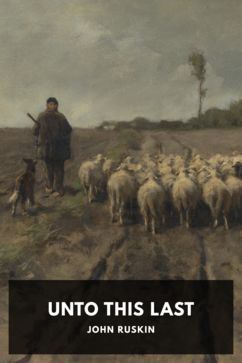
Unto This Last - John Ruskin
Forget dry economic theory. John Ruskin's Unto This Last is a series of four essays that read more like a moral intervention than a textbook. Published in 1860, it was Ruskin's direct challenge to the prevailing ideas of political economy, which treated labor as a mere commodity and profit as the only true goal.
The Story
There's no plot in the traditional sense. Instead, Ruskin builds a powerful case. He starts by dismantling the idea of 'economic man'—the notion that people are only motivated by selfish gain. He argues this is a fantasy that creates a cruel and unstable society. From there, he redefines wealth itself. For Ruskin, true wealth isn't money; it's the possession of things that support and enrich human life. A happy, skilled worker is a form of wealth. A beautiful, well-maintained environment is wealth. He then applies this to justice, famously arguing that a fair wage isn't the lowest the market will bear, but a wage that allows a worker to live a decent, dignified life—'unto this last,' meaning even the lowest laborer deserves this fairness. His final essay calls for a shift in national priority, from chasing profit to fostering the well-being of all citizens.
Why You Should Read It
I picked this up on a whim and was stunned by how current it feels. When Ruskin rages against an economy that sacrifices people for abstract numbers, it echoes today's debates about gig work, living wages, and corporate responsibility. His prose is fierce and poetic. He doesn't just want to change your mind; he wants to change your heart about what we value. It's not a perfect, practical blueprint, but it's a vital compass. It reminds us that economics was once a branch of moral philosophy, concerned with human happiness, not just graphs and growth charts. Reading it is a refreshing, radical experience.
Final Verdict
Perfect for anyone feeling disillusioned with 'business as usual,' fans of thinkers like Dickens or William Morris, and readers who enjoy philosophy that connects directly to real life. If you like books that challenge your assumptions and leave you with more questions than answers, this is for you. It's a short, dense, and profoundly humanist punch to the gut—in the best way possible.
This title is part of the public domain archive. Preserving history for future generations.
Linda Harris
4 months agoThis work demonstrates a clear mastery of contemporary theories.
Kimberly White
1 year agoNot bad at all.
Edward White
1 year agoA must-have for anyone studying this subject.
Emma Wilson
7 months agoWithout a doubt, the content flows smoothly from one chapter to the next. Definitely a 5-star read.
Kimberly Harris
2 years agoThe author provides a very nuanced critique of current methodologies.