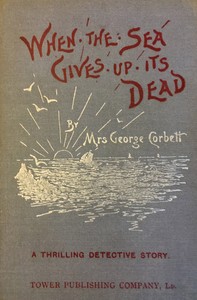
When the Sea Gives Up Its Dead: A Thrilling Detective Story — Text and Context

(3 User reviews)   796
In Category - Mystery Collections
Corbett, George, Mrs., 1846-1930 Project Gutenberg 2020 Not confirmed
Detective and mystery stories; Jewelry theft -- Fiction; Women detectives -- Fiction Readers of public-domain and historical texts
Project Gutenberg digital edition en

Edition facts

Words 65,925
Reading time 287 min
Text sections 27

Before opening When the Sea Gives Up Its Dead: A Thrilling Detective Story — Text and Context, the edition data offers a quick orientation: 65,925 words, 4 hr 47 min estimated reading time, and 27 detected text sections.

The text analysis averages about 18.0 words per sentence, while the detected sections provide another way to judge how the source is divided.

Project Gutenberg metadata also associates the work with “Detective and mystery stories,” connecting these edition facts with the source record’s subject description.

An editorial note on Mrs. George Corbett's 1894 detective novel, focusing on its brisk opening, shifts between dialogue and narrative, and the evolving role of Annie Cory as a female detective in disguise.
Share
Editorial Edition Score 4.8/5

Calculated from edition completeness, EPUB availability, text structure and catalogue metadata. Not a user rating.

How this score is calculated
  • Description quality20 pts
  • Title & short description10 pts
  • Source metadata20 pts
  • Text length15 pts
  • Chapters / structure15 pts
  • EPUB file integrity20 pts

Total of 100 points, scaled to a 2.5-5.0 range. Editions with an empty description or a missing EPUB file are not scored.

Edition quality

Read the Text

and Co., diamond merchants. After hearing all the evidence obtainable, the legal luminary thought it his duty to commit the prisoner to the Assizes, and during that time Harley was condemned to undergo the miseries of confinement and mental torture, without being able to do anything to help himself out of the abyss of disgrace into which he had been plunged.

But though he was powerless himself, others were working bravely for him. At first they also worked hopefully, until it became evident that whoever had concocted the plot of which he was the victim, had neglected no precaution against the failure of their plans. Mr. David Stavanger, the senior partner of the firm, deposed that, influenced by the invariable steadiness, industry, and ability of the prisoner, he had been induced to place more trust in him than he had ever placed in any of the subordinates of the firm. He had been eight years in the employment of Messrs. Stavanger, Stavanger, and Co., and had never given the firm any cause to complain of his conduct until now. “In fact,” continued Mr. David, “he has so wormed himself into our confidence that it has been a very easy matter for him to steal those jewels, and there is no knowing----”

Considerably to Mr. David’s chagrin, however, he was not permitted to continue his remarks, and his evident determination to take accused’s guilt for granted was sharply reprimanded. Fellow employees gave similar evidence to that of Mr. David, but were all so evidently convinced of Harley’s innocence, that counsel for the prosecution no longer felt quite sure of winning the case, until Mr. Gay produced the most damning evidence that could be forthcoming against a man accused of theft. He had, duly armed with a warrant, searched the belongings of Harley Riddell at his own home, and, inside the lining of the light topcoat that he had worn the day before the occurrence of the robbery, the detective had found three of the missing jewels set as rings, which were identified by Mr. Hugh Stavanger, who had seen them in their cases on the 17th of May.

Asked how, if Harley Riddell was the manager, and consequently of considerable importance in the business, it came to pass that the full extent of the robbery was discovered before the arrival of the latter on the scene, Mr. Hugh Stavanger stated that it was usual for Riddell to see to the safety of everything at the shop and to deliver the keys to the senior partner. At nine in the morning these were fetched by the leading shopman, whose duty it was to see that all was in readiness to receive customers at ten o’clock. As Mr. David Stavanger wished to present his eldest daughter with a birthday gift, Mr. Hugh had volunteered to fetch several articles of jewellery for her to choose from, and had, therefore, contrary to his usual custom, gone to the shop at nine o’clock. He had himself unlocked the safes, and on comparing the contents with the inventory which was with them, had at once seen that a great number of valuable stones were missing, and had telegraphed to the members of the firm to come at once. The detective, who was immediately sent for, could find no evidence that any part of the premises had been feloniously entered, or that the safes had been tampered with.

There was much other evidence, some of it of not too relevant a nature, but all of it conducive to the annihilation of any hope of acquittal for the prisoner. His defence was considered feeble, his guilt indisputable, and he was sentenced to five years’ penal servitude.

Five years’ penal servitude! Is any pen powerful enough to picture all that it means to a man like Harley Riddell? One day on the summit of bliss, and the next in the abyss of degradation and despair! One day revelling in love and happiness; the next loaded with misery, desperation, and isolation from all his beloved ones! It is terrible for those who are guilty of crime. But for those who are innocent--God help them!

There was a farewell scene between Harley and his mother, who was passionately indignant at the monstrous injustice of which one of her twin sons was the victim. The poor soul, mindful in her misery of Harley’s solicitude on her behalf, bravely hid her agonising grief under a show of mingled anger and hopefulness, while for the first time in all her long years of widowhood she felt resigned to the fact that the father of her boys no longer lived to witness the disgrace that had fallen upon his name. What though the disgrace was unmerited! It was none the less bitter, and Harley, who knew his mother’s indomitable nature, felt cheered and hopeful in his turn when he heard her vow to use every means, whether they were evidently possible or apparently impossible, to vindicate his character, and bring the guilt of the robbery home to the real perpetrators. Hilton Riddell, his twin brother, cheered him much, too, by his faith in the chances of a speedy unravelment of the plot of which he was evidently the victim.

There was also another with whom a parting interview was permitted, although Harley would almost have preferred to be spared the anguish of mind which it cost him. For the presence of winsome Annie Cory, who was to have been his bride ere long, only brought the more vividly to his mind the picture of all that cruel fate had bereft him of.

She, like the true girl she was, vowed to wait for his release, and to wed none but him. He, being sensitive and refined, vowed just as positively that nothing but the most incontrovertible proofs of his innocence would ever permit him to take advantage of her love.

Mr. Cory was very magnanimous, and he had cordially approved of the engagement of his only child to a man whose combined resources only amounted to £400 a year. For was not he himself wealthy enough to provide very handsomely for his daughter, and were not the various qualities of Harley Riddell far beyond riches alone?

Still, although he liked the young fellow, and would, under happier conditions, have gladly welcomed him as a son-in-law, he fully endorsed Harley’s protestations to the effect that only as a man who could stand before the world unshamed would he ever permit a woman to share his life. For he would not like his daughter to marry an ex-convict, whom folks would look askance at, even though the ex-convict’s friends were all convinced of his innocence and of the injustice of his punishment.

But he deemed it wise to offer no violent opposition to Annie’s determination to be true to the man she loved. He trusted to time to weaken her love, and show her the folly of allying herself to poverty and disgrace. Meanwhile, as he really liked Harley, and fully believed in his innocence, he meant to do all in his power to promote a certain plan which Hilton had confided to him, whereby it was hoped to divert the weight of punishment on to the shoulders that deserved it.

The interview had proved trying to Annie as well as to Harley, and Mr. Cory was very thankful when he arrived at his own house with his daughter, who certainly looked as if she had borne as much as she could.

“Margaret,” he said to his sister, who had been his housekeeper ever since his wife died, eight years before the opening of our story, “I believe the child is dead beat, and I don’t feel too clever myself. Have you anything in the way of a pick-me-up ready?”

“You shall have some hot milk, with a touch of brandy in it, in a few minutes. That will do you both good, and serve to put you off until dinner is ready, which will be another half hour yet. How did the child bear it?”

“Very bravely. Vowed eternal fidelity, and all that sort of thing. But Riddell is too much of a man to take her at her word, and swears to be nobody’s husband until he is proved innocent. And quite right, too. In fact, I hope Annie will get over her infatuation in any case, for I have no fancy for being pointed at as the father-in-law of a man who has been in gaol. You see, although we never for a moment believe that the poor lad had anything to do with the robbery, and are sure that he is the victim of a vile plot, it will be difficult to get the world to think as we do, and, to tell the truth, it’s a deucedly nasty business all round.”

While Mr. Cory had been speaking, Annie had gone up to her own room, and Miss Cory had rung her bell in order to give some directions to a servant before she followed her niece upstairs.

“Williamson,” she said, “bring two glasses of hot milk here as quickly as possible.”

She delivered herself of this order very quietly. But no sooner was the servant’s back turned than she emptied the vials of her wrath on to her brother’s devoted head.

“John Cory,” she said, drawing her really majestic figure up to its full height, and speaking with a solemn deliberation which she only affected on serious occasions. “I’m ashamed of you! I never expected to see the day when my father’s son would deliberately contemplate the desertion and permanent abandonment of a man whose sole sin is his betrayal by some villain who has cunningly contrived to divert suspicion from himself to an innocent man. John Cory, if I could believe that you would do this vile thing, I would leave your roof for ever.”

“But, my dear girl----”

“Don’t ‘my dear girl’ me! You never do it except when you want to talk me over, and at fifty-six I’m too old to swallow gross flattery. Just tell me this--Do you mean to turn your back on young Riddell now that he is powerless to help himself, or do you mean to act like a man?”

“Of course, I mean to do all I can for him.”

“I knew you did. All the same, the bare thought that you could dream of revoking what you promised just before the poor lad’s calamity overtook him, made me feel as if I could shake you. Oh, here’s your milk. Just put your brandy in yourself and drink it, while I go upstairs to Annie. Williamson, see that we have dinner punctually.”

Williamson, having acknowledged her mistress’s order with due deference, hurried away to expedite matters in the lower regions, and Miss Margaret Cory lost no more time in visiting her niece, whom she found sobbing as though her heart was breaking. At this sight, even Miss Margaret, stolid though she usually was, found herself considerably upset. She made a faint attempt to dissuade Annie from crying, but was convinced that her efforts were woefully inadequate, and eventually administered the truest consolation by breaking down herself and mingling her tears with those of the girl whom she loved more than any other being on earth.

“There, auntie, I won’t be so foolish again,” said Annie at last. “But I could not help myself when I thought of all the horrors poor Harley is doomed to endure.”

“And no wonder, my dear. But, please God, we’ll put an end to his misery by freeing him before long.”

“But how can that be? Have you forgotten that he is sentenced to five years’ imprisonment?”

“No, I have not forgotten. Neither have I forgotten a speech that his brother Hilton uttered last night. He said:--‘Heaven helping me, I will leave no stone unturned to run the author of all this misery to earth. He may be very cunning, but I defy him to elude my watchfulness, when once I have set eyes upon him. The mystery is not so great as it perhaps seems to some. The onus of criminality rests between very few people, and I have good reasons for believing that my suspicions are centring themselves round the right man. It is but a question of time, for, if there is a God in Heaven, the guilty coward who really stole those diamonds shall be brought to justice!’ Annie, when I heard the fervour with which those words were uttered, and marked the deliberate determination of Hilton Riddell’s mien, I shared his confidence in the future, and resolved to afford him every facility for achieving his purpose. He will need money, for without money very little can be done. For your sake, my darling, I will give all I can to prove your lover’s innocence.”

“How good you are, auntie!” cried the girl, kissing her relative affectionately. “You always make me feel better. This time, besides comforting me, you have made me a little bit ashamed of myself. Henceforth I will work, instead of giving way to useless repining. If there is any part I can take in the unravelment of this mystery, I will show myself a ready and capable helper.”

“That’s right, dear girl. The police started with the conviction that Harley Riddell was guilty, and hunted up no end of facts to prove themselves in the right. We will start with equally positive convictions in the other direction, and it will be odds if our labour of love does not bear the fruit we desire.”

“Oh, auntie! I am all anxiety to begin! Do let me run down and tell the dad all about it.”

“Not so fast, my dear. If Mrs. Riddell, who has been terribly prostrated by this blow, is able to bear being left an hour or two this evening, her son will call here, by appointment with me, to consult as to what will be the best plans for us to adopt.”

“You dear old thing! You have been actually working already!”

“Certainly. The sooner we begin operating, the better chance we have of being successful, and the sooner we may hope to see Harley justified and at liberty. In fact, you need not be surprised if Hilton Riddell has already made considerable progress. And now, dear, you must make yourself a little presentable, and I expect you to partake of a substantial meal, even as I mean to do, for we must make ourselves strong if we mean to do anything useful.”

The result of Miss Margaret’s tact and management was that Annie was not nearly so downcast that evening as her father had feared she would be, and when Hilton Riddell made his appearance at eight o’clock, he found every member of the Cory family ready and willing to second all his endeavours on Harley’s behalf.

“And how did you leave your mother?” asked Miss Margaret.

“Stronger and better than I could have believed possible,” was the reply. “She is brave and hopeful, and firmly believes that I shall succeed in tracing the real delinquent. One thing troubles me a good deal about my mother. It may be necessary for me to travel, or some other contingency may arise which will render it impossible to be with her much, and I fear that, if left to herself, she may succumb to her troubles.”

“She shall not be left to herself,” cried Miss Margaret, emphasising her remarks by a vigorous shake of the handsome lace lappets which adorned her cap. “She must come and live here while you are away. That is just what you would have proposed yourself, isn’t it, John?”

“Certainly, just the very thing,” echoed John, warmly. “Sorry you got the suggestion out before I did, though. And now, Mr. Riddell, about your means and employment. Don’t think me impertinent or intrusive, but----”

“Pray don’t apologise,” said Hilton, hastily. “I will, as you so kindly take such an interest in us, explain exactly how we stand. My mother, who is an officer’s widow, has a life pension, which the vicissitudes in the career of Harley or myself cannot touch. My employers, Messrs. Treadonem and Co., have magnanimously given me my liberty, and have not been afraid to mention their true reason for discarding the services of the brother of a convict. My time, therefore, is my own, to use as I please. Needless to say, it will be used in my brother’s service. Fortunately, I have a couple of hundred pounds saved, and Harley, during the last six years, has saved a few hundreds also. He has some inkling of my intended course of procedure, and has arranged for me to draw his money, if I require it. But I hope to run my quarry to earth without encroaching upon Harley’s savings, for it will go hard with him at first, especially if he has no money to fall back upon.”

“His money shall not be touched,” put in Mr. Cory in a very decided tone. “I have a nice sum available for unexpected contingencies like the present.”

“And so have I,” answered Miss Margaret.

“You are very kind; I hardly know how to thank you,” said Hilton, very much moved.

“And how can I help?” inquired Annie, piteously. “I have no money of my own, but I am anxious to do some real work, and I am sure you would find me clever and capable.”

“I should only be too glad of your help,” said Hilton, with animation in his mien and entreaty in his voice, “but the only way in which you can help seems too preposterous to suggest to you.”

“Out with it, man,” cried Mr. Cory; “if it is something that cannot be undertaken, no harm will be done.”

“Then here you are, sir. It is necessary that I should gain a little insight into the doings of the family of Mr. David Stavanger, for I am convinced that either he or his son knows where the still missing diamonds could be found. There is an advertisement in to-day’s paper for a holiday governess to the youngest Miss Stavanger, a girl of twelve. To-morrow morning I intended going to the office of Messrs. Bell and White, private inquiry agents, to ask them to send their principal lady detective, Miss Dora Bell, to try for the appointment, as a governess has many means of gaining information concerning what is going on in a household. Now, if you----”

“Not another word, I will turn detective, and beard these lions in their own den,” was Annie’s exclamation.

“But how about references? Besides, they would know your name, perhaps,” objected Mr. Cory.

“You dear innocent,” remarked Miss Margaret, with the calmness born of superior wisdom; “when one takes up detective work, one has not to be too squeamish about ways and means, and you may trust us to devise some scheme to circumvent these villains. If Annie can’t get the post, I’ll try to make myself look more youthful, and make a bid for the appointment.”

Somehow, any lurking objections which Mr. Cory might have had were all overcome, and when Hilton went home that night, many arrangements for the future had been made. Subject to Mrs. Riddell’s own consent, it had been decided that it would be best for her to live with Miss Margaret for a while. Mr. Cory, very much to his own surprise, found himself enrolled as an amateur detective, liable to be called upon for active service at any time. Annie, instead of moping at home and giving way to melancholy, was bent upon yielding efficient help as a lady detective, and Hilton meant to be guided by the exigencies of the moment.

The avowed end and aim of all these good people was to bring the man who was responsible for Harley Riddell’s imprisonment to justice.

The progress of our story will show how they went about their new employment, and what were the results of their endeavours as amateur detectives.

“MISS ANNIE CORY IS CONFIDENTIAL.”

A few days after the events narrated in the last chapter, Miss Margaret Cory was reading aloud from some manuscript which she had just received by post. Her audience was small, being composed of two individuals with whom we are already acquainted--to wit, her brother, Mr. Cory, and Hilton Riddell, who both listened to her with curious interest.

You and I too, dear readers, will take the liberty of hearing what Miss Cory had to say.

The novel opens with Harley Riddell’s irritated soliloquy about a slippery street and a delayed omnibus, immediately establishing a restless, urban atmosphere. The prose moves quickly from his internal complaint to the hushed excitement at Messrs. Stavanger, Stavanger and Co., where the staff’s suppressed agitation signals that something is amiss. Corbett’s narrative voice here is brisk and observant, favoring short, punchy sentences that mirror Harley’s hurry. The early chapters rely heavily on dialogue and interior monologue to convey information, a technique that keeps the pace taut but occasionally leaves descriptive passages sparse.

A Voice That Shifts Between Urgency and Reflection

The narrative voice in When the Sea Gives Up Its Dead is not uniform. In the opening chapter, Harley’s thoughts are rendered in a colloquial, almost breathless register: “Confound that upset! I shall be two minutes behind time.” This direct, exclamatory style gives way to more measured, third-person exposition when the focus moves to the detective work. Later excerpts show a different tone entirely—a clergyman’s heated exchange with a detective, full of frustration and clipped retorts: “How in the world could you bungle so seriously?” The contrast is sharp. Where Harley’s sections feel immediate and personal, the later dialogue becomes a vehicle for plot mechanics, with characters spelling out their disappointments and strategies. This shift suggests that Corbett adjusts her narrative voice according to the scene’s emotional stakes, using speed and directness for tension and slower, more explanatory exchanges for investigative progress.

Pacing Through Dialogue and Disguise

Corbett controls pace largely through dialogue. Early chapters are dense with spoken exchanges that advance the diamond robbery plot quickly, often without much narrative interruption. For instance, the detective’s reply to the clergyman—“My dear sir, when you have lived a little longer, you will perhaps have a better understanding of the difficulties of my profession”—slows the scene momentarily, allowing a character to assert expertise. These conversational beats create a rhythm of acceleration and pause. Meanwhile, the subplot involving Annie Cory introduces a different kind of pacing. The text notes that she “became more brave, nay, positively daring” and “retained her masculine clothing” for prudential reasons. Her undercover work is described in summary fashion, compressing weeks into a few sentences, which quickens the narrative tempo. The juxtaposition of detailed dialogue and compressed narration gives the novel a varied, sometimes uneven, rhythm.

Recurring Details: Letters, Watches, and Disappointments

Several recurring details anchor the story’s language and structure. The motif of watching and being watched appears repeatedly: a house is “carefully watched,” a detective shadows the wrong man, and Annie’s absences are “unexpectedly lengthened.” Corbett often uses the verb “watch” in both literal and figurative senses, reinforcing the theme of surveillance. Another recurring element is the letter or telegram as a plot device; the clergyman “telegraphed the importance of his capture,” and the narrative frequently hinges on missed communications. Finally, the word “disappointment” echoes through the excerpts: “every effort I have made, so far, has resulted in nothing but disappointment.” This lexical repetition underscores the characters’ repeated setbacks and gives the prose a weary, cyclical quality. These small, consistent details—watches, telegrams, disappointments—build a texture of frustrated pursuit that defines the novel’s middle sections.

Readers should pay attention to how Corbett handles the passage of time. The narrative often skips weeks or months in a single paragraph, especially when following Annie’s investigations. This compression can make the plot feel abrupt, but it also keeps the focus on key confrontations and revelations. The novel rewards attention to its minor characters—like the distressed relatives and the bungling detective—who often carry the emotional weight of the story. Approach the text as a series of set pieces rather than a steadily flowing narrative, and note how Corbett uses dialogue to reveal character and advance the mystery simultaneously.

I keep thinking about Annie Cory slipping between roles in When the Sea Gives Up Its Dead, how disguise lets her move through rooms she’d otherwise be shut out of. It reminds me of that quieter unease in The strange countess — Inside the Classic, where identity feels like something worn rather than owned. Strange, how a century later, that particular ache hasn't faded much.

Noah Flores
1 month ago

John Hernandez
1 month ago

Grace Flores
1 month ago

4.5
4.5 out of 5 (3 User reviews )

Add a Review

Your Rating *
  • ...
    Robert Stanton - 1 month ago
    When the Sea Gives Up Its Dead is a riveting detective story that has it all: a puzzling mystery, a determined protagonist, and an atmospheric coastal setting. The plot is intricate, and the pacing is perfect, with reveals that keep you guessing until the very end. The writing is crisp and engaging, making this a standout in the genre. A must-read for fans of classic crime fiction.

  • ...
    Hannah Wilkerson - 1 week ago
    A thrilling and cleverly plotted detective story, When the Sea Gives Up Its Dead delivers on suspense. The protagonist is likable and the mystery is well constructed. However, some secondary characters are thinly drawn, and the resolution feels a bit rushed. Still, it's an entertaining read that will appeal to genre enthusiasts.

  • ...
    Jennifer Davis - 1 week ago
    Despite its evocative title, When the Sea Gives Up Its Dead is a letdown. The plot is clichéd, and the detective is unoriginal. The pacing is uneven, with long stretches of inaction followed by hurried reveals. The writing is serviceable but lacks nuance. An average mystery that won't stay with you long after reading.


Reader reflection

Take a moment to reflect on this book

Create a short personal record of your experience with this book.

Your progress 0 / 10
1

Have you finished this book?

2

Did this book hold your interest?

3

How likely are you to recommend this book?

4

How demanding did the text feel?

Related eBooks