Will Somers, the Boy Detective — A Closer Reading

(9 User reviews)   1966
In Category - Mystery Collections
Morris, Charles, 1833-1922 Project Gutenberg 2019 Not confirmed
Detective and mystery stories; Philadelphia (Pa.) -- Fiction; Merchants -- Fiction; Theft -- Fiction; Dime novels; Forgery -- Fiction Readers of public-domain and historical texts
Project Gutenberg digital edition en

Edition facts

Words 42,857
Reading time 187 min
Text sections 31

The catalog record for Will Somers, the Boy Detective — A Closer Reading provides practical reading context through 42,857 words, 3 hr 7 min estimated reading time, and 31 detected text sections.

The text analysis averages about 10.9 words per sentence, while the detected sections provide another way to judge how the source is divided.

Project Gutenberg metadata also associates the work with “Detective and mystery stories,” connecting these edition facts with the source record’s subject description.

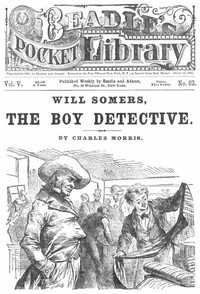
Charles Morris's dime novel follows sixteen-year-old Will Somers, a street-smart boy who talks his way into a Philadelphia dry-goods store and uses slang-laced detective work to solve a series of thefts. The narrative relies on colloquial dialogue, physical description, and incremental clues rather than formal deduction.
Share
Editorial Edition Score 4.8/5

Calculated from edition completeness, EPUB availability, text structure and catalogue metadata. Not a user rating.

How this score is calculated
  • Description quality20 pts
  • Title & short description10 pts
  • Source metadata20 pts
  • Text length15 pts
  • Chapters / structure15 pts
  • EPUB file integrity20 pts

Total of 100 points, scaled to a 2.5-5.0 range. Editions with an empty description or a missing EPUB file are not scored.

Edition quality

Read the Text

“Got any opening in these diggin’s for a feller of my size and good looks?”

The speaker was a boy of some sixteen years of age, a well-built, athletic lad, the sinewy development of his limbs showing through more than one rent in his well-worn clothes.

His claim to good looks was indisputable. A bright black eye gave character to a face of classical outline, straggling curls of dark hair hanging low over his olive-hued cheeks and brow, while his nose and mouth had all the fine curves of the Grecian type.

“What do you want?” asked the gentleman addressed, in a curt tone.

“Well, I ain’t partik’lar,” drawled the boy. “I want a job. Most anything will do. Say cashier, or head clerk.”

The merchant twisted himself around in his chair and looked at the speaker. The latter bore his sharp look unabashed, standing in an erect, easy attitude.

“Suppose I don’t want a cashier?”

“Maybe then you’d give me a job to make fires and run errands.”

“Who told you I wanted a boy?”

“A counter-jumper outside there. I axed him if there was room in this row for a smart young man, and he said he guessed you wanted a partner. So I jest stepped back to see if I wouldn’t suit.”

A frown came upon the merchant’s brow as he heard of this impudent action of one of his clerks.

“Who told you this?” he sharply asked.

“Now look ye here, mister,” said the boy, impressively; “that’s not my lay. I don’t tell tales out of school. I wouldn’t blow on a cat if I caught her stealing a mouse in another man’s kitchen.”

“Get out of here then. I am busy and don’t want to be bothered.”

“See here now,” said the boy, leisurely seating himself in a chair. “You’re not sayin’ nothing about that job. You’ve got a dozen men out there in the store, and I don’t see a boy in the shanty. Now you can’t run a place like this without a wide-awake boy, and I’m jest the feller you want.”

“You have impudence enough to run it yourself,” said the merchant, looking more closely at his importunate visitor.

“Wouldn’t be afeard to try,” said the boy, saucily, putting to his lips a half-smoked cigar which he had all this time held in his hand, and taking a long whiff. “I’ve a notion I could make dry-goods spin amazing. Jest hand me the reins and I bet I put her through at two-forty.”

The merchant laid aside the papers which he had been examining. He pushed back his chair from the table and faced his visitor.

He was a hale, handsome man of some fifty years of age, somewhat imperious in manner, but with a strong sense of humor in his face. He seemed to think that he had met an original character.

“What is your name?” asked the merchant.

“In this here big town of Philadelphia, but in a little street that I s’pose you never heered the name of. I make myself at home anywhere, though.”

“So it seems,” said the merchant, glancing at the handsome appointments of his private office, and then at the ragged dress of the boy.

“It’s only my coat and pants that’s torn,” said the latter, with an air of pride. “I’m all right inside, I bet there’s not a coon in these diggin’s can jump further, run faster, or lift more than me. And I never seen the day yet I was afeard of work! Now how about that job, mister?”

“Leonard,” said the merchant.

“Mr. Leonard, I mean. I’ve been a-waiting to get holt of the north end of your name.”

The merchant looked closely at his precocious visitor, who, to the age of a boy, added the self-assertion and experience of a grown man. The latter leaned back with easy assurance in his chair, and seemed indeed “at home.”

“What have you been used to doing?” asked Mr. Leonard.

“What ain’t I been used to would be a bit more like it,” said Will, resting his two elbows on the table. “Blackin’ boots, and sellin’ papers, and holdin’ hosses has been my big holts, but I’ve dipped into ’most everything else ’cept preaching.”

“You have been a little vagabond, I suppose, all your life, and know as much of the world as men ought to at twenty-five.”

“If there’s a feller inside of ten miles of here that says I ever done anything mean, I can lick that feller; that’s me!” cried Will, indignantly.

“Do you know Philadelphia well?”

“Does a cat know milk? Bet I do. Could navigate it with my eyes shet.”

“Are your parents living?”

“Dunno ’bout my dad,” said Will. “’Spect I’m an orphan. Me and sis was drapped in this here town when we was like young kittens. A big white house, t’other side the Schuylkill, was our head-quarters. Dad sloped. Never heered of him since.”

“The poor-house, eh?” said Mr. Leonard. “You have a sister?”

“Yes. She’s slipped, too. Was took out when I was a baby. Never see’d her since. Hope the girl’s sound. Know I’ve had mighty hard hoein’.”

There was a touch of feeling in Will’s voice which he sought to hide by greater recklessness of manner. Evidently he had a secret yearning for his lost sister.

Mr. Leonard was silent for several minutes before again speaking. He seemed to be debating something within himself.

“So you want to learn something of business?” he at length said.

“You’ve hit that nail square on the head,” said Will, with energy. “I’m gettin’ too big to shove the brush, or handle the extras. What’s more, I’m not goin’ to be a poor critter all my life. I want a bizz that’s got money in it. I’ve sot my eye on a brown-stone shanty up Broad street. If it’s for sale ten years from now I’m in the market.”

Mr. Leonard laughed slightly at the boy’s tone of confidence.

“Fortunes ain’t made as quickly as you fancy, my lad,” he said.

“If I don’t hang my hat up in that shanty, you can count me out,” said Will.

“The saucy young rascal has the making of a business man in him,” said Mr. Leonard, to himself. “I would much rather have a boy that aimed high than one that aimed low. He is a handsome lad, too, and if better dressed would be quite presentable. I have half a notion to try him, with all his impudence. He is a perfect specimen of the street Arab, but he seems quick and intelligent.”

“How about that job?” asked Will, impatiently. “I’m bound to strike one, somewhere, afore night. I’ve give you the refusal. The man that gets me makes a ten-strike, and no braggin’.”

“If I should give you employment could I depend on you to do what you were told?”

“What I was told?” said Will, rising impulsively to his feet. “I wouldn’t give a smashed cent for the feller who couldn’t do more than he was told.”

“That would never do,” replied Mr. Leonard. “I want a boy to do just as he is told.”

“And what chance is there for genius, then, if a feller can’t spread a little?” asked Will, earnestly. “The boy that only does what he’s told won’t never get to Congress.”

“And they who act beyond their instructions sometimes get to the State’s prison, my boy. If I give you a position you must learn to never take a step without orders.”

“I can try,” said Will, with a comical leer, “but it’ll go mighty ag’in’ the grain.”

Their conversation was interrupted at this point by the entrance of a person into the office.

He seemed to be one of Mr. Leonard’s employes, and was a tall, well built man, but dressed with a foppish vanity that at once attracted the boy’s attention.

He looked with surprise at the merchant’s strange visitor, a look of disdain coming upon his face, as he drew somewhat back, as if in fear of contamination. Will glanced at him from head to foot, with a steady, impudent stare.

“The Everhart is in,” he said. “The Danton shipment of silks on board. I have just received notice.”

“That is good news, Wilson,” replied Mr. Leonard. “The market is just ready for them. See to the custom-house charges at once. We must have them in store as soon as possible.”

“I will attend to it,” he said with a somewhat pompous air.

With another look of supercilious wonder at Will he left the room.

“Who’s that cove?” asked the latter.

“That is Mr. Augustus Wilson, my principal bookkeeper.”

“He is a hoss, he is,” said Will, with a contemptuous puff. “A man of his size dressed like a peacock, and biting off his words like a school-girl. I bet he’s a dose.”

“If I should give you employment, Will, you must learn to curb your tongue, and not be so insolent to the men in the store. They would not stand impudence from a boy.”

“I’ll get along with them. Don’t you be afeard,” said Will, with a look of confidence on his handsome face. “I’ve got along with folks all my life, and never been kicked yet. But I’m doubtful if I won’t be callin’ that cove Gus. He’s a gay feller to Mister, he is.”

“You will not stay here long, my lad, if you do. I warn you of that. He is my principal employe, and must be treated with respect. Understand me. Impudence will not serve.”

“All right, Mr. Leonard. But I know I’ll have a fight every time I go to say Mister. Gus will be coming up. When am I to take hold?”

“Come round this hour to-morrow and I will let you know my decision,” said Mr. Leonard, turning again to his papers.

“That won’t gee,” said Will, positively. “If you want me you’d best say so and be done with it. I’m bound to fetch work to-day.”

“Very well,” said the merchant, impatiently. “I will give you a trial. Now don’t bother me any further.”

“If you’d said that half an hour ago I wouldn’t bothered you so long,” said Will, saucily, as he strode out of the room.

CHAPTER II. STORE LIFE.

Mr. Leonard was the proprietor of a large wholesale dry-goods house, on Market street. He dealt extensively in the richer qualities of goods, and cases of costly silks, rich shawls, and other expensive fabrics were constantly imported by him.

There were a dozen or more salesmen, porters, etc., employed about the store, besides the numerous clerks in the counting-house, and in the business hours of the day the long, wide store bustled with activity till it seemed a very bee-hive of commerce.

A few days after his interview with Mr. Leonard found our young hero duly installed as office-boy and general utility in the store. His employer had found him a more creditable suit of clothes, and given him some useful instruction as to personal cleanliness, politeness, etc.

He had succeeded in greatly improving the outward appearance of the boy, but his mental crookedness was not to be so easily straightened. Will was essentially the same lad who had spent his life till now in street avocations, with intervals of fishing, lounging, swimming, fighting and saucing.

He took hold of business with a vim that promised well for his future usefulness, doing the work given him so rapidly and well as to greatly please his employer.

But there was no curbing his tongue, and more than one spat occurred between him and the salesmen, before he had been a day in the store. Before the end of the first week there was an outbreak which threatened to end his engagement.

“Here, boy, take this roll of cloth down to the store and give it to Mr. Johnson. Look alive, now, he is waiting for it.”

This imperative address was made by a nervous, quick-spoken salesman, named Robert Brown.

Will was employed in opening a case of goods. He looked up with a glance of disdain.

“I’ve took in another job,” he said. “Ain’t doin’ two things at once. You know the way down. Tote it down yourself.”

“What do you mean, you young rascal?” cried the man, in a passion. “If you stay in this place you will have to do what you are told or you’ll be helped. Take this down at once.”

“What’s goin’ to happen if I don’t?” said Will, dropping the tool he had been using.

“I’ll send you spinning down-stairs and out of the store door in a hurry,” said the man, still fuming.

“Look here, Mr. Brown, or Bob Brown, if you like it better, maybe you don’t know that you’re barking up the wrong tree,” said Will, insolently. “Ordering ain’t in my line. Ask me like a gentleman and I’ll stand on my head for you; but I’m not a feller that’s used to bein’ kicked by any man’s toe or tongue, either.”

“Then you won’t take it down?”

“I’ll see you so far t’other side of nowhere that a forty-horse team couldn’t draw you back in a lifetime, afore I’ll take it an inch.”

Will returned to his former task of opening the case.

Mr. Brown’s face was purple with rage, and the veins stood out on his forehead, as he listened to this unexampled rebellion.

“Why, you ragged young reprobate, who was only brought here by charity!” he cried, hotly. “Hang me if I don’t kick you down-stairs myself, and fling the goods after you!”

Suiting the action to the word he grasped Will with a nervous grip, and sought to hustle him to the head of the stairs.

But if ever man caught a Tartar, Mr. Brown had done so in this action.

Will lifted the iron tool in his hand with an impulse to strike his assailant. With another impulse he threw it from him, and used his sinewy limbs with a vigor which Mr. Brown had not dreamed of his possessing.

In a moment he had torn loose from his grasp, and by an alert trip had stretched his foe on his back on the floor.

“That’s the way I pile up my shingles!” cried Will exultingly. “Come to time, old hoss. I’ve chawed up better men than you.”

The language of the street, which he had partly laid aside, came back to Will in his excitement.

The furious salesman sprung to his feet and rushed at the boy with clinched fists. Two other men, who had been engaged with them on the third floor of the building, hurried up.

“Hold there, Bob!” cried one of these. “Don’t try that on a boy.”

“Let him alone,” said Will, as he deftly parried his blows. “He’s my meat. I wasn’t brung up on free fights to back down from a counter-hopper.”

But the man who had spoken pushed between and separated them, just as Will planted his fist with a stinging blow on Brown’s left cheek.

“Come, come, Bob!” said the peacemaker, “that’s no way to settle disputes with a boy. If the fellow has been impudent report him to Mr. Leonard, but never try your fists on a boy.”

Mr. Brown did report, and Will was sent for to Mr. Leonard’s office. Our hero proved a very poor hand at giving evidence in his own favor, but the men who had separated them described the whole occurrence.

“Don’t let anything like this happen again,” said Mr. Leonard, after lecturing Will, severely. “Mr. Brown placed himself in the wrong or I would have to discharge you. Don’t misuse the confidence I have placed in you.”

“All right,” said Will, independently. “But the man that tries to wipe his feet on me is goin’ to touch ground with his nose, that’s all.”

This episode did not injure Will’s standing in the store, for Mr. Brown was not a general favorite.

His good-humor and willingness to work soon gained him friends, and faults were excused in him that would have proved fatal otherwise to his position.

He had a fine voice, and sung ditties with wonderful vim. He could dance like a negro minstrel, could tumble like an acrobat, and had more tricks than a circus clown.

Nothing pleased him better than to get on one of the upper floors, out of sight of customers, and treat the admiring clerks to a taste of his quality.

His chief trouble, in such cases, sprung from the new clothes in which Mr. Leonard had dressed him.

“It’s a gallus rig. I’ll give in,” he said, “but I ain’t been used to fancy fixin’s. There goes the coat, and here goes the vest, and up go the sleeves, and now I’m in trim for work. P’int out what you want done and I’m in.”

“Nothing just now, Will. Let us have that ole Virginny break-down.”

“Yes, I see myself waltzing round on my ear for you, and no pianner music, and not even a jews-harp. Don’t dance till I hear a tune. Whistle up, somebody, my boot-soles is itching.”

One of the men whistled a quick tune, and Will’s feet rattled over the floor in the most astonishing steps, relieving his feelings now and then by a somerset, or a dance on his hands.

“Hi, lads! let the music out,” he cried. “That’s your style! Heel and toe. Ain’t I a screamer? Just observe me.”

The next instant he was at the top of a high step-ladder, singing a negro melody for dear life, and keeping time with hands and feet on the boards.

“Hush! here comes Mr. Leonard,” cried a scout. “He has heard all that rascally noise. Limber up and get to work _quick_.”

The men hastened to various avocations, somewhat to Will’s surprise. He was as honest as the sun, and would never have thought of such deceit. He had, all his life, fathered all his actions.

When Mr. Leonard appeared, Will was seated in his shirt-sleeves on a dry-goods box, whistling in a low tone, and keeping time with his heels.

Mr. Leonard looked inquiringly around, a look of displeasure on his face.

“What has been going on here!” he asked, sharply. “I heard an uproar all the way down to my office. You are all suddenly at work. What have you been doing, boy?”

“Nothing. Only killing time,” said Will, indifferently. “We kinder run out of work, and I wanted to learn these fellows a South street wharf break-down. Want to see me do it?”

Will jumped from his box and struck an attitude.

“No. And I want less noise and commotion. If you wish to stay in my employment you must learn to curb yourself a little. Let us have no more such performances.”

“You suit me fu’st-rate so fur. Got no notion of dischargin’ you yet,” said Will. “But what’s to be done? I can’t hold in. It’s out of the question. There’d be something bu’st sure.”

“Well,” said Mr. Leonard, turning on his heel to hide a broad smile. “I must give you some out-door work--send you on errands. Can I trust you to do them correctly?”

“I dunno. Won’t make no promises. You can try me. That’s the way to find out. I know everything and everybody out of doors; that’s something.”

“Very well; I will try you.”

Thenceforth Will varied his store duties with out-door avocations, his quick and intelligent performance of which gave much satisfaction.

CHAPTER III. MR. LEONARD’S VISITOR.

It was two or three days after the last-narrated events that a slender, keen-eyed person stopped in front of Mr. Leonard’s store. He was dressed in grayish clothes, and wore a wide-rimmed hat.

He glanced up at the lofty iron front, reaching five stories high, and then briskly entered the store, threading his way back between the open cases of goods which covered the long floor to the counting-house.

Sending in his card he was at once admitted to Mr. Leonard’s private office.

“Take a seat, Mr. Fitler,” said Mr. Leonard, pushing aside his papers.

The first chapter of Charles Morris's Will Somers, the Boy Detective opens with a sixteen-year-old applicant who announces himself with a drawl: “Got any opening in these diggin’s for a feller of my size and good looks?” The line establishes a voice that is both cheeky and self-aware, and the merchant's curt reply sets up a pattern of verbal sparring. Morris devotes unusual attention to the boy's physique—the “sinewy development of his limbs” visible through rents in his clothes—and to his “classical outline” features, including “straggling curls of dark hair” and “olive-hued cheeks.” This physical specificity, combined with the boy's unapologetic slang, marks him as a protagonist who is observed from the outside before he is allowed to act.

Dialect as a Character Marker

Will Somers's speech is the most consistent authorial choice in the excerpts. He uses contractions and colloquialisms that set him apart from the merchants and officers: “I ain't partik'lar,” “I axed him,” “Bet I bring them up with a half-hitch.” The dialogue is not merely decorative; it signals his social position and his self-constructed identity as a shrewd outsider. When Miss Arlington asks about his suspicions, Will replies, “Never mind now… There's more than one in it. Been spotting them for some time.” The clipped, confident phrasing suggests a boy who has learned to guard his information. Morris also contrasts Will's vernacular with the more formal speech of Mr. Leonard and the officer, creating a linguistic divide that reinforces the tension between the boy's low status and his growing influence.

The Store as a Stage for Suspicion

The dry-goods store is not just a setting but a mechanism for generating suspicion. Morris uses the physical layout—the basement, the cellar, the counter—as spaces where thefts can occur unseen. The investigation proceeds through incremental details: a piece of cloth given to a ward, a suspicious old man visiting Will, and the discovery that robberies have been occurring “over a year.” The officer, Mr. Fitler, insists that “the work could not have been done without an accomplice here,” narrowing the field of suspects to the employees. Morris's descriptions of the store are functional rather than atmospheric; the building exists to be watched, searched, and doubted. The reader is invited to track clues alongside the characters, but the excerpts leave many connections implied rather than stated.

Physical Description and the Body as Evidence

Morris repeatedly describes Will's body in ways that suggest both vulnerability and capability. The “rent in his well-worn clothes” hints at poverty, while the “sinewy development” implies physical readiness. When Will stands “in an erect, easy attitude” under the merchant's sharp look, his posture becomes a form of defiance. Later, the officer suggests following the boy to learn “his places of resort and associates,” treating his movements as potential evidence. This attention to the protagonist's physicality is unusual in dime-novel detective fiction, which often prioritizes action over description. Morris uses the body as a text to be read: Will's appearance invites trust or suspicion, and his own awareness of this—his “confident manner” and “assured air”—becomes a tool in his investigations.

The Limits of the Excerpts: Unresolved Threads

The provided excerpts cover only the opening chapters and a later conference scene, leaving the full trajectory of the plot unclear. Will's claim that he will “take him out of jail” refers to John Elkton, but the nature of Elkton's involvement—whether he is a thief, a dupe, or a red herring—is not revealed. Similarly, the officer's plan to “spot” the old man who visited Will is mentioned but not followed through. Morris introduces multiple suspects (Will himself, the “counter-jumper,” the mysterious visitor) without resolving their roles in the excerpts. Readers should expect a story that builds through incremental revelations and relies on Will's inside knowledge, but the complete resolution of the thefts and the clearing of Elkton's name are only hinted at in the material available.

Morris's prose is lean and functional, favoring dialogue and action over interior reflection. Readers who enjoy period slang and the mechanics of a store-based mystery will find the text engaging, but those seeking psychological depth or elaborate plotting may need to adjust expectations. The dime-novel format rewards quick reading and incremental clue-dropping, and Will Somers's confidence—expressed in phrases like “I never said a thing I didn't do”—carries the narrative forward even when the evidence is thin.

Reading about Will Somers talking his way through Philadelphia reminded me of another voice, rougher and older, that I once followed across the rails. There’s a particular patience in how both stories let clues surface slowly, like dust settling. That same unhurried feeling lives in Dyke Darrel the Railroad Detective; Or, The Crime of the Midnight Express — Inside the Classic, and I find myself returning to it the way one returns to a familiar station bench.

Wyatt Carter
1 month ago

Gabriel Gonzalez
1 month ago

Dylan Young
2 weeks ago

Liam Torres
1 week ago

Amelia Carter
1 week ago

5
5 out of 5 (9 User reviews )

Add a Review

Your Rating *
There are no comments for this eBook.

Reader reflection

Take a moment to reflect on this book

Create a short personal record of your experience with this book.

Your progress 0 / 10
1

Have you finished this book?

2

What was your overall reaction to the book?

3

Would you encourage someone else to read it?

4

How easy was the book to follow?

Related eBooks