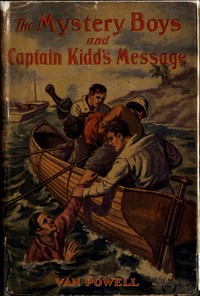
The Mystery Boys and Captain Kidd's Message — Key Ideas to Explore

(11 User reviews)   2190
In Category - Mystery Collections
Powell, Van Project Gutenberg 2016 Not confirmed
Detective and mystery stories; Pirates -- Juvenile fiction; Mystery fiction Readers of public-domain and historical texts
Project Gutenberg digital edition en

Edition facts

Words 58,104
Reading time 253 min
Text sections 9

For The Mystery Boys and Captain Kidd's Message — Key Ideas to Explore, the stored edition analysis reports 58,104 words, 4 hr 13 min estimated reading time, and 9 detected text sections.

The text analysis averages about 15.1 words per sentence, while the detected sections provide another way to judge how the source is divided.

Project Gutenberg metadata also associates the work with “Detective and mystery stories,” connecting these edition facts with the source record’s subject description.

An editorial note on Van Powell's 1931 mystery, focusing on its narrative voice, pacing shifts from dialogue to action, and the use of sensory details like sun-gazing and water sounds to build suspense.
Share
Editorial Edition Score 4.7/5

Calculated from edition completeness, EPUB availability, text structure and catalogue metadata. Not a user rating.

How this score is calculated
  • Description quality20 pts
  • Title & short description10 pts
  • Source metadata20 pts
  • Text length15 pts
  • Chapters / structure15 pts
  • EPUB file integrity20 pts

Total of 100 points, scaled to a 2.5-5.0 range. Editions with an empty description or a missing EPUB file are not scored.

Edition quality

Read the Text

e Incas of Peru, in an old hidden Inca city among the Andes, was, at this time, exploring and studying in the island of Jamaica, among the West Indies. He was a great scholar and a student of old civilizations and was writing some chapters of a book on the Carib Indians, the original inhabitants of the islands when Columbus discovered them.

Cliff’s Aunt Lucy thought it would be wise for Cliff to join his father, to be well away from danger of infection; because the three chums were inseparable, consent was easily secured for Tom and Nicky to go with him. The three friends had been residing on a plantation in the heart of the island for nearly a week. There, with Cliff’s father and a young man, Clarence Neale, who was securing Carib relics for a great Museum of Indian History in New York, they tried to help out by searching for Carib pottery and ornaments. Jamaica had a great lure for them, for Nicky, a “pirate bug,” called Jamaica “Pirates’ Paradise!”

This interest was not due to any desire on Nicky’s part to be a wild, fierce seadog, sailing from some port with letters of marque, to pillage unprotected ships. The days for such things lay far in the past and although Nicky was excitable and impulsive he was, at heart, a very steady, sincere boy, a true American living up to the ideals of all that American boyhood means.

But in Nicky’s family there was an old paper which was a direct message to one of his ancestors from no less a person than the alleged pirate, Captain Kidd!

Naturally Nicky, scarcely more than fourteen, was elated when he knew that he was permitted to accompany Cliff Gray, with their comrade, Tom, slightly older than either, to the island which had once been governed by a reformed pirate, in the heart of the West Indies where once piracy had flourished.

They found very little more than legends and old tales to whet their interest. Piracy had given place to commerce on the seas, as sailing ships had surrendered to steam. And so, instead of digging for buried treasure, on the sixth morning of their visit, they had found themselves digging carefully in a corner of an uncultivated field, to unearth broken bits of earthenware, possibly some small ornaments, or other relics of the Caribs who once roamed the island.

Digging early to avoid the mid-day heat during which everybody was quiet and inactive, they had discovered the unaccountable interest of the colored boy and when he had scuttled away they returned to their work wondering a little about it.

“When we rescued your father from the Incas and got some of their gold the whole business started with a mystery, Cliff.” Tom referred to an adventure during the previous summer in which they had explored a hidden city in Peru and gone through many exciting escapades.

“Wouldn’t it be odd if that boy started up a new mystery?” Nicky suggested. “We’re right in the heart of mystery land. Voodoo—piracy in the past—and—and everything!”

“Look—but don’t let him see you!” Cliff nudged his comrades. “By the right side of that old cabin—there’s our ‘boy-friend!’”

Sure enough, the ebony face protruded around the old shack that stood in the field, not far from their trench.

“Listen, fellows,” whispered Nicky, “there is something queer about this. How can we get hold of him and make him tell us what he expects is going to happen. He’s just looked up at the sun again!”

“You pretend to chase him,” Tom advised. “When he disappears and is out of sight I will go the other way and head him off.”

Nicky promptly started toward the boy, who ran away around the cabin. Tom lost no time in taking a direction around the other side of the shack. There was a shrill yell of fear and the sound of a scuffle, and back came Nicky and Tom, almost dragging a terrified colored boy.

Cliff joined them close to the cabin.

“Now,” said Nicky, “we’re not going to hurt you. But you tell us what made you look at the sun and then watch us!”

The boy was silent. Suddenly he began to wriggle and to struggle and all three took hold of him. They did not intend to harm him but his actions had their curiosity fully aroused.

“Here! White boys! Let that colored boy alone, do you hear!”

A shrill, cracked voice came from the cabin. The three white chums hesitated, looking at one another and then at the cabin.

In its doorway stood an old, bent woman, who seemed to be all skin and bones. Her face looked like crinkled, black parchment, dry and wrinkled. Her hands were skinny and had long nails and clawlike fingers. She leaned on a stick and made them all think of pictures of witches they had seen. Her eyes blazed at them.

A little frightened by the old crone’s evident fury, they let go of the boy who scuttled past the woman into the shack.

“We didn’t hurt him,” Nicky said defiantly. “He was—” and he told her how the boy had acted. “We wanted to know why he did it,” he ended.

The woman scowled at them.

“You know very quick,” she said in her shrill, cracked tones. “You go away or sun make you very sick in the head!”

“Ho!” cried Nicky, “will it? Who says so?”

“Sh-h-h!” Tom nudged him. “Don’t you remember what Cliff’s father told us about Voodoo on these islands?”

“Yes, I do,” Nicky answered under his breath. “But I’m not afraid! Why does she want us to go away? What is there in this field that she doesn’t want us to see?”

“It’s Voodoo, I tell you!” Tom urged. “These old Voodoo witches can enchant people.”

“Do you really believe that?” demanded Nicky. The old woman was fumbling and tugging at an old bag, dirty and of some queer animal or reptile skin, as he spoke.

“Well—” Tom hesitated, “I know they say it’s only the effect on ignorant minds that makes Voodoo hurt people.”

“Well, it can’t hurt me!” declared Nicky, “And, as I say—why would she want to ‘voodoo’ us—white fellows and strangers?”

“I think Nicky’s right,” Cliff declared. “She must have some reason.”

“Listen,” whispered Nicky, excitedly, “one of you run and bring Mr. Gray or the other man—Mr. Neale. Let’s get to the bottom of this. I’ll give you any odds you like that she is trying to drive us away because something’s hidden in this field—maybe—maybe——”

“Treasure!” gasped Cliff and ran like a deer for the older members of their party. Treasure!

CHAPTER II ONE HALF OF A CIPHER

That the old crone was very much “worked up” was easily to be seen. Tom and Nicky, watching uneasily, saw her fumble in her old bag and draw out with her bony fingers three queer objects.

These were small figures, made rudely of clay or mud. Tom and Nicky started and stared at them. They were made in the shape of small human figures, with heads a little larger than peas, and with dented places to mark out the arms and legs.

“What do you think those things are?” Tom whispered. “I don’t like this. Remember what Mr. Neale said about this woman?”

“Yes,” Nicky answered softly. “He said Ma’am Sib is a Voodoo woman and that the colored people are afraid of her. But I’m not! I want to see what she is going to do.”

That was quickly seen. She laid the little objects in a row on the doorsill; all of them had their tiny heads pointed out from the shade of the roof, so that the heads were in the sunshine.

She scowled at Nicky and Tom, then muttered under her breath and glanced up toward the sun, then back at the boys.

“I know it’s just imagination,” Tom told his chum, “but I feel sort of queer——”

Nicky made a practical suggestion.

“I think she’s trying to scare us away by making us believe that she has bewitched us or something,” he said, “It’s something that the sun will do to us. If you’re uneasy, go and stay in the cabin shade at the side.”

Tom looked sheepish and uncomfortable, but after hesitating for a while his fears overcame his good sense and he went out of sight.

Nicky did not follow; instead, he made an unexpected move.

Quick as a flash he leaped forward, bent and made a scooping movement of his fingers. When he dodged back out of reach of the irate old woman’s cane, his hand was closed over the mud images.

“I’ll keep these,” he said, trembling a little with natural uncertainty as to the outcome of his bravado.

“Here comes Cliff with Mr. Neale!” called Tom from beside the cabin, while the colored boy poked his head out through the door and made his eyes roll in his excitement.

Cliff and the young archaelogist were climbing the fence. They hurried over and confronted the woman.

“What does this mean, Ma’am Sib?” asked Clarence Neale quietly. He showed no anger, only curiosity. The old woman looked up at the tall, clean-cut young fellow, not much more than twenty-two or so, and frowned.

“White boys not to dig! I order them to go yesterday. They come back! I—” she made a gesture toward Nicky who unclosed his hand. The moisture of his palm was already breaking up the shape of the figures.

“Cliff’s father told us about the Egyptians doing this like this,” Nicky said. “They used to make little images of wax, he said, and put spells on them to injure the magicians’ enemies—then when they stuck pins in the wax, or burned it, the enemies were supposed to suffer with pain. But I didn’t know they did that sort of thing in Jamaica.”

“Sometimes,” Mr. Neale admitted. “But why did you come back to dig when Ma’am Sib ordered you away?”

“It isn’t her field,” Cliff answered. “I asked father. And, besides, there is another trench started. See! Over there.” He pointed to the digging that had been done at a point closer to the cabin.”

“Can they really hurt you—these voodoo people?” Tom asked. “I began to feel sort of uneasy——”

Mr. Neale spoke quietly in reply. “The boy was told to do as he did so as to suggest an idea to you,” he explained. “You see, all sorts of magic depend on our being afraid. We are afraid of things we do not understand. Because we don’t understand them we think ‘maybe they do have power to hurt us.’”

“It’s just the same as if I came to Tom some morning and looked at him as if something was wrong, and then asked him what’s the matter,” Cliff said. “He’d wonder and then begin to think that something was wrong and he would begin to feel sick, if he kept thinking about it long enough.”

“Exactly,” Mr. Neale replied. “Voodoo depends on ignorance and fear. Because people are ignorant and afraid, their own minds work against them. Tom let himself imagine there was danger——”

“I knew it,” Tom said, shamefacedly, “but it got the best of me.”

“But why did she do it?” demanded Nicky. “Not just because we didn’t obey her and stop digging——”

“I claim there must be something hidden here that she knows about and she tried, the way she is used to doing, to drive us away,” Cliff declared.

“There isn’t anything buried here that I have heard about,” Clarence Neale responded. He turned to the woman, “Ma’m Sib, what induced you to try to frighten these friends of mine?”

“Perhaps I can help you?” inquired a voice behind them. So absorbed had they all been in the discussion that they had not noticed the arrival of a slender colored fellow of nineteen. He stood just back of them, smiling pleasantly. He was as black as ebony, with perfect, white teeth which showed in strong contrast when he gave his good-natured smile. He spoke without the Southern Negro’s dialect, as is the custom of all the Jamaica inhabitants whose speech is often of the very best English, with only a few colloquial bits of dialect.

Mr. Neale turned. He recognized the grandson of old Ma’am Sib.

“Your grandmother has been voodooing my young assistants, Sam,” he said pleasantly. “They were digging and she must have thought that voodoo was easier than the natural way—to come and ask me to keep them away.”

The young Negro shrugged his shoulders. He had been sent to a school in the United States and he was better educated than was his ancient grandmother.

“No harm is done, anyhow, sar,” he replied. “I ask you to forgive.”

“Done!” answered the white man, “but I am curious to know just what is so important that she should take that sort of measure to drive off our digging comrades.”

“She thought that there was something buried here,” explained the colored fellow. “She knew that I have been doing some exploring in my spare time. But I found what I was looking for—and I was so disappointed that I did not even bother to tell her, sar.”

“Yes, sar. There is an old legend in our family and my grandmother had told me and I was searching for a letter. When Captain William Kidd traded between New York and these islands, before he was really a pirate, he was much friends with our Governor. In those days the Governor was kind to pirates. He let them come into harbor and he did not give them to the law for punishing.”

Nicky and his friends became alert. Nicky thought of the old paper so carefully preserved by his family, although no one thought it would ever amount to anything. Cliff and Tom were intensely interested because this was becoming a living story, linking the present with the old, piratical days and their natural love of adventure was whetted by the suave words of the colored man.

“You may not know about Captain Kidd,” Sam continued. Nicky knew a great deal but he remained silent, listening eagerly. “He was really not as bad as the story books have made him. He was not one of the terrible pirates. But he did wrong and finally he was made a prisoner in America, and was kept in prison until he could be sent to England to be tried.”

He became very earnest and they all drew closer.

“While he was in prison he sent a letter to his friend, the Governor of Jamaica, who had a house not far from this place. That was the owner of this field and his family holds it yet. We are descendants of old family servants of that Governor. Well, sar, the letter came one day and the Governor began to brag about finding great treasure soon; one of my race who was his body-servant thought the letter must tell about the treasure and so he stole it. But he became disgusted and buried the despatch box. I do not know why. At least, I did not know why until I dug it up last night!”

They were all tense with suspense as he reached into his pocket and pulled out a folded paper. Holding his hands around it until he made sure that it was the right one, his eyes rolling with the colored race’s love for being the center of the interest, he slowly opened the paper, holding it down low so that they could all see the surface.

It was dirty and brown with age and the ink on it was faint and faded to a faint brownish tint.

They all craned their necks.

What they saw was disappointing, as Sam had said. There were three small, irregular shaped circles toward the top of the paper, in such a relation to one another that if a line had been drawn between each pair so as to connect them, they would have been at the points of a triangle.

At one side, and a little lower down, was the regulation, old-fashioned representation of a compass to show direction.

Further down, there was part of a word which they made out to be “per.” Still further down, was a mass of tiny dots and marks, too faint to be given any meaning, they were not in the form of letters, but were just like the blotches that break out on the skin during measles-here, there and everywhere. But at the left side they went right to the edge of the paper, and there was a very dim line starting there and running a little way in among the blotches.

Just beneath was a nautical bearing: “25—30—13 N.”

“You can see,” said Sam, his finger running along the left hand edge, “this paper is torn off. It is only half of a cipher, sar.”

Mr. Neale, Cliff and Tom nodded.

“So it is of no good.” said Sam, but he returned it to his pocket. “It may come that the other half will be found. I hope so.”

Then he turned and looked, with surprise, toward Nicky.

“Can it be,” muttered Sam, “that Ma’am Sib’s voodoo has worked, after all?”

Nicky was turning somersaults and rolling about like a boy who has gone mad!

CHAPTER III A “MYSTERY BOYS” MEETING

Watching Nicky’s contortions, Ma’am Sib began to see pictures in her mind of herself in jail and she became more afraid than she had made the boys.

She knew that the open practice of voodoo was against all laws and she had not really meant to do any more than frighten the boys off. But Nicky’s actions caused her to dread the consequences to herself. But Tom and Cliff, understanding their comrade, had different thoughts. When Tom looked at Cliff he saw the latter calmly but determinedly scratching his left ear. Tom instantly folded his arms!

Tom hastened to Nicky and grabbed his chum between two somersaults.

“Cliff’s calling for a council,” he whispered. Nicky became at once a very sober and quietly normal young fellow.

The three chums were the sole members of a secret order which they named from the fact that each of them had a mystery in his life; so their secret order was called “The Mystery Boys.”

Nicky, to begin with, had in his family the supposed message from the former pirate, William Kidd. Tom’s mystery had to do with the fact that his sister had never been located after an attack on a Mexican mine by bandits; after which no trace of the girl, living there with her father, the mine superintendent, had ever been found. Cliff had solved his mystery the summer before; his father, studying Inca civilization, had been held prisoner by Incas of the old Peruvian race, in a city hidden among the Andes; a letter had reached Cliff, and he, with Tom and Nicky and a history instructor from Amadale, and with “Quipu Bill” whom they had met in Peru, had discovered and rescued the old scholar and had secured some Inca gold at the same time.

The purpose of the secret order was to be able to exchange ideas in the presence of other people who were not members of the clique, without the outsiders knowing about it. The Mystery Boys had made up their order for the purpose of helping one another in every way, but in secret. Their motto was “Seeing All, I see nothing; Knowing All, I know nothing; Telling All, I tell nothing!”

In order to have help in rescuing Cliff’s father, the order had added the young history instructor, a Mr. Whitley, and “Quipu Bill,” but after the thrilling adventures among the Incas, wherein the secret signals of the order had served the members in many “tight” places, Bill went off to a ranch in the West, and the instructor returned to his classes; both retained membership, but not actively.

Cliff’s signal to Tom had been a call for a secret communication, and Tom, folding his arms in sign of agreement, quickly urged Nicky to silence. Cliff understood Nicky’s wild capering.

Nicky, very sober, came up with Tom to rejoin the group.

The opening chapter of The Mystery Boys and Captain Kidd's Message immediately establishes a distinctive narrative voice through the boys' dialogue. Nicky's impulsive questioning—"What is the matter with that colored boy?"—sets a tone of restless curiosity, while Tom and Cliff offer more measured responses. The text lingers on small, puzzling details, such as the boy's repeated glances at the sun, creating a sense of unease that propels the scene forward. This interplay between spoken words and unspoken tension recurs throughout the excerpts, where whispered exchanges and cautious movements often precede bursts of action.

Dialogue as a Driver of Pace

The narrative frequently accelerates through rapid-fire exchanges. In the opening, Nicky's persistent questions—"But why does he look up at the sun?"—push the scene from observation to confrontation. Later, during the boat escape, commands like "Pull hard on your port oar" and clipped responses ("Right-o!") create a staccato rhythm that mirrors the urgency of the moment. These dialogues are not merely expository; they reveal character traits—Nicky's impulsiveness, Tom's caution, Cliff's strategic thinking—while keeping the plot moving. The author often breaks longer descriptive passages with short lines of speech, effectively controlling the reader's sense of time.

Sensory Details and Atmospheric Tension

Van Powell builds suspense through specific sensory cues. The sun, described as "about two hours high," is not just a time marker but a focal point for the boy's strange behavior. Later, the water is "limpid," and the listing boat's rail "almost dipp[ed] into" it, grounding the scene in tactile and visual detail. Sounds are equally important: the "gruff hail" from the unknown vessel, the "sounds of voices" from the cabin, and the "oaths" of trapped men all contribute to an auditory landscape that heightens tension. These details are never superfluous; they anchor the reader in the physical world of the story, making the sudden shifts to action more impactful.

Shifts Between Stealth and Action

The excerpts show a clear pattern of quiet, careful movement followed by sudden, decisive action. The boys "tread water" and "crept closer" before climbing aboard, their motions described with verbs like "slipped" and "crept." This stealth phase builds anticipation, often punctuated by whispered dialogue. Then, action erupts: doors slam, a boat is captured, and the boys row away "with all their strength." The pacing mirrors a classic adventure structure—calm observation, tense preparation, explosive event—but the author varies the length of each phase. The escape sequence, for instance, compresses multiple actions into a few paragraphs, while the initial encounter with the boy unfolds more slowly, allowing curiosity to simmer.

Readers may find it useful to note how the author balances the boys' collective voice with individual traits. Nicky's impulsiveness often triggers plot developments, while Tom and Cliff provide counterweights. Pay attention to the way the narrative lingers on physical sensations—the heat of the sun, the feel of water—as these moments often precede key turning points. The story's rhythm rewards close attention to dialogue and description alike.

There’s something about the way Van Powell lets the sun-glow and the lapping water carry the tension in The Mystery Boys—a quiet patience that feels rare now. It stays with you, like a half-remembered afternoon. I found that same unhurried ache in When the Sea Gives Up Its Dead: A Thrilling Detective Story — Text and Context, where the salt air itself seems to hold a secret.

Lucas Johnson
1 week ago

Mila White
1 week ago

Dylan Rodriguez
2 weeks ago

Harper Carter
4 weeks ago

Sofia Martin
3 weeks ago

5
5 out of 5 (11 User reviews )

Add a Review

Your Rating *
  • ...
    Linda Fitzpatrick - 1 month ago
    An exciting adventure that will captivate young readers. The Mystery Boys' journey to uncover Captain Kidd's message is full of twists and turns, with a satisfying conclusion. The book is well-written, with engaging characters and a plot that keeps you guessing. Perfect for young mystery enthusiasts.

  • ...
    Benjamin Brown - 1 month ago
    The book tries to be an adventurous mystery, but it falls short. The plot is predictable, and the characters lack depth. The writing feels simplistic even for a children's book, making it a forgettable read. Could have been much more compelling.

  • ...
    Caitlin Patricia Brown - 3 weeks ago
    The Mystery Boys And Captain Kidd's Message offers a fun, fast-paced plot that will keep young readers entertained. The clues are cleverly placed, though the resolution might be a bit predictable for older readers. Still, an enjoyable read for its intended audience.


Reader reflection

Take a moment to reflect on this book

Create a short personal record of your experience with this book.

Your progress 0 / 10
1

Where are you in your reading?

2

Did this book hold your interest?

3

How likely are you to recommend this book?

4

How easy was the book to follow?

Related eBooks