The phantom hunter; or, love after death — Reading Companion

(6 User reviews)   1951
In Category - Crime Investigation
Ellis, Edward Sylvester, 1840-1916 Project Gutenberg 2022 Not confirmed
Western stories; Detective and mystery stories; Guardian and ward -- Fiction; False imprisonment -- Fiction; Frontier and pioneer life -- Fiction; Kentucky -- Fiction; Attempted murder -- Fiction; Dime novels; Unrequited love -- Fiction; Wyandot Indians -- Fiction; Girty, Simon, 1741-1818 -- Fiction; Arson investigation -- Fiction Readers of public-domain and historical texts
Project Gutenberg digital edition en

Edition facts

Words 39,572
Reading time 173 min
Text sections 18

This digital edition of The phantom hunter; or, love after death — Reading Companion is described by source-level measurements including 39,572 words, 2 hr 53 min estimated reading time, and 18 detected text sections.

The text analysis averages about 17.0 words per sentence, while the detected sections provide another way to judge how the source is divided.

Project Gutenberg metadata also associates the work with “Western stories,” connecting these edition facts with the source record’s subject description.

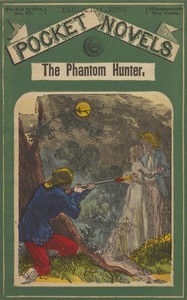
An 1872 dime novel set in a Kentucky frontier settlement, where a young man is hanged for murder, a hunter tracks a villain, and a scout named Kirby Kidd speaks in a distinctive dialect. The narrative uses third-person omniscience, shifting between characters and locations.
Share
Editorial Edition Score 4.7/5

Calculated from edition completeness, EPUB availability, text structure and catalogue metadata. Not a user rating.

How this score is calculated
  • Description quality20 pts
  • Title & short description10 pts
  • Source metadata20 pts
  • Text length15 pts
  • Chapters / structure15 pts
  • EPUB file integrity20 pts

Total of 100 points, scaled to a 2.5-5.0 range. Editions with an empty description or a missing EPUB file are not scored.

Edition quality

Read the Text

Among the earliest settlements of Kentucky was that which figures in our story. At the time of the following events it contained some fifty dwellings, surrounded by strong palisades to defend them from the savages, besides a well-constructed block-house, which was not only strongly garrisoned, but claimed the additional protection of a brass field-piece. This last-named instrument presented quite a formidable appearance to prowling Indians, as it sat on the summit of the block-house reflecting every sunbeam from its polished surface.

One bright afternoon, early in the month of August, there was an unusual commotion at the Indian frontier post.

The entire population, men and women, old and young, had assembled on a broad, level spot just beyond the limits of the fort, many of them to look upon a scene such as they had never before witnessed. This spot was known as “the green,” and it was where the youth of the settlement were wont to repair for their sports, but those gathered there now wore sad faces, and conversed with each other in low, serious tones. And well they might, for they were there to see a man hung for murder!

Russell Trafford was one of the most honored and highly esteemed young men of the place, and yet, on this bright August afternoon, he was to be put to death for the willful murder of another person, who had enjoyed a like reputation. Being an orphan, the young man had lived with his uncle, Doctor Trafford, in the largest and most substantial cabin in the settlement, the worthy doctor being a kind but eccentric individual, who could not have loved his nephew more had the latter been a son instead. These two had never been known to be at odds until very recently, and in fact the peace, harmony and happiness with which they had always lived together, had been a subject of remark on more than one occasion.

But one night, at a late hour, an alarm of fire was raised. The excited settlers, rushing out of their houses, made the startling discovery that the dwelling of Doctor Trafford was in flames. It was readily perceived that the fire had already made such headway as to be past extinguishing, but, notwithstanding that fact, crowds of people rushed to the spot to watch the doomed cabin as it burned, and to learn the cause of the catastrophe. Arriving on the scene, the only person they found there was Russell Trafford. The young man was standing in front of the burning structure, with an _open tinder-box_ in his hand, gazing up at the flames, pale and silent. When spoken to he started violently, and then, quickly thrusting the tinder-box in his pocket, he clasped his hands and cried out in tones of mental anguish, that his poor uncle was dead—murdered—burned alive in his own house! Somebody asked him how he came to be outside of the cabin with an open tinder-box in his hand, and he replied in an absent sort of a way, that he didn’t know—the box was not his—he had found it, he supposed, and begged them to let him alone.

The idea of the esteemed Doctor Trafford being burned to death in his own house and bed, aroused the indignation of all. Somebody had done the deed, and somebody must suffer for it; and the finger of circumstantial evidence pointed to the victim’s nephew, Russell, as the guilty one. Suspicion was fastened strongly upon him, despite the good name he had hitherto borne. On the following day the remains of Doctor Trafford were looked for amid the ruins of the demolished domicil, and the search was rewarded by the finding of a skull and the rest of the bones that belong to the human body, all totally destitute of flesh. These were decently interred, as a last tribute of respect to the dead.

Russell Trafford was arrested, and allowed to go through a mock trial. An Irish boy named Mike Terry—a lad of some fourteen summers, who had lived with the doctor in the capacity of servant—testified that Russell and his uncle had quarreled on the morning preceding the tragedy, and, moreover, that he himself had _seen_ Russell set fire to the building, and he (Mike) had barely escaped with his own life.

This was sufficient. Russell Trafford was declared guilty of firing the cabin with intent to kill his uncle, and he was sentenced to be “hanged by the neck, until dead.” And the sunny afternoon in question was set apart for the punishment of the offender, and many of those who gathered on the green to witness the execution wore sorrowful faces as they looked on the doomed man for the last time. For it was hard to believe that he, who had always been so honorable, upright and noble, could commit such a horrible crime as that ascribed to him. Instead, however, of hanging him by the simple means of a rope and a tree, after the Lynch-law custom of that day, a rude scaffold had been hastily constructed, and the evident intention of the people was to have the affair conducted in proper style. The executioner was an old hunter, ranger and scout, who gloried in the euphonious appellation of Kirby Kidd. Grizzled old borderman that he was, fearless, true-hearted and kind, he formed a good specimen of his class, and his sturdy, Herculean frame showed to good advantage as he stood at his post. His keen black eyes roamed over the crowd with seeming indifference, and occasionally he was observed to address a few words to the prisoner. He was leaning carelessly on his rifle, holding in one hand a tall death-cap, made of undressed bear-skin. There was still a third party on the scaffold. This was a friendly Wyandott Indian, of the name of Wapawah, who was the constant companion of Kirby Kidd when hunting or on the trail, and who had rendered valuable service to many of the frontier posts along the Ohio. Wapawah was as brave a warrior as ever trod Kentucky soil, and possessed all the cunning, vindictiveness and reticence, characteristic of his race. Just now he stood beside his white friend like an image carved in bronze, with his arms folded over his tawny breast, watching the proceedings in stoical silence.

While the spectators were waiting nervously for the _finale_, the attention of many was attracted to a rather curious-looking individual, who suddenly made his appearance among them. This was a man of medium size, clad in the ordinary garb of a hunter and ranger, who trailed after him a long, black rifle as he walked. There was not the sign of an expression on the fellow’s face. A red, straggling beard covered his mouth and chin; long hair of the same color brushed his shoulders at every movement of his head; an ugly patch disfigured his left cheek; and a rough bandage concealed his right eye. Altogether his was not the most prepossessing face ever seen. Nobody seemed to know him, nor did he return any of the searching glances directed at him. He was pressing through the crowd toward the scaffold, looking neither to the right nor left, but straight ahead.

When the stranger had pushed himself through the wondering throng, he unhesitatingly ascended to the elevated platform, and confronted Kirby Kidd, the hangman. For some minutes the two hunters conversed together in low, earnest tones, the friendly Indian standing near, and evidently drinking in every word that was uttered. When the secret conference had been kept up so long that the mob began to show its impatience by angry shouts, it was promptly ended, and the stranger turned away. Then the hangman spoke out loudly, exclaiming:

“Wal, Nick Robbins, ye know it’s my way. I allers try to do my duty, whether it be pleasant or no.”

“Sartinly, Kidd,” returned the person called Nick Robbins. “Go ahead an’ string the cuss up. I know yer wouldn’t have nothin’ to do with the thing ef yer thought he didn’t desarve it.”

With this, the stranger with the bandaged eye turned and descended to the ground, still dragging his gun after him. Wapawah, the Wyandott, followed him, and the two withdrew to a spot apart from the crowd, where they might talk unheard.

A few of the settlers went forward to shake the hand of the young convict, and bid him a last farewell. Among these were three persons who attracted considerable attention—a man and two women. They were Mr. Moreland, his wife and daughter. Mr. Moreland was one of the first men of the settlement, a sensible, industrious and stout-hearted pioneer, who knew well why God had given him health and a pair of strong arms, and who acted accordingly. He had a wife of the same disposition, kind, charitable and self-sacrificing, and their daughter resembled them both. In point of beauty, Isabel Moreland certainly had no superior in all Kentucky, and in those days real beauty was not so scarce as in this age of fashion and folly. She was the betrothed of Russell Trafford, and people had said they would make an excellent match, but that was all over now, and here stood the young man under the gallows, on the eve of a felon’s death, while his affianced wife wept bitterly as he bid her a final adieu.

This affecting scene over, Russell Trafford was asked if he had any thing to say before dying. He replied that he desired a very brief hearing, and then stepped to the edge of the scaffold to speak. He was strangely calm and collected, and his voice was clear, steady and distinct. He said:

“Friends and former friends: it affords me extreme happiness to know that there are those among you who still have faith in my innocence, in spite of all evidence to the contrary. On the heads of such I invoke the blessing of God as I die. For you who believe me guilty I bear no malice, nor even reproach, but trust that a just Heaven will undeceive you after I am gone, and bring the true offender to the retribution he deserves. I am ready to die.”

He stepped back as he made this last declaration, and the old ranger immediately placed the death-cap over his head.

It is not necessary to inflict upon the reader a detailed account of the sickening scene which followed. Sufficient to say, that Russell Trafford was hung before the eyes of his former friends and the grieved maiden who had promised to become his wife. The body of the young man was lowered from the gallows, and placed in the coffin that awaited it, which was nothing more than a rude pine box constructed for this purpose. Old Kirby Kidd, the Wyandott Indian, and their friend, Nick Robbins, volunteered to take the corpse in custody until the morrow, and protect it from the enraged mob, who, it was feared, not being satisfied with the murderer’s death, would further vent its wrath upon the dead body.

On the following day a grave was dug in a pretty glade just outside of the settlement, and burial services were performed.

JONATHAN BOGGS, FROM MAINE.

Isabel Moreland stood in the doorway of her father’s cabin one morning, two or three days after the execution of her lover, Russell Trafford. She was very pale, but very calm. The roses, which had been the admiration of all, were gone from her cheeks, and her dark, soulful eyes, which had been the particular admiration of her ill-fated lover, were hollow and unusually large. A sad, pitiful, expression dwelt in their clear depths, and the lines on her forehead told a tale of mental suffering. The settlers who passed that way, seeing her standing there, marveled at the change that had taken place in her since the death of young Trafford, and felt their hearts moved to pity for the broken-hearted girl.

Presently a man sauntered up to the door, attracted thither by the charming one who stood there. He was a big, burly fellow, with the brute plainly stamped on his coarse, red face, and an air of reckless depravity about him that proclaimed him any thing else but a man. He wore a slouched hat, pulled carelessly down on one side of his head, completely hiding his right eye. This was Jim McCabe, the veriest bully and profligate in the settlement, who, it was said, was so devoid of principle that no piece of deviltry was too great for him to commit. He had been one of Russell Trafford’s rivals in love, and of all the rivals he had been compelled to contend with, Russell had regarded Jim McCabe as the most insignificant. But, now that his successful competitor was out of the way, McCabe seemed to think it possible to thrust himself into the vacant place, and seeing her this morning at the door of her home, he determined to seize the opportunity of renewing the contest for the much-coveted hand and heart.

“Good-morrow, Miss Moreland,” said he, with a profound bow, and an attempt to smile pleasantly.

“Well, sir?” returned the girl, coldly.

“Perfectly well, I thank you,” replied the rogue, choosing to misconstrue her words. “But, really, Miss Moreland, you are looking decidedly unwell to-day. What can be the matter, if I may ask? Are you ill?”

“No? Now that is strange. One would suppose that you had just risen from a prolonged illness. You see I am naturally concerned for the health of one so dear to me. By the way, that was a sad affair about Doctor Trafford and his ingrate of a nephew, wasn’t it?—a sad affair all round. As a friend, I feel for you deeply, but I think you were fortunate in thus finding out the character of your intended husband before—”

“Sir, I must trouble you to drop this subject now and forever.”

Isabel Moreland turned her flashing eyes upon the man as she spoke, and gave him a look that made him recoil. But, quickly recovering himself, he replied, in a tone of apology:

“Why, I did not suspect that I was treading forbidden ground. I only wished to express my sympathy for you, and you certainly need it, since your favored suitor has proven himself only fit to grace the end of a rope.”

“Do you persist in talking of this?” demanded Isabel.

“Not at all—not at all,” was the humble rejoinder. “It being your desire, the subject shall be dropped immediately. I would merely observe, what an inhuman wretch that man was to deliberately kill his own uncle, and that in the most horrible manner conceivable.”

“If you have come here to jeer and mock at me, you must continue your insults without my presence,” interrupted our heroine, and so saying she entered the house, and quietly closed the door between her and her tormentor.

Jim McCabe ground his teeth with rage. Was this to be the result of the new game he had so hopefully commenced? Did she, then, hate him so bitterly? and was her love for Russell Trafford so great that his death had produced this marked change in her lovely face? But Jim McCabe was not the man to submit thus tamely. He shook his fist at the door which shut the maiden from his view, and muttered:

“This is all very fine, my proud lady, but the time is not far off when you will look at Jim McCabe with a much softer expression in those eyes. I have played none but my loose cards as yet, but there are trumps to follow that are certain to win, and two weeks shall not pass away before I shall have the pleasure of seeing this haughty jade at my feet.”

He hissed the last words through his clenched teeth, and his usually red face grew still redder with anger.

He was walking away from the spot, when a peculiar voice behind him arrested his footsteps.

“Hello, you! Jest draw rein a minute, ef you please.”

Instinctively guessing that he was the one accosted, McCabe stopped to see who the presumptuous person was. A tall, angular specimen of humanity, with long, dangling legs and ungainly feet, was coming toward him with awkward strides. He was an utter stranger to McCabe, but the latter saw at a glance that he was a Yankee, of the raw sort, evidently just from his native State. His dress alone would have proven that fact, to say nothing of the nasal twang in his voice, and the “down-east” peculiarity of speech. He wore a tall, white hat, the nap of which stuck straight out; a pair of striped trowsers, which clung tenaciously to the awkward members they protected; and a blue, threadbare coat, whose swallow-tails reached nearly to his heels.

“How d’ye dew, stranger?” drawled the specimen, as he came up. “Right nice weather we’re havin’ nowadays, ain’t it?”

“Splendid. But what do you want of me?”

“What dew I want? Law, now, you’re jest like all the rest o’ the western folks—want a feller tew come tew the p’int instanter, without the least bit o’ prevaricatin’ or dodgin’ round the stump, as Tabitha Simpson used to say. Tabitha Simpson was my third cousin, stranger, on my mother’s side, a gal o’ the femenine persuasion, by the way, and I swan tew man, there never was a couple in all Christendom as had more fun than Tabitha and me used to have. There was one time in partic’lar—”

“See here,” interposed McCabe, crustily, “before you continue your nonsense I should like to know who you are?”

“Me? Darn my buttons! mother allus said I was the most forgitful child she had, and I’m forever provin’ the fact to myself in this very way. Me? Why, bless you, I’m Jonathan Boggs, all the way from Maine! Jonathan Boggs, stranger, a first-rate feller on the whole, who was considered the smartest member of his father’s family, until he robbed neighbor Green’s hen-roost and had to turn tail on the old humstead.”

Jim McCabe began to regard the Yankee with some curiosity.

“When did you arrive here, Mr. Boggs?” he inquired.

“I brought up in this hamlet yesterday,” replied the Yankee, squeezing his hands with difficulty into the pockets of his “tights.”

“Yesterday,” repeated the other. “It may seem strange to you, but I really think I have seen your face somewhere.”

“Dew tell? I s’pect you have, mister, for I often go there,” said the “specimen,” with provoking coolness. “As Tabitha Simpson used to say, ‘Cousin Jonathan must be known to be liked,’ and I’m glad to l’arn as how my phiz ain’t unfamiliar tew you—”

But Jim McCabe was too thoroughly exasperated by the _sang froid_ of his interlocutor, to let him go on in this strain.

“Well, well!” he exclaimed, “if you have any thing of importance to say, I wish to hear it at once.”

“Want to know!” returned the stranger, elevating his eyebrows. “Now that’s what I call right down mean, bluffin’ a chap off in that ’ere style when he’s talkin’ ’bout the land of his birth, and old-time associations. I find I can’t talk enough to please you, but I calkilate you’ll ’scuse me on the score that natur’ neglected to put the gift o’ gab in my blamed noddle.

“Now, in that respect, I ain’t one iotum like the old woman, ’cause why? she can talk the ha’r right off o’ your head in three jerks of a possum’s ear, and ef you’s with her from Sunday mornin’ till Saturday night, you wouldn’t find a chance to crowd in a word edgewise. But I did forgit my business, that’s a fact; thereby givin’ further proof that mother told no lie, when she said as how I was etarnally disrememberin’ every blamed thing of importance. But now tew the p’int, as Tabitha allus said, when tellin’ one o’ her long-winded yarns. Tabitha had been childerns’ nuss at some time of her life, and so had acquired a habit o’ story-tellin’ that clung to her through the hull course of her existence—”

“Curse you for an idiot!” growled McCabe, irascibly, and with an oath he started away.

“Hold on, mister,” said Jonathan Boggs, coolly laying his hand on the other’s shoulder. “Don’t go off ’thout hearin’ me through.”

“Hands off, scoundrel!” commanded the settler, fiercely. “I’ll knock you down if you repeat this insult.”

The novel opens with a public execution on a village green, described as a scene the settlers had never before witnessed. The condemned man, Russell Trafford, is a respected orphan living with his uncle, Doctor Trafford. The narrative immediately establishes a tension between communal justice and individual reputation, a pattern that recurs throughout the excerpts.

The author, writing under the pseudonym Edwin Emerson, employs a third-person omniscient narrator who moves freely between characters. In one passage, the narrator directly addresses the reader with "This we instantly observe," a technique common in dime novels that creates a sense of shared observation. The prose is economical, favoring action and dialogue over interiority.

Dialect and Diction: Kirby Kidd's Voice

The scout Kirby Kidd speaks in a thick dialect that marks him as a backwoods character. His speech is rendered phonetically: "Mold me into buckshot ef ’tain’t beginnin’ to look a trifle suspicious!" and "I’m a-setting hyur as cool as a cowcumber in Jinawary." This dialect serves multiple purposes. It distinguishes Kidd from more educated characters like Russell Trafford, whose speech is not marked in the excerpts. It also signals authenticity, a common device in frontier fiction to suggest the speaker is a product of the wilderness rather than civilization.

Kidd's idiom is not merely decorative. The author uses it to convey his shrewdness and humor. When Kidd mutters "Bah! I might gab in that strain from now till the world comes to an eend," the dialect underscores his self-awareness and his role as a comic yet capable figure. The phonetic spelling—"hyur" for "here," "kum" for "come"—is consistent, suggesting the author paid careful attention to the sound of the character's voice.

Narrative Structure: Shifting Perspectives

The excerpts reveal a narrative that moves between multiple characters and locations, often within the same chapter. Chapter I focuses on the execution and the backstory of Russell Trafford. Chapter X shifts to a different setting—a glen by a river—and introduces Kirby Kidd alone by his fire. The narrator then follows Nick Robbins as he trails Jim McCabe, and later returns to Kidd awaiting the return of an Indian scout named Wapawah.

This structure creates a sense of simultaneity, as if events are unfolding in parallel. The narrator signals these shifts with phrases like "On this same morning another fire had been kindled" and "Thus cogitating, Nick Robbins followed the villain." The effect is a widening of the story's scope, moving from a single dramatic event to a network of characters whose paths are likely to converge.

Setting as Character: The Frontier Landscape

The Kentucky frontier is rendered in precise, functional detail. The settlement is described with its palisades, block-house, and brass field-piece "reflecting every sunbeam from its polished surface." Later, a glen is described as "hemmed in on three sides by a semi-circular ledge of rocks," with a fire placed so that its smoke becomes "very nearly invisible" by the time it rises above the rocks.

These details are not merely atmospheric. They serve the plot: the glen's concealment is crucial for a character hiding from Indians. The author also notes the "knowledge of Indian perspicacity" required to choose such a spot, linking setting to character skill. The landscape is a stage for survival, and the narrator treats it with the same attention given to human actors.

Dialogue and Action: Economy of Speech

Dialogue in the excerpts is sparse but functional. When Nick Robbins confronts Jim McCabe, the narrator reports only that he "laid his hand on McCabe’s shoulder" without recording any words. This restraint is typical of the dime novel style, where action often carries more weight than speech.

Kirby Kidd's monologue is the exception. His extended muttering serves as exposition, revealing his concern for Wapawah and his opinion of Nick Robbins. The author uses this soliloquy to convey information that would otherwise require a separate scene. Kidd's speech is also a marker of his isolation—he talks to himself because there is no one else to hear. The contrast between his loquacity and the silence of other characters highlights the range of the author's technique.

Readers attentive to the author's choices in diction and narrative structure will find a work that balances formulaic elements with specific, observed details. The dialect of Kirby Kidd, the shifting perspectives, and the functional descriptions of the frontier landscape all reward close reading. The novel does not offer psychological depth, but it does demonstrate how dime novels of the 1870s constructed a sense of place and character through economical prose and strategic use of voice.

That old dime novel, The Phantom Hunter, left a strange quiet in me—the hanged man’s ghost feeling less like fear and more like longing. Kirby Kidd’s odd speech stayed in my head for days, a kind of lonely music. It reminded me of how For the Defence — Story, Setting & Ideas lingers with its own weight, the way certain stories just settle into you, unhurried, and don’t quite leave.

Alexander Campbell
2 weeks ago

Camila Brown
1 month ago

Aria Lewis
1 week ago

Ava Moore
4 weeks ago

Aria Lee
1 month ago

4.5
4.5 out of 5 (6 User reviews )

Add a Review

Your Rating *
  • ...
    Rachael Jensen - 1 month ago
    A deliciously Gothic romance with a supernatural twist. 'The Phantom Hunter Or Love After Death' blends love, loss, and the supernatural in a hauntingly beautiful narrative. The characters are compelling, and the mood is perfectly eerie. It's a thought-provoking read that stays with you long after the final page.

  • ...
    Robert Lane - 1 month ago
    The title promises more than the book delivers. The 'phantom' appears rarely, and the romance feels forced. The prose is overly flowery and slows down the plot. The concept has potential, but the execution is weak. A disappointing read overall.

  • ...
    Roger Ingram - 3 weeks ago
    The atmosphere is genuinely spooky and the romance is touching, but the pacing is uneven. Some chapters are thrilling, others drag. Also, the identity of the phantom is predictable. Nevertheless, it's a decent read for fans of classic ghost stories.


Reader reflection

Record your reading impressions

A brief reflection can help important ideas stay with you longer.

Your progress 0 / 10
1

Where are you in your reading?

2

Did this book hold your interest?

3

How likely are you to recommend this book?

4

How demanding did the text feel?

Related eBooks