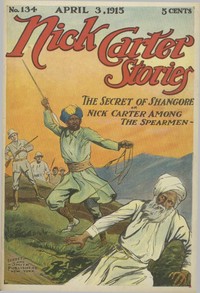
Nick Carter Stories No. 134, April 3, 1915; The Secret of Shangore; Or, Nick Carter Among the Spearmen — Themes and Context

(4 User reviews)   1137
In Category - Mystery Collections
Carter, Nicholas (House name) Project Gutenberg 2021 1915
India -- Fiction; Detective and mystery stories; Millionaires -- Fiction; Dime novels; Fugitives from justice -- Fiction Readers of public-domain and historical texts
Project Gutenberg digital edition en

Edition facts

Words 38,966
Reading time 170 min
Text sections 24

Nick Carter Stories No. 134, April 3, 1915; The Secret of Shangore; Or, Nick Carter Among the Spearmen — Themes and Context can be approached with a clearer sense of reading commitment from its source measurements: 38,966 words, 2 hr 50 min estimated reading time, and 24 detected text sections.

The text analysis averages about 13.6 words per sentence, while the detected sections provide another way to judge how the source is divided.

Project Gutenberg metadata also associates the work with “India -- Fiction,” connecting these edition facts with the source record’s subject description.

This editorial note examines how the opening, middle, and later excerpts of Nick Carter Stories No. 134 guide a first reading, focusing on the detective's entry into the Himalayan setting, the shifting power dynamics with the fugitive Pike, and the cultural details that shape the narrative.
Share
Editorial Edition Score 4.7/5

Calculated from edition completeness, EPUB availability, text structure and catalogue metadata. Not a user rating.

How this score is calculated
  • Description quality20 pts
  • Title & short description10 pts
  • Source metadata20 pts
  • Text length15 pts
  • Chapters / structure15 pts
  • EPUB file integrity20 pts

Total of 100 points, scaled to a 2.5-5.0 range. Editions with an empty description or a missing EPUB file are not scored.

Edition quality

Read the Text

AN ECHO FROM THE FOE.

“No, Carter! I shall not go back until I have got my hands on that wretched crook, William Pike, and I don’t care if it leads me into the very heart of this strange country where they say a white man never has come from alive.”

The speaker was Jefferson Arnold, the multimillionaire shipowner and importer of Oriental goods, whose establishment was one of the best known of its kind in New York City.

His firm jaw came together with a snap, and his dark eyes sparkled with determination in the red light of the camp fire, as he looked at the world-renowned detective for approval of his determination.

“I am rather glad to hear you say that,” was Nick Carter’s calm reply.

Jefferson Arnold jumped up from the rock upon which he had been sitting and went around to shake the detective by the hand.

“I knew you would agree with me,” he shouted. “We have found my son Leslie among these rascals, and we’ve driven them back, over the Himalayas all right. But that is not enough for me. I want to see what these mysteries are that we have heard so much about.”

“Bully for you, Mr. Arnold!” cried Patsy Garvan. “That’s the stuff. I want to lick one or two of those black brutes for what they did to us the last time we had a mix-up.”

“What do you mean?” put in Chick. “I ask that as first lieutenant of the greatest detective in the world. We licked ’em, didn’t we?”

“Sure we licked them!” agreed Patsy promptly. “But they blazed away at us with poisoned arrows and tried to dig holes in us with their spears. It wasn’t their fault they did not lay out our whole bunch.”

Nick Carter laughed heartily.

“When people get into a fight, Patsy,” he reminded his young second assistant, “the object is understood to be to hurt the enemy as much as possible. You should not hold that against anybody who puts up a fair fight.”

“That’s all right!” conceded Patsy. “But this wasn’t any fair fight—at least on the side of these Indians from the Land of the Golden—what is it?”

“The Land of the Golden Scarab,” supplied Nick.

“All right! I’d forgotten that word. It’s always a sticker to me,” grumbled Patsy. “But, anyhow, when those fellows, with their white turbans and black faces, and their thin shirts and short pants, came surging from behind the rocks, trying to get us by surprise, I hadn’t any use for them. What I want is a man to stand up before me and give me a fair-and-square give-and-take. Then I haven’t any kick coming if I get the worst of it.”

“When shall we start?” asked Jefferson Arnold impatiently.

“You mean you will not go down to Calcutta, to get re-enforcements, then?” asked Nick.

“No, indeed,” returned the millionaire. “What would be the use of that? Here we are, right among the foothills of the Himalayas, and we know—or think we know—that this mysterious race of beings, who worship the Golden Scarab, are just on the other side of the range, in front of us.”

“That’s what I learned when those fellows were leading me along,” put in Leslie Arnold, as he carelessly took from his belt the automatic revolver given to him by Nick Carter a short time before, and lovingly regarded the cartridges. “Ask Adil.”

Adil—tall, dark, grave, and of the best type of Hindu—came forward from the shadows and made a salaam to the company in general.

“Adil is my friend,” continued Leslie.

“Thy servant, sahib,” corrected Adil respectfully.

“His valet, as we should say in New York,” came from Jefferson Arnold. “Here in India they say body servant—except when they use an Indian word. It’s all the same. Go ahead, Adil!”

“They were taking us to Bolongu, where the Golden Scarab is all powerful,” explained Adil. “They said we should get there in another day. It was then that Sahib Leslie and I got away. So we did not go.”

“You bet you didn’t go,” put in Patsy Garvan. “You ran into us, and we had a word or two to say.”

“And that is all you know about it?” asked Jefferson Arnold, disregarding Patsy’s interruption.

“I have heard much more,” replied Adil. “But I do not _know_ any more than I have said.”

“We can go on with the force we have,” remarked Nick Carter slowly. “Because, no matter how large a one we might take with us, they would count for little against the hordes of Bolongu.”

“Do you mean that you don’t think we can get hold of Pike, if he stands in with them?” asked Jefferson Arnold.

“No. What I mean is that we may have to depend more on strategy than on physical violence,” smiled Nick Carter. “We shall have to pit our brains against theirs.”

“That ought to be easy,” snorted Patsy. “What do these Indian ‘smokes’ know?”

“The wisdom of the East is proverbial,” returned Nick, in grave tones. “There is not the slightest doubt that the men of the Land of the Golden Scarab have more general knowledge than many white men.”

“Wow!” howled Patsy, at what he regarded as a horrible reflection on his race. “If I didn’t think I knew more than any of these black spear throwers we’ve met in India, I’d quit business and go to playing checkers the rest of my life.”

“Well, that’s all about that—isn’t it?” interrupted Jefferson Arnold impatiently. “Let’s get a move on.”

“We will wait another hour,” suggested Nick Carter. “By that time the moon will be down. We shall be in an exposed situation as soon as we get out of this cave. If there were moonlight, any of those fellows who might be farther up the mountain could shoot poisoned arrows into us, or even reach us with spears.”

“Well, this is something I didn’t expect,” remarked Chick, as the others moved from the fire, leaving him alone with Nick Carter. “We were lucky enough to rescue young Leslie, and we got his man Adil, too. That is all you were asked to do, wasn’t it?”

“Yes,” answered Nick. “We came to India to find Leslie Arnold. His father was in such pitiful distress, that I should have been disposed to lend him what help I could, even if he had not engaged me on a business basis.”

“Of course you would,” assented Chick, and he knew it was the exact truth. “But now that you have found Leslie, and he’s all right, do you think it is worth while to go any farther?”

“Why not?” asked Nick dryly.

“Because, as you know, your desk in New York must be piled up with business by this time,” returned Chick, with some warmth. “It is a question whether such a man as you, on whom so many persons depend when they are in trouble, has the right to stay away longer than he is absolutely obliged.”

“Legal right—or moral?” smiled the famous detective.

“Moral, of course,” was Chick’s quick response. “And that has always had as much weight with you as the other kind. Therefore, I say that we ought to let Pike go. The Arnolds can find him without you. That is, if he can be found at all.”

“Anyhow, if they can’t, it’s none of our business. We are a long way from Madison Avenue, remember. It will take us many weeks to get home, even if we were to start to-night. We shall have to travel nearly half around the world.”

Nick Carter was amused at his companion’s earnestness. He knew that Chick’s advice was given with the very best motives. His assistant would follow him into the very jaws of death—had done so on many occasions. But it seemed to Chick, now that they had finished the job they had come for, that it would be better to get home as quickly as possible.

It was quite true, as he had said, that there would most likely be piles of business on his chief’s desk in his Madison Avenue home by this time, and that scores of people would be anxiously awaiting his return.

But Nick Carter believed that he owed it to Jefferson Arnold to help him bring the rascally William Pike to justice, whether the money he had stolen from the Arnold Company’s Calcutta office—a hundred thousand dollars—were recovered or not.

Pike had been a trusted employee—the manager of the Indian branch of the great New York house—and he had taken advantage of his position to steal what might be called a fortune.

For the moral effect on others, he should be caught and made to answer for his crime.

Perhaps there was another, and potent, reason for the great detective desiring to penetrate the mysteries of the great Himalayan range that he confessed hardly to himself—his innate love of adventure.

Nick Carter always had been interested in the vast unknown stretches of Asia, and what he had heard of Bolongu, the Land of the Golden Scarab, had been of a nature to make him long to go there.

There was every reason to suppose that William Pike had found his way into this strange country, because Leslie Arnold knew that he himself was on his way there when he managed to escape. Pike had some kind of compact with the natives of Bolongu, and it was to their land he had doubtless gone when his scheme against young Arnold failed.

“Sahib! We must fight!” suddenly boomed a deep voice out of the darkness of the cave in which smoldered the remains of the camp fire. “They come.”

The owner of the voice stalked into the red glow of the fire and made a deep salaam to the detective.

“Hello, Jai Singh! Where did you get that news?” asked Nick Carter.

“Jai Singh watches, sahib!” was the grave reply. “The men of the Golden Scarab are far off. But not far enough to hide. They have one of their priests in the rocks across this mountain.”

“You mean in Bolongu? I should say there is more than one there,” rejoined the detective. “If the stories I have heard are true, hundreds of them are in the Land of the Golden Scarab.”

“This priest is much nearer,” returned Jai Singh. “He prepares the things required for feasts of the god in Bolongu.”

Nick Carter got to his feet and looked at the tall, dignified Hindu in some impatience.

“What the deuce do you mean?” he demanded. “And why should we care for one priest? Where are the men we drove back yesterday?”

Before Jai Singh could speak, there came an answer to Nick Carter’s query which could not be mistaken.

It was a concerted howl of hatred and vengeance, which reverberated among the rocks and seemed to be close at hand.

Nick jumped to his feet, his rifle in hand, ready for instant use, as he looked around for the other men of his party.

Jai Singh smiled soberly and shook his head.

“They are not in our camp, nor very near the place we hide,” he said. “The sahib can put down his gun for the present.”

“I heard them not more than a hundred yards away,” insisted Nick Carter.

Again Jai Singh shook his head, while the smile his dark face had worn before crept slowly to the corners of his mouth and into his deep eyes.

“You think you heard them close. That is because the mountain walls carry sounds from a long distance. It was the echo that came to us. The men who shouted are two miles away.”

For a moment Nick looked at the tall East Indian as if inclined to contradict him. Then he recollected that he had heard a great deal about these wonderful mountain echoes, and he said nothing.

“It is on the same principle as the whispering galleries of great buildings,” he thought. “I have heard whispers from a distance seemingly right in my ear in the Capitol at Washington. Why should I doubt the phenomenon in this wonderful land of strange things?”

“What’s the orders, chief?” suddenly broke in Patsy Garvan, whose unquenchable curiosity brought him over when he saw Jai Singh and Nick Carter in conference. “Do we go ahead and clean out those blacks in the mountains, or are we to take a quiet jaunt into the Land of the Golden Pelican, or whatever it is?”

“We shall get to the Land of the Golden Scarab in due time, I hope,” was Nick Carter’s quiet reply. “We shall start in five minutes. Tell everybody to get ready. And——”

But Patsy had already rushed off to announce joyfully that they were going into action, and he did not hear anything more from his chief.

WHAT THEY FOUND IN THE CAVE.

“The fact that we know the rascals are two miles away makes it unnecessary for us to care about the moonlight,” remarked Nick Carter, as, ten minutes afterward he strode along a narrow ledge that wound its way up the mountainside.

“I am glad of it,” grunted Jefferson Arnold. “I didn’t want to wait for anything.”

Nick did not reply. He turned to see that all his little army was coming along, and that all were properly equipped for anything that might happen in the way of fighting.

There were his two assistants, the two Arnolds, Adil, and Jai Singh, with the four coolies, whom he could perhaps be able to depend on in a scrimmage, but who, at all events, were useful to carry most of the baggage.

In addition to all these, there was one member of the party who said nothing, but who was not to be despised in a pinch—the magnificent bloodhound, Captain.

Trained to do police work from his puppyhood, and with a scent that never failed so long as there was anything for him to follow, Captain might still prove himself to be the most valuable individual in the party when it was desirable to follow some slippery and cunning foe.

They were walking along a narrow path of rock, with a towering wall on one side and a seemingly bottomless cañon on the other. It was such a trail as is often found in the mountainous districts of the Far West of America.

“Be cautious,” Nick Carter admonished his followers. “This is the kind of place where there might easily be a guard at intervals, if the Bolongu men know as much about the strategy of warfare as I believe.”

“You need not fear, sahib,” came from Jai Singh. “They are frightened. They will not attack us till we have got out of this part of the mountains. They shout, but that is all.”

“I wish they would show up a little nearer,” observed Patsy. “I’m getting as rusty as an old gate for want of a scrap.”

“Keep quiet, Patsy!” growled Chick, by his side. “You’ll get all the fighting you want before this trip is over—perhaps a little more. What’s this cave just in front of us, I wonder? I see several of them.”

“They have been used by outposts,” volunteered Jai Singh. “See! Here is a rusted spear head. It has been here for years, from the look of it. But it shows that sentries have used these caves at some time.”

“There always have been fights in this part of the country, I should say,” remarked Nick Carter. “Is that a flight of steps I see yonder?”

“How far is it away?”

“It does not look so far,” declared Nick. “Don’t you think you are stretching it, Jai Singh?”

“It may be a little nearer as the eagle flies,” replied the Hindu. “But the trail is even more than three miles.”

“Gee! This is more like a Marathon than a healthy scrap,” grumbled Patsy. “He talks about three miles as easily as if it were only three feet. This kind of stunt might fit a letter carrier from the Bronx. But I wish we had horses or a motor car.”

Patsy Garvan liked to complain in this way. It was exercise for his tongue and gave his lively mind something to do. His discontent was only skin-deep, however. He did not mean anything, and Nick Carter, who overheard, smiled in amusement.

The path became narrower, so that only one person could walk at a time, and even then with the greatest of care. Then again it widened out, with room for three men abreast without being crowded.

“There are the steps!” exclaimed Nick Carter, as they turned a sharp corner. “We are getting into warm quarters.”

“Some of the Bolongu men may be at the top,” suggested Jai Singh.

“Do you think so?” asked Jefferson Arnold.

“I do not,” returned the Hindu.

“You don’t?” spluttered Jefferson. “Then why in thunder do you say——”

“It is wise to be steady,” was Jai Singh’s grave rebuke.

The flight of steps was a long one. When they got to the top, Patsy Garvan said he had counted three hundred and nine steps.

“That is correct,” confirmed Jai Singh. “I have counted them before, as well as now. I have often thought that, with a picked twoscore of men I could hold it against a hundred. What do you say, sahib?”

He turned to Nick Carter—as he generally did when he sought confirmation of some statement he had made.

“I think you are right,” returned the detective. “But I am glad the Bolongus are not here, keeping us off. These steps have saved us going a long way around, from the appearance of it.”

“They have,” assented Jai Singh. “You want to get to their land quickly, and I help you to do it. We could have gone a longer and safer way. But this is straight.”

“What do you mean by ‘a safer way,’ Jai Singh—Bolongus?”

“There would have been no fear of meeting Bolongus. But we may have to fight our way after coming up these steps.”

Nick Carter did not reply. It would have been waste of time to tell the Hindu that there was no desire to avoid the Bolongus. Jai Singh knew that as well as anybody.

The trail seemed now more perilous than ever. So narrow was it in places that they had to edge along sideways, with their toes actually overhanging the dizzy abyss. And it was some three thousand feet to the bottom, at that.

Once the butt of Jefferson Arnold’s rifle touched a projection behind him. He tilted forward, and it was only the quick throwing out of Nick Carter’s arm that saved him from lurching headlong into space.

It was Chick who saved the next man from deadly danger. One of the four coolies stepped on a loose pebble, which rolled under his feet and caused him to half turn toward the brink of the precipice.

The coolie was carrying rather a heavy load. Chick saw him sway under it, and an agonized expression came into his face.

“Look out there, son!” called out Patsy.

But Patsy was too far away to help, willing as he was to do it. It was up to Chick. He gripped the man by the legs below the knees and flung him flat, to take the jerking strain which he knew must come.

It did come, too. The coolie flung up his arms and fell over the edge of the precipice. But Chick held on grimly till the man had wriggled back to safety. That was what he had laid himself out to do.

It was all over in two or three seconds. But it seemed more than a minute before they heard the reverberating crash as the load he had carried reached the bottom of the cañon.

The sound sent a chilly feeling to Chick’s heart that nothing in the way of any ordinary danger could have done.

“I reckon we’ll use ropes,” decided Nick Carter, who saw that his assistant had actually turned a little pale. “We won’t take any more chances.”

Two long lines of rope were knotted together and a loop turn taken around the waist of each man in the party.

Nick Carter took the lead, while Jai Singh was in the middle, they being the heaviest members of the party, and Chick at the rear end. Captain trotted along behind. He was sure-footed enough not to require ropes to keep him out of trouble.

The story begins with a campfire scene in the Himalayas, where millionaire Jefferson Arnold declares he will not turn back until he captures the crook William Pike, even if it leads into a country where no white man has returned alive. Nick Carter’s calm approval and Patsy Garvan’s enthusiastic response establish a team dynamic and a clear goal: pursuit into unknown territory. The dialogue is brisk, with characters speaking in short, determined sentences that convey urgency and resolve. This opening immediately orients the reader to the stakes and the exotic setting.

The Pursuit and the Fugitive’s Role

The early chapters establish William Pike as a fugitive who has integrated into the hidden city of Shangore. By Chapter XI, Pike is no longer merely a target but a guide, offering to lead the party out of the city. The dialogue reveals a tense alliance: Jefferson Arnold threatens Pike with a pistol on one side, his son on the other, and Chick close behind. Pike’s knowledge of local customs—such as the enforced obedience of inferiors—becomes a plot device. The reader sees how the fugitive’s insider status is both a threat and a resource, a tension that drives the middle sections.

Cultural Details and the Festival of the Golden Scarab

The excerpts drop specific cultural markers: the Festival of the Golden Scarab, the palace of Calaman, and the hierarchical obedience of servants. Nick Carter demonstrates his shooting skill to gain Calaman’s trust, and the party waits for nightfall to escape. These details are not mere decoration; they structure the plot. The festival provides a deadline, and the palace setting creates a confined, watchful environment. The reader is invited to note how the detective uses local customs to his advantage, a pattern that likely continues throughout the story.

Voice and Characterization Through Dialogue

The dialogue distinguishes characters sharply. Jefferson Arnold speaks with blunt determination: “I shall not go back until I have got my hands on that wretched crook.” Patsy Garvan uses colloquialisms like “Gee, Chick! I’m sorry I wasn’t with you.” Nick Carter’s replies are measured and calm. The fugitive Pike adopts a sickly smile and a deferential tone. These vocal tics give the reader immediate cues about each character’s role and temperament, making the large cast manageable.

Structure of Suspense and the Use of Time

The narrative uses time constraints to build suspense. In Chapter XI, the party must wait until dark to escape, and Nick Carter has a shooting demonstration scheduled for the next day. The five-hour wait in the palace rooms, with servants bringing coffee and sweetmeats, creates a lull before action. The reader is kept aware of the ticking clock. This pattern—a pause followed by a dash—appears in the opening chase over the Himalayas and likely recurs, giving the story a rhythmic structure of tension and release.

As you read, pay attention to how the fugitive Pike’s knowledge of Shangore shifts from being a liability to an asset, and how the setting—a hidden city with its own rules—shapes every character’s choices. The story rewards close attention to dialogue and cultural details, which are not background but active elements of the plot.

I remember how Nick Carter’s trek among those Himalayan spearmen feels less like adventure and more like a slow study in estrangement. That same uneasy quiet lingers in Love and hatred — Reading Notes, where every gesture toward affection seems to tighten the distance between two souls. Both books whisper that companionship often grows loudest in silence.

Lucas Rivera
1 week ago

Michael Nelson
1 week ago

Amelia Rodriguez
1 week ago

Luke Carter
1 week ago

4.5
4.5 out of 5 (4 User reviews )

Add a Review

Your Rating *
There are no comments for this eBook.

Reader reflection

Before you leave, reflect on the book

Use these questions to collect your thoughts before moving on.

Your progress 0 / 10
1

What is your current status with this title?

2

How much did you enjoy the reading experience?

3

Would you encourage someone else to read it?

4

How easy was the book to follow?

Related eBooks