1

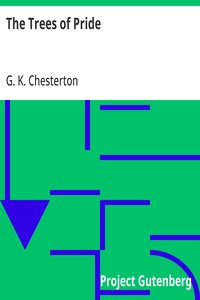
The Trees of Pride — A Closer Reading
(0 User reviews)
921
Project Gutenberg
1999
Not confirmed
Murder -- Fiction; Mystery fiction
Readers of public-domain and historical texts
Project Gutenberg digital edition
en
Edition facts
Words
28,529
Reading time
125 min
Text sections
3
Before opening The Trees of Pride — A Closer Reading, the edition data offers a quick orientation: 28,529 words, 2 hr 5 min estimated reading time, and 3 detected text sections.
The text analysis averages about 20.0 words per sentence, while the detected sections provide another way to judge how the source is divided.
Project Gutenberg metadata also associates the work with “Murder -- Fiction,” connecting these edition facts with the source record’s subject description.
Source:
Project Gutenberg record #1721
In this Cornish mystery, Chesterton contrasts rationalism with folklore as Squire Vane's wager about peacock trees leads to his disappearance. The narrative weaves ironic characterizations, a contested ax, and a well that may hold truth.
Read the complete public-domain text at its original source.
Read on Project GutenbergThe opening portrait of Squire Vane establishes a pattern of ironic contrast that runs through the tale. Described as an "elderly schoolboy" whose English education preserved his intellect "at the stage of boyhood," Vane is a man who prides himself on having "no nonsense about him" yet perpetually does nonsensical things. His failed diplomatic career—kicking off one boot at a mosque, proposing a procession carry a Jew as a relic—illustrates a literal-mindedness that backfires. This tension between self-image and action, between rationalism and the irrational, sets the stage for a mystery that hinges on whether the legendary peacock trees can indeed kill.
The Wager and the Wood
The story's central conflict emerges from a wager: Squire Vane bets that the peacock trees, which local legend says lure men to their deaths, are harmless. This bet pits empirical confidence against folk belief. The narrative voice, however, undercuts both sides. Vane's rationalism is shown as blinkered—he is "always doing nonsensical things" while claiming hard-headedness. Meanwhile, the legend itself is treated with a kind of wry detachment; the trees are described as having "a sort of sickness" that affects watchers, but the cause remains ambiguous. The wood becomes a stage where characters' perceptions blur: the American Paynter admits to a "sleeping sickness" near the trees, while the lawyer Ashe dismisses it as merely "a private hobby of going to bed at night." This unresolved tension between supernatural and mundane explanations drives the investigation.
The Ax and the Well
Two objects anchor the physical evidence: a woodman's ax found at the bottom of a well, and a hat with a hole matching a skull wound. The ax, retrieved by Paynter, is described as having "a dull brown stain" on its blade. Yet the characters immediately dispute its significance. Paynter argues the ax points to the woodman, a mystic who might see the weapon as "solemn and sacrificial." Ashe counters that a sane woodman would not use his own ax, and that the murderer likely threw it away. The well itself becomes a symbol: Paynter declares "Truth lies at the bottom of a well" as he pulls up the ax. But the truth remains elusive—the ax is found, but its meaning is contested. The hole in the hat, fitting exactly over the skull wound, provides a grim identification but no clear motive.
Character as Clue
Chesterton builds the mystery through character traits that double as potential clues. Vane's daughter Barbara is introduced as "a good-looking girl with heavy red hair and a face as grave as one of the garden statues"—a description that aligns her with the silent, observing statues in the garden. The American Paynter is methodical, pulling up the ax and insisting on deductions. The lawyer Ashe is cautious, questioning assumptions. Even minor figures like the doctor are invoked for their professional opinions. The narrative does not simply present suspects; it presents ways of seeing. Each character's interpretation of events—whether supernatural, psychological, or forensic—reflects their own biases. The reader is left to weigh these perspectives, much like the characters themselves weigh the evidence of the ax and the well.
Readers attentive to Chesterton's characteristic irony will find that the mystery's solution may matter less than the clash of worldviews it exposes. The peacock trees, the ax, and the well are not merely clues but symbols of how different minds construct truth. Pay close attention to what each character assumes—and what they overlook. The story rewards a second reading that tracks not just who did what, but how each observer's pride in their own rationality leads them astray.
I keep thinking about how Chesterton lets the peacock trees hold their mystery without forcing an answer, and it reminds me of that old Fleet Street tale where the barber’s cellar hides something unspoken. Both leave you sitting with the unease rather than solving it. The String of Pearls; Or, The Barber of Fleet Street. A Domestic Romance. — Background and Themes lingers in that same quiet, unsettled way.
There are no reviews for this eBook.
There are no comments for this eBook.
Reader reflection
What did you think of this book?
Answer a few questions and save a private reflection on this device.
Your progress
0
/
10
2
How much did you enjoy the reading experience?
3
Is this a title you would suggest to others?
4
How demanding did the text feel?
5
How useful were the ideas in this book?
6
How closely did the book connect with your experience?
7
Which element worked best for you?
8
How would you rate its originality?
9
What is the main idea you are taking away?
10