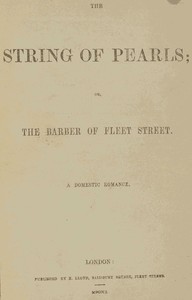
The String of Pearls; Or, The Barber of Fleet Street. A Domestic Romance. — Background and Themes
Edition facts
For The String of Pearls; Or, The Barber of Fleet Street. A Domestic Romance. — Background and Themes, the stored edition analysis reports 448,009 words, 32 hr 28 min estimated reading time, and 179 detected text sections.
The text analysis averages about 17.7 words per sentence, while the detected sections provide another way to judge how the source is divided.
Project Gutenberg metadata also associates the work with “Historical fiction,” connecting these edition facts with the source record’s subject description.
Calculated from edition completeness, EPUB availability, text structure and catalogue metadata. Not a user rating.
How this score is calculated
- Description quality20 pts
- Title & short description10 pts
- Source metadata20 pts
- Text length15 pts
- Chapters / structure15 pts
- EPUB file integrity20 pts
Total of 100 points, scaled to a 2.5-5.0 range. Editions with an empty description or a missing EPUB file are not scored.
Read the Text
CHAPTER I. THE STRANGE CUSTOMER AT SWEENEY TODD'S.
Before Fleet-street had reached its present importance, and when George the Third was young, and the two figures who used to strike the chimes at old St. Dunstan's church were in all their glory--being a great impediment to errand-boys on their progress, and a matter of gaping curiosity to country people--there stood close to the sacred edifice a small barber's shop, which was kept by a man of the name of Sweeney Todd.
How it was that he came by the name of Sweeney, as a Christian appellation, we are at a loss to conceive, but such was his name, as might be seen in extremely corpulent yellow letters over his shop window, by any who chose there to look for it.
Barbers by that time in Fleet-street had not become fashionable, and no more dreamt of calling themselves artists than of taking the tower by storm; moreover they were not, as they are now, constantly slaughtering fine fat bears, and yet, somehow people had hair on their heads just the same as they have at present, without the aid of that unctuous auxiliary. Moreover, Sweeney Todd, in common with those really primitive sort of times, did not think it at all necessary to have any waxen effigies of humanity in his window. There was no languishing young lady looking over the left shoulder in order that a profusion of auburn tresses might repose upon her lily neck, and great conquerors and great statesmen were not then, as they are now, held up to public ridicule with dabs of rouge upon their cheeks, a quantity of gunpowder scattered in for beard, and some bristles sticking on end for eyebrows.
No. Sweeney Todd was a barber of the old school, and he never thought of glorifying himself on account of any extraneous circumstance. If he had lived in Henry the Eighth's palace, it would be all the same as Henry the Eighth's dog-kennel, and he would scarcely have believed human nature to be so green as to pay an extra sixpence to be shaven and shorn in any particular locality.
A long pole painted white, with a red stripe curling spirally round it, projected into the street from his doorway, and on one of the pains of glass in his window, was presented the following couplet:--
"Easy shaving for a penny, As good as you will find any."
We do not put these lines forth as a specimen of the poetry of the age; they may have been the production of some young Templar; but if they were a little wanting in poetic fire, that was amply made up by the clear and precise manner in which they set forth what they intended.
The barber himself, was a long, low-jointed, ill-put-together sort of fellow, with an immense mouth, and such huge hands and feet, that he was, in his way, quite a natural curiosity; and, what was more wonderful, considering his trade, there never was seen such a head of hair as Sweeney Todd's. We know not what to compare it to; probably it came nearest to what one might suppose to be the appearance of a thick-set hedge, in which a quantity of small wire had got entangled. In truth, it was a most terrific head of hair; and as Sweeney Todd kept all his combs in it--some people said his scissors likewise--when he put his head out of the shop-door to see what sort of weather it was, he might have been mistaken for an Indian warrior with a very remarkable head-dress.
He had a short disagreeable kind of unmirthful laugh, which came in at all sorts of odd times when nobody else saw anything to laugh at at all, and which sometimes made people start again, especially when they were being shaved, and Sweeney Todd would stop short in that operation to indulge in one of those cachinatory effusions. It was evident that the remembrance of some very strange and out-of-the-way joke must occasionally flit across him, and then he gave his hyena-like laugh, but it was so short, so sudden, striking upon the ear for a moment, and then gone, that people have been known to look up to the ceiling, and on the floor, and all round them, to know from whence it had come, scarcely supposing it possible that it proceeded from mortal lips.
Mr. Todd squinted a little, to add to his charms; and so we think that by this time the reader may, in his mind's eye, see the individual whom we wish to present to him. Some thought him a careless enough, harmless fellow, with not much sense in him, and at times they almost considered he was a little cracked; but there were others who shook their heads when they spoke of him; and while they could say nothing to his prejudice, except that they certainly considered he was odd, yet, when they came to consider what a great crime and misdemeanour it really is in this world, to be odd, we shall not be surprised at the ill-odour in which Sweeney Todd was held.
But for all that he did a most thriving business, and considered by his neighbours to be a very well-to-do sort of man, and decidedly, in city phraseology, warm.
It was so handy for the young students in the Temple to pop over to Sweeney Todd's to get their chins new rasped; so that from morning to night he drove a good business, and was evidently a thriving man.
There was only one thing that seemed in any way to detract from the great prudence of Sweeney Todd's character, and that was that he rented a large house, of which he occupied nothing but the shop and parlour, leaving the upper part entirely useless, and obstinately refusing to let it on any terms whatever.
Such was the state of things, A.D. 1785, as regarded Sweeney Todd.
The day is drawing to a close, and a small drizzling kind of rain is falling, so that there are not many passengers in the streets, and Sweeney Todd is sitting in his shop looking keenly in the face of a boy, who stands in an attitude of trembling subjection before him.
"You will remember," said Sweeney Todd, and he gave his countenance a most horrible twist as he spoke, "you will remember Tobias Ragg, that you are now my apprentice, that you have of me had board, washing, and lodging, with the exception that you don't sleep here, that you take your meals at home, and that your mother, Mrs. Ragg, does your washing, which she may very well do, being a laundress in the Temple, and making no end of money; as for lodging, you lodge here, you know, very comfortably in the shop all day. Now, are you not a happy dog?"
"Yes, sir," said the boy timidly.
"You will acquire a first-rate profession, quite as good as the law, which your mother tells me she would have put you to, only that a little weakness of the head-piece unqualified you. And now, Tobias, listen to me, and treasure up every word I say."
"I'll cut your throat from ear to ear, if you repeat one word of what passes in this shop, or dare to make any supposition, or draw any conclusion from anything you may see, or hear, or fancy you see or hear. Now you understand me,--I'll cut your throat from ear to ear,--do you understand me?"
"Yes, sir, I won't say nothing. I wish, sir, as I may be made into veal pies at Lovett's in Bell-yard if I as much as says a word."
Sweeney Todd rose from his seat; and opening his huge mouth, he looked at the boy for a minute or two in silence, as if he fully intended swallowing him, but had not quite made up his mind where to begin.
"Very good," at length he said, "I am satisfied, I am quite satisfied; and mark me--the shop, and the shop only, is your place."
"And if any customer gives you a penny, you can keep it, so that if you get enough of them you will become a rich man; only I will take care of them for you, and when I think you want them I will let you have them. Run out and see what's o'clock by St Dunstan's."
There was a small crowd collected opposite the church, for the figures were about to strike three-quarters past six; and among that crowd was one man who gazed with as much curiosity as anybody at the exhibition.
"Now for it!" he said, "they are going to begin; well, that is ingenious. Look at the fellow lifting up his club, and down it comes bang upon the old bell."
The three-quarters were struck by the figures; and then the people who had loitered to see it done, many of whom had day by day looked at the same exhibition for years past, walked away, with the exception of the man who seemed so deeply interested.
He remained, and crouching at his feet was a noble-looking dog, who looked likewise up at the figures; and who, observing his master's attention to be closely fixed upon them, endeavoured to show as great an appearance of interest as he possibly could.
"What do you think of that, Hector?" said the man.
The dog gave a short low whine, and then his master proceeded,--
"There is a barber's shop opposite, so before I go any farther, as I have got to see the ladies, although it's on a very melancholy errand, for I have got to tell them that poor Mark Ingestrie is no more, and Heaven knows what poor Johanna will say--I think I should know her by his description of her, poor fellow! It grieves me to think how he used to talk about her in the long night-watches, when all was still, and not a breath of air touched a curl upon his cheek. I could almost think I saw her sometimes, as he used to tell me of her soft beaming eyes, her little gentle pouting lips, and the dimples that played about her mouth. Well, well, it's of no use grieving; he is dead and gone, poor fellow, and the salt water washes over as brave a heart as ever beat. His sweetheart, Johanna, though, shall have the string of pearls for all that; and if she cannot be Mark Ingestrie's wife in this world, she shall be rich and happy, poor young thing, while she stays in it, that is to say as happy as she can be; and she must just look forward to meeting him aloft, where there are no squalls or tempests.--And so I'll go and get shaved at once."
He crossed the road towards Sweeney Todd's shop, and, stepping down the low doorway, he stood face to face with the odd-looking barber.
The dog gave a low growl and sniffed the air.
"Why Hector," said his master, "what's the matter? Down, sir, down!"
"I have a mortal fear of dogs," said Sweeney Todd. "Would you mind him, sir, sitting outside the door and waiting for you, if it's all the same? Only look at him, he is going to fly at me!"
"Then you are the first person he ever touched without provocation," said the man; "but I suppose he don't like your looks, and I must confess I aint much surprised at that. I have seen a few rum-looking guys in my time, but hang me if ever I saw such a figure-head as yours. What the devil noise was that?"
"It was only me," said Sweeney Todd; "I laughed."
"Laughed! do you call that a laugh? I suppose you caught it of somebody who died of it. If that's your way of laughing, I beg you won't do it any more."
"Stop the dog! stop the dog! I can't have dogs running into my back parlour."
"Here, Hector, here!" cried his master; "get out!"
Most unwillingly the dog left the shop, and crouched down close to the outer door, which the barber took care to close, muttering something about a draught of air coming in, and then, turning to the apprentice boy, who was screwed up in a corner, he said,--
"Tobias, my lad, go to Leadenhall-street, and bring a small bag of the thick biscuits from Mr. Peterson's; say they are for me. Now, sir, I suppose you want to be shaved, and it is well you have come here, for there aint a shaving-shop, although I say it, in the city of London that ever thinks of polishing anybody off as I do."
"I tell you what it is, master barber: if you come that laugh again, I will get up and go. I don't like it, and there is an end of it."
"Very good," said Sweeney Todd, as he mixed up a lather. "Who are you? where did you come from? and where are you going?"
"That's cool, at all events. Damn it! what do you mean by putting the brush in my mouth? Now, don't laugh; and since you are so fond of asking questions, just answer me one."
"Oh, yes, of course: what is it, sir?"
"Do you know a Mr. Oakley, who lives somewhere in London, and is a spectacle-maker?"
"Yes, to be sure I do--John Oakley, the spectacle-maker, in Fore-street, and he has got a daughter named Johanna, that the young bloods call the Flower of Fore-street."
"Ah, poor thing! do they? Now, confound you! what are you laughing at now? What do you mean by it?"
"Didn't you say, 'Ah, poor thing?' Just turn your head a little a one side; that will do. You have been to sea, sir?"
"Yes, I have, and have only now lately come up the river from an Indian voyage."
"Indeed! where can my strop be? I had it this minute; I must have laid it down somewhere. What an odd thing that I can't see it! It's very extraordinary; what can have become of it? Oh, I recollect, I took it into the parlour. Sit still, sir, I shall not be gone a moment; sit still, sir, if you please. By the by, you can amuse yourself with the _Courier_, sir, for a moment."
Sweeney Todd walked into the back parlour and closed the door.
There was a strange sound suddenly, compounded of a rushing noise and then a heavy blow, immediately after which Sweeney Todd emerged from his parlour, and folding his arms, he looked upon _the vacant chair_ where his customer had been seated, but the customer was _gone_, leaving not the slightest trace of his presence behind except his hat, and that Sweeney Todd immediately seized and thrust into a cupboard that was at one corner of the shop.
"What's that?" he said, "what's that? I thought I heard a noise."
"If you please, sir, I have forgot the money, and have run all the way back from St. Paul's churchyard."
In two strides Todd reached him, and clutching him by the arm he dragged him into the farther corner of the shop, and then he stood opposite to him, glaring him full in the face with such a demoniac expression that the boy was frightfully terrified.
"Speak!" cried Todd, "speak! and speak the truth, or your last hour has come. How long were you peeping through the door before you came in?"
"Yes, peeping; don't repeat my words, but answer me at once, you will find it better for you in the end."
"I wasn't peeping, sir, at all."
Sweeney Todd drew a long breath as he then said, in a strange, shrieking sort of manner, which he intended, no doubt, should be jocose,--
"Well, well, very well; if you did peep, what then? it's no matter; I only wanted to know, that's all; it was quite a joke, wasn't it--quite funny, though rather odd, eh? Why don't you laugh, you dog? Come, now, there is no harm done. Tell me what you thought about it at once, and we will be merry over it--very merry."
"I don't know what you mean, sir," said the boy, who was quite as much alarmed at Mr. Todd's mirth as he was at his anger. "I don't know what you mean, sir; I only just come back because I hadn't any money to pay for the biscuits at Peterson's."
"I mean nothing at all," said Todd, suddenly turning upon his heel; "what's that scratching at the door?"
Tobias opened the shop-door, and there stood the dog, who looked wistfully round the place, and then gave a howl which seriously alarmed the barber.
"It's the gentleman's dog, sir," said Tobias, "its the gentleman's dog, sir, that was looking at old St. Dunstan's clock, and came in here to be shaved. It's funny, aint it, sir, that the dog didn't go away with his master?"
"Why don't you laugh if it's funny? Turn out the dog, Tobias; we'll have no dogs here; I hate the sight of them; turn him out--turn him out."
"I would, sir, in a minute; but I'm afraid he wouldn't let me, somehow. Only look, sir--look; see what he is at now! did you ever see such a violent fellow, sir? why he will have down the cupboard door."
"Stop him--stop him! the devil is in the animal! stop him I say!"
The dog was certainly getting the door open, when Sweeney Todd rushed forward to stop him! but that he was soon admonished of the danger of doing, for the dog gave him a grip of the leg, which made him give such a howl, that he precipitately retreated, and left the animal to do its pleasure. This consisted in forcing open the cupboard door, and seizing upon the hat which Sweeney Todd had thrust therein, and dashing out of the shop with it in triumph.
"The devil's in the beast," muttered Todd, "he's off! Tobias, you said you saw the man who owned that fiend of a cur looking at St. Dunstan's church."
"Yes, sir, I did see him there. If you recollect, you sent me to see the time, and the figures were just going to strike three quarters past six; and before I came away, I heard him say that Mark Ingestrie was dead, and Johanna should have the string of pearls. Then I came in, and then, if you recollect, sir, he came in, and the odd thing, you know, to me, sir, is that he didn't take his dog with him, because you know, sir--"
"Because what?" shouted Todd.
"Because people generally do take their dogs with them, you know, sir; and may I be made into one of Lovett's pies, if I don't--"
"Hush, some one comes; it's old Mr. Grant, from the Temple. How do you do, Mr. Grant? glad to see you looking so well, sir. It does one's heart good to see a gentlemen of your years looking so fresh and hearty. Sit down, sir; a little this way, if you please. Shaved, I suppose?"
"Yes, Todd, yes. Any news?"
"No, sir, nothing stirring. Everything very quiet, sir, except the high wind. They say it blew the king's hat off yesterday, sir, and he borrowed Lord North's. Trade is dull too, sir. I suppose people won't come out to be cleaned and dressed in a mizling rain. We haven't had anybody in the shop for an hour and a half."
"Lor' sir," said Tobias, "you forget the sea-faring gentleman with the dog, you know, sir."
"Ah! so I do," said Todd. "He went away, and I saw him get into some disturbance, I think, just at the corner of the market."
"I wonder I didn't meet him, sir," said Tobias, "for I came that way; and then it's so very odd leaving his dog behind him."
"Yes, very," said Todd. "Will you excuse me a moment, Mr. Grant? Tobias, my lad, I just want you to lend me a hand in the parlour."
The opening chapter of The String of Pearls introduces Sweeney Todd through a threat: 'I'll cut your throat from ear to ear, if you repeat one word of what passes in this shop.' The barber's lesson to his apprentice Tobias establishes a pattern of coercive speech that recurs throughout the excerpts. The narrator immediately positions the reader inside a world where verbal menace substitutes for physical action, and where the shop itself becomes a stage for psychological intimidation.
Threat as Dialogue
When Todd instructs Tobias, the threat is not merely a plot device but a stylistic signature. The barber's words are precise and conditional: 'if you repeat one word' and 'dare to make any supposition.' This phrasing reveals a controlling mind that anticipates disobedience. Later, Ben's repeated catchphrase 'Easy does it' offers a contrasting verbal tic—colloquial, affectionate, and repetitive. The juxtaposition of Todd's calculated menace with Ben's folksy reassurance highlights how the authors use dialogue to signal character alignment. Todd's threats are always direct and possessive; he speaks of 'my shop' and 'my razor,' while Ben's speech is full of endearments and physical gestures. The excerpts show that the authors rarely let a character speak without revealing their moral standing through rhythm and vocabulary.
The Narrator's Moral Hand
The narrator frequently steps in to guide reader response, as when Johanna is described as sustained by 'a power which from the commencement of the world has supported many.' This intrusive commentary frames the story as a moral exemplum, even as the plot revels in gothic excess. The rhetorical question 'Was it not a world of wonders that amid all this, Johanna did not go mad?' directly addresses the reader, creating a shared sense of astonishment. The narrator also uses exclamatory phrases like 'God bless me!' and 'Lor bless me!' to inject a colloquial, almost theatrical tone. These interjections break the fourth wall and remind the audience that they are consuming a serialized sensation novel, not a naturalistic account.
Domestic Spaces as Sites of Horror
The barber's shop is described as 'close to the sacred edifice' of St. Dunstan's, a detail that sets up a contrast between the mundane and the monstrous. The preface claims that 'the secret passage' connecting Todd's cellars to the church vaults 'still remains,' grounding the horror in a recognizable London geography. The excerpts show that domestic interiors—a shop, a parlour, a fruiterer's window—are where violence and rescue intersect. Johanna's retreat to the parlour to avoid a public scene underscores how the authors exploit the tension between private terror and public propriety. The repeated mention of Fleet Street as a real thoroughfare lends a documentary air to the fiction, making the reader feel that the horrors could be just around the corner.
Voice and the Serial Structure
With 179 text sections and a word count of 448,009, this novel was designed for serial publication. The excerpts reveal how each chapter ends with a hook: Ben's kiss that 'might have been heard at Sweeney Todd's' or the promise of visitors at nightfall. The authors vary paragraph length dramatically, from single lines of dialogue to dense descriptive passages. The preface's claim that the work 'excited in the Literary world an almost unprecedented interest' suggests that the authors were self-conscious about their audience's appetite for suspense. The use of multiple character voices—Todd's clipped threats, Ben's rambling endearments, the narrator's moralizing—creates a polyphonic texture that keeps the reader engaged across many installments.
Readers approaching this edition should attend to the way the authors balance sensational violence with domestic sentiment. The excerpts show that the novel's power lies not in gore but in the steady accumulation of verbal threats and moral commentary. Pay attention to how characters speak: Todd's conditional threats, Ben's repetitive catchphrases, and the narrator's direct addresses all contribute to a reading experience that is as much about voice as about plot.
There’s a strange comfort in how the old penny dreadfuls made terror feel like a domestic secret, the horror tucked into everyday rooms. That same quiet unsettling lingers in A Case in Camera — Story, Setting & Ideas, where the camera’s eye turns the familiar into something watchful. I keep thinking about that barber’s shop, and the way we all peer through windows, half-afraid of what looks back.
Anthony Rivera
1 week ago-
Rachel Rodriguez - 4 weeks ago
The String of Pearls is a tedious and poorly constructed tale. The pacing is excruciatingly slow, and the repetition of plot points becomes annoying. The characters are one-dimensional, and the horror is more campy than frightening. While it has historical significance, it fails to engage modern readers. I would recommend skipping it unless you're a scholar. -
Kristy Pace - 3 weeks ago
The String of Pearls offers a fascinating glimpse into Victorian penny dreadfuls, with a compelling and eerie plot. However, the narrative can be slow and overly descriptive at times, and the twists are somewhat predictable. Still, it's an important piece of horror history and a decent read for those interested in the origins of the Sweeney Todd legend. -
Jared Sherman - 1 week ago
The String of Pearls, the original tale of Sweeney Todd, is a gripping and macabre classic that excels at creating dread. The story of the demon barber and his unsavory pies is told with a deliciously dark Victorian flair. The characters are memorable, and the plot is full of suspense. A must-read for anyone who loves gothic horror and classic thrillers.
Record your reading impressions
A brief reflection can help important ideas stay with you longer.
Leo Williams
4 weeks ago