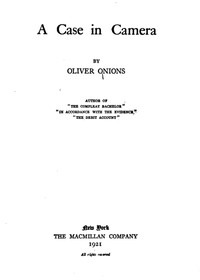
A Case in Camera — Story, Setting & Ideas
Edition facts
A Case in Camera — Story, Setting & Ideas can be approached with a clearer sense of reading commitment from its source measurements: 85,055 words, 6 hr 10 min estimated reading time, and 9 detected text sections.
The text analysis averages about 15.5 words per sentence, while the detected sections provide another way to judge how the source is divided.
Project Gutenberg metadata also associates the work with “Murder -- Fiction,” connecting these edition facts with the source record’s subject description.
Calculated from edition completeness, EPUB availability, text structure and catalogue metadata. Not a user rating.
How this score is calculated
- Description quality20 pts
- Title & short description10 pts
- Source metadata20 pts
- Text length15 pts
- Chapters / structure15 pts
- EPUB file integrity20 pts
Total of 100 points, scaled to a 2.5-5.0 range. Editions with an empty description or a missing EPUB file are not scored.
Read the Text
lip had at least two good reasons for being in high feather that morning. The first of these was that barely a week ago, with a magnificent new quill pen, he had signed the Roll, had shaken august hands, and was now Philip Esdaile, A.R.A., probably the most gifted among the younger generation of painters of the pictorial phenomena of Light.
I and his second reason for contentment happened to arrive almost simultaneously at the wrought-iron gate that opened on to his little front garden. We all knew that for many months past our barrister friend, Billy Mackwith, had been tracking down and buying in again on Philip's behalf a number of Philip's earlier pictures--prodigal pictures, parted with for mere bread-and-butter during the years of struggle, and now very well worth Philip's re-purchase if he could get them into his possession again. (I may perhaps say at once that I don't think Philip owed his Associateship to his pictures of that period. It is far more likely that the artist thus honored was Lieutenant Esdaile, R.N.V.R., sometime one of the Official Painters to the Admiralty.)
A carrier's van stood drawn up opposite the gate, and I saw Mackwith's slim, silk-hatted and morning-coated figure jump down from the seat next to the driver. Evidently Philip had seen the arrival of the van too, for he ran down the short flagged path to meet us.
"You don't mean to say you've brought them all?" he cried eagerly.
"The whole lot. Fourteen," Mackwith replied. "Glad I just caught you before you left."
Esdaile and his family were leaving town that morning for some months on the Yorkshire Coast, and it was this departure that was the occasion of the farewell breakfast.
The three of us carried the recovered canvases through the small annexe, where the breakfast-table was already laid, and into the large studio beyond. There we stood admiring them as they leaned, framed and unframed, against easels and along the walls. No doubt you remember Esdaile's paintings of that period--the gay white and gray of his tumultuous skies, the splash and glitter of his pools and fountains, the crumbling wallflowered masonry of his twentieth-century _fêtes-champêtre_. There is nothing psychical or philosophic about them. He simply has that far rarer possession, an eye in his head to see straight with.
"Well, which of 'em are you going to have for yourself, just by way of thank-you, Billy?" the painter asked. "Any you like; I owe you the best of them and more.... And of course here comes Hubbard. Always does blow in just as things are being given away, if it's only a pink gin. How are you, Cecil?"
The new-comer wore aiguillettes and the cuff-rings of a Commander, R.N. He was a comparatively new friend of mine, but for two years off and on had been a shipmate of Esdaile's, and I liked the look of his honest red face and four-square and blocklike figure. We turned to the pictures again. I think their beauties were largely thrown away on Hubbard. Somebody ought to have told him that their buying-in meant a good thousand pounds in Esdaile's pocket. Then he would have looked at them in quite a different manner.
In the middle of the inspection Joan Merrow's white frock and buttercupped hat appeared in the doorway, and we were bidden to come in to breakfast. Monty Rooke and Mrs. Cunningham had just arrived, which made our party complete.
The little recess in which we breakfasted was filled with the sunlight reflected from the garden outside. Everything in it--the napkins and fruit and chafing-dishes on the table, the spring flowers in the bowls, the few chosen objects on the buff-washed walls, the showery festoon of the chandelier overhead--had the soft irradiation of a face seen under a parasol. Little shimmers of light, like love-making butterflies, danced here and there whenever glasses or carafes were moved, and the stretches of shining floor almost looked as if trout might have lurked beneath them.
And where the tall French windows stood wide open the light seemed to be focused as if by a burning-glass on the two little Esdaile boys who played beneath the mulberry that rose above the studio roof.
I don't suppose the whole of Chelsea could have shown a merrier breakfast-party than we made that May morning. For, in addition to our host's new Associateship and those fourteen wandering pictures safely back home again, we had a further occasion for light-heartedness that I haven't mentioned yet. This was the wedding, to take place that day week, of Mrs. Cunningham and Monty Rooke. Philip was generously lending them his house and studio for the summer. Monty we had all known for years, but Mrs. Cunningham I for one set eyes on for the first time that morning. Later I got a much more definite impression of her. For the present I noticed only her slender and beautiful black-chiffon-covered arms, the large restless dark eyes that seemed to disengage themselves from under the edge of her black satin turban hat, and her manicured fingers that reminded you of honeysuckle. The Esdailes had received her "on the ground floor," so to speak, and it obviously pleased Monty that Philip had called her Audrey straight away.
So we talked of the approaching wedding, and the Associateship, and the painting-cottage in Yorkshire, and so back to the pictures again. On this subject Commander Hubbard unhesitatingly took the lead.
"Well, it's certainly Art for mine my second time on earth," he good-humoredly railed, the aiguillettes swinging gently on his breast. "Fancy going out of town this weather! Taking away all that gear behind the bulkhead there,"--he jerked his head to where Philip's painting paraphernalia lay ready packed in the hall--"a few yards of raw canvas bent on battens--and bringing it back again worth twenty pounds an inch!"
Hubbard had a Whitehall job that summer, and loathed it. Esdaile laughed.
"Can't see why they didn't make me a full Academician while they were about it," he said.
"_And_ he's grumbling!" Hubbard retorted. "Perfectly revolting fellow. That's too much lunching with Admirals. Listen, Mrs. Esdaile, and I'll tell you the kind of thing we mere senior officers had to put up with. A hoist breaks out from the flagship, and every glass in the Squadron is glued to it. You'd think at least we were to proceed to sea immediately. Nothing of the sort! It's the Admiral presenting his compliments to this wretched wavy-ringed fellow your husband, and would he give him the pleasure--would Lieutenant Esdaile, R.N.V.R., condescend--stoop--to take luncheon with him! The Admiral, if you please! And that's what it is to be an Official Painter!"
Esdaile laughed again. He was trying to remove in one unbroken piece the paring of an apple for Joan Merrow.
"Give him a smile now and then and he'll eat out of your hand, Mollie," he said. "Now, Joan, the last little bit--this is where a steady hand comes in--there!" He held up in triumph the wiggle of apple paring. "Throw it over your left shoulder and see what initial it makes on the floor. Here's my guess on this bit of paper under my napkin--'C for Ch' ... Ah, clumsy infant!" The strip had fallen in two pieces. "There goes your luck. Allee done gone finish. I'll have the apple myself; you'd better go and write the rest of those labels."
The Esdailes had to all intents and purposes adopted Joan Merrow now that she was alone in the world. On the day when Philip, half scared by the risks he was taking, had informed his private pupils that their tuition took up too much of his painting-time, he had not included Joan. She had continued to prime his canvases and to make use of his models at long range from odd corners of the studio; and then, during his absence on Service, she had come to live in the house, had taught and mended for the children, and had been companion and friend to Mollie. By an affectionate fiction, her former fees were supposed to cover the cost of her board, and a proper arrangement was to be come to one of these days. She was twenty, had only lately ceased to have the stripling figure that is all youth and no sex, and was already acquiring that mystery of physical shape and of mind and emotion that causes men's heads to turn behind and their lips to murmur, "Ah--in another year or so----"
There was still the faint echo of chattering schoolrooms in the repartee that came from her pretty lips. Pertly and with little tosses of her head she enumerated the duties she had discharged that morning.
"The labels are all distinctly written, with the name at the top, then a space, and 'Santon, Yorks' quite at the bottom so you can tear it off and use the label again for somewhere else. Both the taxis are ordered for one-thirty, and Mr. Rooke won't have to send on letters because they're all being re-addressed at the Post Office. The doors and windows are all fastened, and I've shown Mrs. Cunningham where everything is for after the wedding. And I didn't want the apple, and you've no business to write things about me on your horrid bits of paper!"
And we all laughed as she suddenly twitched Philip's napkin away and tucked the horrid bit of paper safely away into her bosom.
I have told the foregoing in some detail because I want you to see the careless and happy party into which that morning's bolt dropped a quarter of an hour later. I want you to see the contrast between our homely light-heartedness and the complex tangle of all that followed. I will now tell you what the bolt was.
Breakfast was over, and we men had gone into the studio again. Mrs. Cunningham was helping Mollie to clear away, and Joan Merrow had joined the children in the garden, and with them was looking up at an aeroplane, the soft organ-like note of which had suddenly ceased. We were having Hubbard's views on Art again.
"But that submarine sketch of yours is the pick of all you've done to my mind, Esdaile," he was saying. "Old Horne at the periscope, eh? You caught him to a hair; a snapshot couldn't have been better! And we bagged that beggar ten minutes later, Norwegian flag and all," he added with professional satisfaction.
Philip Esdaile gave a quick exclamation.
"By Jove, that just reminds me! The orange curaçao, of course! The very thing after all that fruit--corrects the acidity, as the doctors say. We'll have some."
The Commander gave him a sharp look. On the face of it there was no very evident reason why the torpedoing of a German ship flying the Norwegian flag should remind Esdaile of orange curaçao, but no doubt there was a story behind that we others knew nothing of. If ships have to be put down there is no sense in sending bottles of delectable liqueur to the bottom of the sea also.
"What!" cried Commander Hubbard, R.N. "You don't mean to say that _you_ had the infernal neck to take your whack----"
A mere wretched wavy-ringed fellow to loot bottle for bottle with his betters like that!
But Esdaile, with a wink, demanded the key of the cellar from Monty Rooke, told him to get the liqueur glasses out, and was off.
It was at that moment that the crash came that seemed to bring the whole of Chelsea running out of doors.
The shrill cry of "The aeroplane! The aeroplane!" was hardly out of the children's mouths before it was upon us--I don't mean the aeroplane, but the other thing. Judging from the harsh but muffled roar, the first installment of the crash, so to speak, which was the plane itself, must have been a quarter of a mile away; but between that and the second one there was hardly time to take breath. Simultaneously, as it seemed, there came a rushing of air, a loud cracking, and a nauseating thud on the studio roof; and Joan Merrow ran in with the children, one under either arm and her head down. The street outside was a sudden clatter of running feet and short spasmodic cries.
"Good God, right on our heads!" the Commander muttered, his eyes aloft.
The next moment he was at the studio door looking for Esdaile.
Had he found him I should not be writing this story. Not finding him, he assumed command.
"All right. All over now, little fellows. There won't be any more. Mrs. Esdaile, you ladies will stay just where you are, please. Get on to the telephone, Mackwith. You other fellows come with me."
He thought it better that somebody should investigate before the women began to move about too freely.
One order at any rate was superfluous--that to telephone to the police. Aeroplanes do not crash in Chelsea in the middle of the morning unobserved. Already the windows on the other side of the street were packed with faces, and every face was turned in the same direction.
This was towards the torn fabric of a parachute that had lodged partly on the studio roof, partly in the branches of the mulberry in the garden.
Hubbard ran out through the French windows and looked up. Tapes trailed and rippled and fluttered in the merry morning breeze, and the gray silk ballooned and rose and fell. But the sound of running feet warned Hubbard not to pause. He strode quickly down the flagged path, shot the catch of the wrought-iron gate in the faces of the too curious, and then hurried into the house again. He addressed Rooke, who stood by the group of shocked women.
"Here, you seem to know this house pretty well. How do we get up there?" he asked.
"Bathroom window, I should think," Rooke replied. "This way."
The bathroom lay at the end of a short passage on the floor above. The three of us dashed upstairs. Rooke tried the bathroom door, but found it locked. "Damn!" he muttered, and then I reminded him that possibly he had the key of it in his pocket.
It was oddly irritating to watch him try first one key and then another. We wanted to tell him to make haste, as if he could have made any greater haste than he was doing. Then luckily he hit on the right one. The door opened, we sprang across the cork-covered floor, and Rooke began to tug at the window-catch. The window was one of these late-Victorian windows with a colored border and white incised stars, and already the tragic huddle a dozen yards away could be seen, violently crimson through the red squares and morbidly blue through the blue ones.
Then, as the sash flew up, all was sunshine again, and the wrecked parachute and the two men enwrapped in its folds could be seen only too clearly.
Monty Rooke had a new silver-gray suit on that morning, but already he had thrown one leg over the sill.
"I'm not so heavy as you fellows," he muttered. "I'm not so sure about this gutter--give me a hand while I try it. Then I can shin up that spout over there."
Hubbard took the small, nervous hand in his own beefy fist and let him down three or four feet. "All right," said Rooke, after a moment's trial; and, spread-eagled out on the annexe roof, he began to make his way towards the higher roof of the studio beyond.
"Tapes oughtn't to have fouled like that," I heard the Commander say under his breath as we watched. "Parachuting's safe enough if you're any height at all. This breeze, I suppose, and risking the double load. Wonder they didn't go slap through."
It was, indeed, merely by inches that the two men had missed the roof-glass. Apparently the parachute, the roof-frame and the mulberry had shared the shock among them. Not that another fifteen feet would have made much difference to the poor devils, I couldn't help thinking.
The street was now a densely-packed mass of faces, all watching Rooke's progress. Even the whispering had ceased. Then cries of "Make way there!" were suddenly heard. Fifty yards away a ladder, preceded by a plump young man in a horsey check coat, was being passed over people's heads. Every hand that could touch the ladder did so, as if out of some odd pride of assistance. What anonymous mind had foreseen the need of it none could have told. Down below Mackwith opened the gate; an Inspector, followed by a couple of constables and the last relay that bore the ladder, entered; and Mackwith closed the gate again. The ladder was set up by the splintered mulberry, and the Inspector and one of the constables joined Rooke on the roof.
Five minutes later Rooke was down again. Hubbard and I had also descended. We met him as he came in at the French window.
"Well?" we both demanded at once.
He was agitated, as indeed he had some reason for being. He had had an unpleasant task. Before replying he advanced to the breakfast-table and poured himself out some water into the nearest glass. The glass knocked unsteadily as he set it down again. Then he glanced down at his clothes, made a movement as if to brush the grime from them, but gave a jerk to his tie instead.
Nevertheless his news was not all bad. In one particular it was rather astonishingly good. One of the two men, it appeared, was by no means fatally hurt--was, indeed, quite likely to pull through.
"Do you know who they are?" Hubbard asked.
Again Monty seemed preoccupied with his clothes. Then we had his tidings, jerkily and bit by bit.
The plane itself had come down somewhere by the Embankment, and was said to have caught fire. Parts of the parachute seemed to be singed too. Both men were civilian flyers; at least neither was in uniform. The other poor fellow was killed. The ambulance had been sent for, and for the present there was little more to be done. The police were seeing to the rest. This was the sum of what Monty told us.
Then we heard the voice of Mackwith, who had come up behind us.
"That's so," he confirmed. "I've just been having a word with the Inspector about that. He doesn't think anybody here will have to attend any inquiry or anything; the police evidence ought to be enough. So I was thinking, Mrs. Esdaile," he turned to Mollie, whose face was still pale and drawn and who bit the corner of her lip incessantly, "that the best thing for you to do is to stick to your program just as if this hadn't happened. You'll do no good staying here. You didn't see it,"--here Joan Merrow, from the little sofa, raised her head but dropped it again without speaking--"well, I mean that even Joan didn't see anything that five hundred other people didn't see just as well. Rooke may just possibly be wanted, but anyway he'll be here. And as for Philip----"
He broke off abruptly. Of a sudden we all stared at one another. We had forgotten all about Philip. Where was he?
If you remember, he had gone down into the cellar to fetch a bottle of wine. And in performing this simple errand he had been away for close on half an hour.
Mollie Esdaile, all on edge again, turned swiftly to Monty Rooke.
"Where is he? He did go down there, didn't he? You did give him the cellar key, didn't you? And nobody heard him go out of the house?"
Well, that was a matter that was very easily ascertained. Already Hubbard had taken a stride towards the door that led to the cellar.
But he did not reach the door. A footstep was heard behind it and the turning of a key, and Esdaile entered. In one hand he carried a stone jar of Dutch curaçao. In the other, arrestively out of place in the spring sunshine, its flame a dingy orange and its little spiral of greasy smoke fouling the air, he held a lighted candle in a flat tin stick.
For a moment we all gazed stupidly at that jar and candle; but the next moment our eyes were fastened on Philip's face.
The narrator of A Case in Camera announces his tale as one of a killing on a May morning in 1919, but he delays the violence to dwell first on a breakfast party at Philip Esdaile's studio in Lennox Street, Chelsea. The opening scene is crowded with details: a newly elected A.R.A., a barrister friend who has tracked down fourteen of Esdaile's early paintings, and a carrier's van arriving at the gate. The narrator's voice is unhurried, almost conversational, as he sets the stage for a story that will move from London studios to a Santon headland, from a ladder held by a neighbor to a platform bright with geraniums and lobelia.
A Narrator Who Steps Forward and Steps Back
The first-person narrator is an unnamed presence who admits to taking “a slight liberty with time” and introduces characters as he himself encountered them. He describes watching Billy Mackwith jump from a carrier's van, then later confesses that he first saw Charles Valentine Smith on a Santon platform, not in the chronological order of events. This deliberate manipulation of sequence gives the narrative a retrospective, almost memoir-like quality. The narrator also positions himself as a participant: he is invited to stay with the Esdailes, takes children down to the shore, and is introduced to Smith as “still young at heart.” Yet he never claims omniscience, leaving gaps in knowledge that mirror the reader's own uncertainty.
Recurring Images: Ladders, Masks, and the Ghost of Khaki
Two images recur with particular force. The first is a ladder: Westbury, a neighbor, holds a ladder while a man descends, and the narrator later realizes that Westbury's hands had been on the victim's pockets before Philip Esdaile's. The ladder becomes a symbol of access, of witness, and of guilt. The second image is the “ghost of khaki” that clings to men who have returned from war. The narrator observes that even in mufti, their faces and movements are edged with a faint rim, like a color-print out of register. This visual metaphor ties the murder to the lingering effects of war, suggesting that the violence of 1919 cannot be separated from the violence of 1914–1918. A third motif, the mask, appears in the epigraph: “One Mask doth to another say / ‘Let us be open as the Day’ / The better to conceal himself.”
Movement Between London and the Coast
The story shifts between two primary settings: the studio in Lennox Street, Chelsea, and the Santon headland on the coast. The London scenes are crowded with people—Philip Esdaile, Billy Mackwith, the carrier, the neighbor Westbury—and with objects: a quill pen, a roll of paintings, a ladder. The coastal scenes are more open, filled with light and flowers: a station platform decorated for a flower competition, a trap waiting at a level crossing, a cliff path too steep for a wounded man. This movement from enclosed urban space to expansive seaside setting mirrors the narrator's own journey from observer to participant, and from the immediate aftermath of the killing to a longer, more reflective view of its consequences.
The Unnamed Victim and the Young Assassin
The victim is named only once in the excerpts—Monty Rooke—and the killer, Charles Valentine “Chummy” Smith, is introduced not as a murderer but as a young man in an unbelted sky-blue uniform, walking with a stick. The narrator calls him “our young murderer” and “her pleasant young assassin,” but these labels come after a description of his appearance and manner. Smith speaks of distances in kilometers, talks of motor-bicycles, and sprinkles his speech with ragtime French. He is a product of the war, and his crime is presented not as a shocking aberration but as something that emerges from the same world that produced the khaki ghost. The narrator never explains the motive, leaving the reader to piece together the circumstances from the fragments of conversation and observation.
Readers should attend to the narrator's careful management of time and perspective. He withholds information, jumps ahead, and then returns, forcing the reader to reconstruct the sequence of events. The recurring images—ladders, masks, khaki ghosts—are not decorative but structural, linking the personal violence of the murder to the larger violence of the war. The book rewards a slow reading that notices these patterns and questions the narrator's reliability.
Reading about Oliver Onions’ shifting Chelsea scenes, I remembered the summer I spent in a borrowed flat, watching strangers through a window, wondering what secrets they carried. That same creeping intimacy—how a domestic surface hides darker currents—came back when I first held The String of Pearls; Or, The Barber of Fleet Street. A Domestic Romance. — Background and Themes. Both books make me feel like I’ve walked past a familiar door, then realized I’ve never truly seen inside.
Camila Allen
1 week agoGrayson Gonzalez
1 month agoMatthew Torres
2 weeks ago-
Brian Walker - 1 month ago
{'review_type': 'Positive', 'content': 'A cleverly plotted legal thriller that keeps you intellectually engaged. A Case In Camera weaves an intricate puzzle with sharp dialogue and believable legal intricacies. The courtroom scenes are tense, and the characters are well-crafted. The pacing is brisk, and the final reveal is satisfying. An outstanding example of the genre that will appeal to mystery and legal fans alike.'} -
Calvin Zamora - 2 weeks ago
{'review_type': 'Neutral', 'content': "A competent legal mystery with a solid central case. The courtroom drama is interesting, and the protagonist is sympathetic. However, the plot relies on some legal coincidences, and the solution may not surprise seasoned readers. Still, it's a decent read for those who enjoy courtroom procedurals."} -
Kathleen West - 6 days ago
{'review_type': 'Negative', 'content': "Despite its promising setup, A Case In Camera is underwhelming. The legal details are dry and often slow down the story. The mystery is easily solvable, and the characters are stock archetypes. The author seems more interested in showing off legal knowledge than telling an engaging tale. I was bored and wished I hadn't picked it up."}
Take a moment to reflect on this book
Create a short personal record of your experience with this book.
Madison Garcia
2 weeks ago