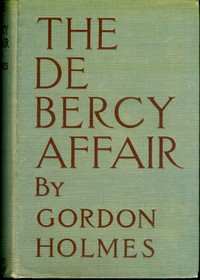
The de Bercy Affair — Edition Insights
Edition facts
The catalog record for The de Bercy Affair — Edition Insights provides practical reading context through 78,296 words, 5 hr 41 min estimated reading time, and 8 detected text sections.
The text analysis averages about 15.7 words per sentence, while the detected sections provide another way to judge how the source is divided.
Project Gutenberg metadata also associates the work with “Detective and mystery stories,” connecting these edition facts with the source record’s subject description.
Calculated from edition completeness, EPUB availability, text structure and catalogue metadata. Not a user rating.
How this score is calculated
- Description quality20 pts
- Title & short description10 pts
- Source metadata20 pts
- Text length15 pts
- Chapters / structure15 pts
- EPUB file integrity20 pts
Total of 100 points, scaled to a 2.5-5.0 range. Editions with an empty description or a missing EPUB file are not scored.
Read the Text
When did you telegraph to Kenterstone?"
Mr. Winter whisked a pink telegraphic slip from off the blotting-pad, and read:
Inspector Furneaux not here to my knowledge. _Police Superintendent_, KENTERSTONE.
"Another legal quibbler--fat, too, I'll be bound," he growled. Then he laughed a little in a vein of irritated perplexity, and said:
"Thank you, Johnson. You, at least, seem to have done everything possible. Try again in the morning. I _must_ see Mr. Furneaux at the earliest moment! Kindly bring me the latest editions of the evening papers, and, by the way, help yourself to a cigar."
The gift of a cigar was a sign of the great man's favor, and it was always an extraordinarily good one, of which none but himself knew the exact brand. Left alone for a few minutes, he glanced through a written telephone message which he had thrust under the blotting-pad when Police Constable Johnson had entered. It was from Paris, and announced that two notorious Anarchists were en route to England by the afternoon train, due at Charing Cross at 9.15 p.m.
"Anarchists!" growled the Chief Inspector--"Pooh! Antoine Descartes and Émile Janoc--Soho for them--absinthe and French cigarettes--green and black poison. Poor devils! they will do themselves more harm than his Imperial Majesty. Now, where the deuce _is_ Furneaux? This Feldisham Mansions affair is just in his line--Clarke will ruin it."
Johnson came back with a batch of evening papers. Understanding his duties--above all, understanding Mr. Winter--he placed them on the table, saluted, and withdrew without a word. Soon the floor was littered with discarded news-sheets, those quick-moving eyes ever seeking one definite item--"The Murder in the West End--Latest"--or some such headline, and once only was his attention held by a double-leaded paragraph at the top of a column:
A correspondent writes:--"I saw the deceased lady in company with a certain popular American millionaire at the International Horse Show in June, and was struck by her remarkable resemblance to a girl of great beauty resident in Jersey some eight years ago. The then village maid was elected Rose Queen at a rural fête, I photographed her, and comparison of the photograph with the portrait of Mademoiselle de Bercy exhibited in this year's Academy served to confirm me in my opinion that she and the Jersey Rose Queen were one and the same person. I may add that my accidental discovery was made long before the commission of the shocking crime of yesterday."
Under present circumstances, of course, we withhold from publication the name of the Jersey Rose Queen, but the line of inquiry thus indicated may prove illuminative should there be any doubt as to the earlier history of the hapless lady whose lively wit and personal charm have brought London society to her feet since she left the Paris stage last year.
Winter did not hurry. Tucking the cigar comfortably into a corner of his mouth, he read each sentence with a quiet deliberation; then he sought a telephone number among the editorial announcements, and soon was speaking into a transmitter.
"Is that the _Daily Gazette_?... Put me on to the editorial department, please.... That you, Arbuthnot? Well, I'm Winter, of Scotland Yard. Your evening edition, referring to the Feldisham Mansions tragedy, contains an item.... Oh, you expected to hear from me, did you? Well, what is the lady's name, and who is your correspondent?... What? Spell it. A-r-m-a-u-d. All right; if you feel you _must_ write to the man first, save time by asking him to send me the photograph. I will pass it on to you exclusively, of course. Thanks. Good-by."
Before the receiver was on its hook, the Chief Inspector was taking a notebook from his breast pocket, and he made the following entry:
Mirabel Armaud, Rose Queen, village near St. Heliers, summer of 1900.
A knock sounded on the door.
"Oh, if this could only be Furneaux!" groaned Winter. "Come in! Ah! Glad to see you, Mr. Clarke. I was hoping you would turn up. Any news?"
"Nothing much, sir--that is to say, nothing really definite. The maid-servant is still delirious, and keeps on screaming out that Mr. Osborne killed her mistress. I am beginning to believe there is something in it----"
Winter's prominent steel blue eyes dwelt on Clarke musingly.
"But haven't we the clearest testimony as to Osborne's movements?" he asked. "He quitted Miss de Bercy's flat at 6.25, drove in his motor to the Ritz, attended a committee meeting of the International Polo Club at 6.30, occupied the chair, dined with the committee, and they all went to the Empire at nine o'clock. Unless a chauffeur, a hall-porter, a head-waiter, two under-waiters, five polo celebrities, a box-office clerk, and several other persons, are mixed up in an amazing conspiracy to shield Mr. Rupert Osborne, he certainly could not have murdered a woman who was alive in Feldisham Mansions at half-past seven."
Clarke pursed his lips sagely. As a study in opposites, no two men could manifest more contrasts. Clarke might have had the words "Detective Inspector" branded on his forehead: his features sharp, cadaverous, eyes deep-set and suspicious, his nose and chin inquisitive, his lips fixed as a rat-trap. Wide cheek-bones, low-placed ears, and narrow brows gave him a sinister aspect. In his own special department, the hunting out of "confidence men," card-sharpers, and similar hawklike pluckers of the provincial pigeon fluttering through London's streets, he was unrivaled. But Winter more resembled an intellectual prizefighter than the typical detective of fiction. His round head, cropped hair, wide-open eyes, joined to a powerful physique and singular alertness of glance and movement, suggested that he varied the healthy monotony of a gentleman farmer's life by attendance at the National Sporting Club and other haunts of pugilism. A terror to wrongdoers, he was never disliked by them, whereas Clarke was hated. In a word, Winter was a sharp brain, Clarke a sharp nose, and that is why Winter groaned inwardly at being compelled to intrust the Feldisham Mansions crime to Clarke.
"What is your theory of this affair?" he said, rather by way of making conversation than from any hope of being enlightened.
"It is simple enough," said Clarke, his solemn glance resting for a moment on the box of cigars. Winter nodded in the same direction. His cigars were sometimes burnt offerings as well as rewards.
"Light up," he said, "and tell me what you think."
"Mademoiselle de Bercy was killed by either a disappointed lover or a discarded husband. All these foreign actresses marry early, but grow tired of matrimony within a year. If, then, there is no chance of upsetting Mr. Osborne's alibi, we must get the Paris police to look into Miss de Bercy's history. Her husband will probably turn out to be some third-rate actor or broken-down manager. Let us find _him_, and see if _he_ is as sure of his whereabouts last evening as Mr. Rupert Osborne professes to be."
"You seem to harp on Osborne's connection with the affair?"
"And why not, sir? A man like him, with all his money, ought to know better than to go gadding about with actresses."
"But he is interested in the theater--he is quite an authority on French comedy."
"He can tackle French tragedy now--he is up to the neck in this one."
"You still cling to the shrieking housemaid--to her ravings, I mean?"
"Perhaps I should have mentioned it sooner, sir, but I have come across a taxicab driver who picked up a gentleman uncommonly like Mr. Osborne at 7.20 p.m. on Tuesday, and drove him from the corner of Berkeley Street to Knightsbridge, waited there nearly fifteen minutes, and brought him back again to Berkeley Street."
The Chief Inspector came as near being startled as is permissible in Scotland Yard.
"That is a very serious statement," he said quietly, wheeling round in his chair and scrutinizing his subordinate's lean face with eyes more wide-open than ever, if that were possible. "It is tantamount to saying that some person resembling Mr. Osborne hired a cab outside the Ritz Hotel, was taken to Feldisham Mansions at the very hour Miss de Bercy was murdered, and returned to the Ritz in the same vehicle."
"Exactly so," and Clarke pursed his thin lips meaningly.
"So, then, you _have_ discovered something?"
Mr. Winter's tone had suddenly become dryly official, and the other man, fearing a reprimand, added:
"I admit, sir, I ought to have told you sooner, but I don't want to make too much of the incident. The taxicab chauffeur does not know Mr. Rupert Osborne by sight, and I took good care not to mention the name. The unknown was dressed like Mr. Osborne, and looked like him--that is all."
"William Campbell--cab number X L 4001. I have hired him to-morrow morning from ten o'clock, and then he will have an opportunity of seeing Mr. Osborne----"
"Meet me here at 9.30, and I will keep the appointment for you. Until--until I make other arrangements, I intend to take this Feldisham Mansions affair into my own hands. Of course, I should have been delighted to leave it in your charge, but during the past hour something of vastly greater importance has turned up, and I want you to tackle it immediately."
"Something more important than a society murder?" Clarke could not help saying.
"Yes. You know that the Tsar comes to London from Windsor to-morrow? Well, read this," and Winter, with the impressive air of one who communicates a state secret, handed the Paris message.
"Ah!" muttered Clarke, gloating over the word "Anarchists."
"Now you understand," murmured Winter darkly. "Unfortunately these men are far too well acquainted with me to render it advisable that I should shadow them. So I shall accompany you to Charing Cross, point them out, and leave them to you. A live monarch is of more account than a dead actress, so you see now what confidence I have in you, Mr. Clarke."
Clarke's sallow cheeks flushed a little. Winter might be a genial chief, but he seldom praised so openly.
"I quite recognize that, sir," he said. "Of course, I am sorry to drop out of this murder case. It has points, first-rate points. I haven't told you yet about the stone."
"The stone that did for Miss de Bercy. The flat was not thoroughly searched last night, but this morning I examined every inch of it, and under the piano I found--this."
He produced from a pocket something wrapped in a handkerchief. Unfolding the linen, he rose and placed on the blotting-pad, under the strong light of a shaded lamp, one of those flat stones which the archeologist calls "celts," or "flint ax-heads." Indeed, no expert eye was needed to determine its character. The cutting edge formed a perfect curve; two deep indentations showed how it had been bound on to a handle of bone or wood. At the broadest part it measured fully four inches, its length the same, thickness about three-quarters of an inch. That it was a genuine neolithic flint could not be questioned. A modern lapidary might contrive to chip a flint into the same shape, but could not impart that curious bloom which apparently exudes from the heart of the stone during its thousands of centuries of rest in prehistoric cave or village mound. This specimen showed the gloss of antiquity on each smooth facet.
But it showed more. When used in war or the chase by the fearsome being who first fashioned it to serve his savage needs, it must often have borne a grisly tint, and now _again_ each side of the strangely sharp edge was smeared with grewsome daubs, while some black hairs clung to the dried clots which clustered on the irregular surfaces.
Sentiment finds little room in the retreat of a Chief Inspector, so Winter whistled softly when he set eyes on this weird token of a crime.
"By gad!" he cried, "in my time at the Yard I've seen many queer instruments of butchery--ranging from a crusader's mace to the strings of a bass fiddle--but this beats the lot."
"It must have come out of some museum," said the other.
"It suggests a tragedy of the British Association," mused Winter aloud.
"It ought to supply a first-rate clew, anyhow," said Clarke.
"Oh, it does; it must. If only----"
Winter checked himself on the very lip of indiscretion, for Clarke detested Furneaux. He consulted his watch.
"We must be off now," he said briskly. "Leave the stone with me, and while we are walking to Charing Cross I can give you a few pointers about these Anarchist pests. Once they are comfortably boxed up in some café in Old Compton Street you can come away safely for the night, and pick them up again about midday to-morrow. They are absolutely harm--I mean they cannot do any harm until the Tsar arrives. From that moment you must stick to them like a limpet to a rock; I will arrange for a man to relieve you in the evening, nor shall I forget to give your name to the Embassy people when they begin to scatter diamond pins around."
When he meant to act a part, Winter was an excellent comedian, and soon Clarke was prowling at the heels of those redoubtables, Antoine Descartes and Émile Janoc.
Once Clarke was safely shelved, Winter called the first taxicab he met and was driven to Feldisham Mansions. An unerring instinct had warned him at once that the murder of the actress was no ordinary crime; but Clarke had happened to be on duty when the report of it reached the Yard a few minutes after eight o'clock the previous evening, and Winter had bewailed the mischance which deprived him of the services of Furneaux, the one man to whom he could have left the inquiry with confidence.
The very simplicity of the affair was baffling. Mademoiselle Rose de Bercy was the leading lady in a company of artistes, largely recruited from the Comédie Française, which had played a short season in London during September of the past year. She did not accompany the others when they returned to Paris, but remained, to become a popular figure in London society, and was soon in great demand for her _contes drôles_ at private parties. She was now often to be seen in the company of Mr. Rupert Osborne, a young American millionaire, whose tastes ordinarily followed a less frivolous bent than he showed in seeking the society of an undeniably chic and sprightly Frenchwoman. It had been rumored that the two would be married before the close of the summer, and color was lent to the statement by the lady's withdrawal from professional engagements.
So far as Winter's information went, this was the position of affairs until a quarter to eight on the night of the first Tuesday in July. At that hour, Mademoiselle de Bercy's housemaid either entered or peered into her mistress's drawing-room, and saw her lifeless body stretched on the floor. Shrieking, the girl fled out into the lobby and down a flight of stairs to the hall-porter's little office, which adjoined the elevator. By chance, the man had just collected the letters from the boxes on each of the six floors of the block of flats, and had gone to the post; Mademoiselle de Bercy's personal maid and her cook, having obtained permission to visit an open-air exhibition, had, it seemed, been absent since six o'clock; the opposite flat on the same story was closed, the tenants being at the seaside; and the distraught housemaid, pursued by phantoms, forthwith yielded to the strain, so that the hall-porter, on his return, found her lying across the threshold of his den.
He summoned his wife from the basement, and the frenzied girl soon regained a partial consciousness. It was difficult to understand her broken words, but, such as they were, they sent the man in hot haste to the flat on the first floor. The outer and inner doors were wide open, as was the door of the drawing-room, and sufficient daylight streamed in through two lofty windows to reveal something of the horror that had robbed the housemaid of her wits.
The unfortunate Frenchwoman was lying on her back in the center of the room, and the hall-porter's hurried scrutiny found that she had been done to death with a brutal ferocity, her face almost unrecognizable.
Not until the return of the French maid, Pauline, from the exhibition, could it be determined beyond doubt that robbery was not the motive of the crime, for she was able to assure the police that her mistress's jewels were untouched. A gold purse was found on a table close to the body, a bracelet sparkled on a wrist cruelly bruised, and a brooch fastened at the neck the loose wrap worn as a preliminary to dressing for the evening.
Owing to the breakdown of the only servant actually present in the flat at the time of the murder, it was impossible to learn anything intelligible beyond the girl's raving cry that "Mr. Osborne did it." Still, there was apparently little difficulty in realizing what had happened. The housemaid had been startled while at supper, either by a shriek or some noise of moving furniture, had gone to the drawing-room, given one glance at the terrifying spectacle that met her eyes, and was straightway bereft of her wits.
The Chief Inspector was turning over in his mind the puzzling features of the affair when his automobile swept swiftly out of the traffic and glare of Knightsbridge into the quiet street in which stood Feldisham Mansions. A policeman had just strolled along the pavement to disperse a group of curious people gathered near the entrance, so Winter stopped his cab at a little distance and alighted unobserved.
He walked rapidly inside and found the hall-porter at his post. When the man learnt the visitor's identity he seemed surprised.
"Mr. Clarke has bin here all day, sir," he said, "and, as soon as he left, another gentleman kem, though I must say he hasn't bothered _me_ much----" this with a touch of resentment, for the hall-porter's self-importance was enhanced by his connection with the tragedy.
"Another gentleman!"--this was incomprehensible, since Clarke would surely place a constable in charge of the flat. "What name did he give?"
"He's up there at this minnit, sir, an' here's his card."
Winter read: "Mr. Charles Furneaux, Criminal Investigation Department, Scotland Yard."
"Well, I'm jiggered!" he muttered, and he added fuel to the fire of the hall-porter's annoyance by disregarding the elevator and rushing up the stairs, three steps at a time.
Winter felt at once relieved and displeased. Twice during the hour had his authority been disregarded. He was willing to ignore Clarke's method of doling out important facts because such was the man's secretive nature. But Furneaux! The urgent messages sent to every place where they might reach him, each and all summoned him to Scotland Yard without the slightest reference to the Feldisham Mansions crime. It was with a stiff upper lip, therefore, that the Chief Inspector acknowledged the salute of the constable who admitted him to the ill-fated Frenchwoman's abode. Furneaux was his friend, Furneaux might be admirable, Furneaux was the right man in the right place, but Furneaux must first receive an official reminder of the claims of discipline.
The subdued electric lights in the hall revealed within a vista of Oriental color blended with Western ideals of comfort. Two exquisitely fashioned lamps of hammered iron, rifled from a Pekin temple, softened by their dragons and lotus leaves the glare of the high-powered globes within them. Praying carpets, frayed by the deserts of Araby, covered the geometric design of a parquet floor, and bright-hued draperies of Mirzapur hid the rigid outlines of British carpentry. A perfume of joss-sticks still clung to the air: it suggested the apartments of a Sultana rather than the bower of a fashionable lady in the West End of London.
First impressions are powerful, and Winter acknowledged the spell of the unusual here, but his impassive face showed no sign of this when he asked the constable the whereabouts of Mr. Furneaux.
"In there, sir," said the man, pointing to a door.
Winter noted instantly that the floor creaked beneath his light tread. The rugs deadened his footsteps, but the parquetry complained of his weight. It was, he perceived, almost impossible for anyone to traverse an old flooring of that type without revealing the fact to ordinarily acute ears. Once when his heel fell on the bare wood, it rang with a sharp yet hollow note. It seemed, somehow, that the place was empty--that it missed its presiding spirit.
The novel begins not with a murder but with a missing policeman. Chief Inspector Winter, frustrated and chewing his mustache, searches for Inspector Furneaux—a man the earth “must have opened and swallowed.” The opening chapter, “Some Phases of the Problem,” establishes a police procedural tone, with Winter telephoning stations and reading a terse telegram from Kenterstone. The mystery is framed as an institutional puzzle: a Scotland Yard man has vanished, and his colleagues are baffled. This sets up a narrative that will later shift between police investigation and personal entanglements.
The Missing Inspector as Narrative Engine
The first excerpt introduces Furneaux only through his absence. Winter’s dialogue—snapping at a constable, calling a station-sergeant a “fat-head”—reveals a man under pressure. The telegram from Kenterstone (“Inspector Furneaux not here to my knowledge”) adds a deadpan bureaucratic note. A Paris message about anarchists en route to England hints at wider stakes. The reader is left with a question: is Furneaux a victim, a suspect, or something else? This opening strategy—withholding the central figure—creates a vacuum that the plot will fill.
A Letter, a Telegram, and a Steamed Envelope
The middle excerpt pivots to domestic intrigue. Rosalind Marsh writes a letter to Osborne, then frantically sends a telegram to stop him reading it. But the letter has been intercepted: Pauline steamed it open, and Hylda Prout, jealous, steams it again. The prose dwells on physical details—the silver tripod, the gum pot, the “daubs” of paste. Osborne, holding both letter and telegram, faces a moral test: the envelope is already open, but he reseals it. The scene is a study in temptation and surveillance, where every character is watching or hiding something.
Multiple Perspectives and Unreliable Access
The excerpts show a narrative that jumps between Scotland Yard, private apartments, and characters’ inner states. Winter’s official view contrasts with Rosalind’s emotional turmoil and Hylda’s scheming. The reader knows more than any single character: we see the letter being steamed twice, but we do not yet know its contents. This technique—doling out information through fragmented viewpoints—is typical of the mystery genre. The later excerpt, with its focus on a blood-spotted suit found in Osborne’s trunk, suggests that the police case is building, but the personal betrayals may be equally central.
Voice and Period Detail
Tracy’s prose is brisk and idiomatic, with touches of period flavor: “the great man’s favor,” “a woman of fads,” “like Tantalus.” The dialogue is clipped and expressive—Winter’s “fat-head” and “legal quibbler” establish character quickly. The setting is Edwardian London, with telegrams, ‘buses, and cigar brands. The physical objects—the trunk, the silver tripod, the gum pot—are not just props but clues to social status and domestic routine. A first-time reader should note how these details accumulate: the story’s world is built through small, concrete observations.
These excerpts suggest a mystery that balances police procedure with personal drama. The reader is invited to track who knows what, and when. Pay attention to the objects: letters, telegrams, clothes, daggers. The narrative withholds key information, but it also plants visible clues. The opening’s missing inspector and the middle’s steamed letter are both puzzles that demand solution—but the solution may depend on understanding the characters’ hidden motives as much as the physical evidence.
There’s something about rereading the opening of de Bercy—that first tense search—that makes me think of how we grow attached to persistence in old mysteries. It reminds me of the way The Romance of Elaine Sequel to "Exploits of Elaine" — A Closer Reading lingers in my mind, much like Furneaux’s quiet footsteps. I find myself smiling at these echoes.
Leo Baker
1 month agoNoah Perez
1 week agoWilliam Nelson
4 weeks ago-
Joshua Jordan - 1 month ago
The De Bercy Affair falls short of its potential. The plot is convoluted, with too many unnecessary subplots that confuse rather than enrich the story. The protagonist is hard to relate to, and the twists feel forced. While the historical setting is interesting, the execution fails to engage. I found myself skimming pages just to reach the end. Disappointing. -
Lisa Jessica Todd - 1 month ago
The De Bercy Affair is a gripping historical mystery that keeps you guessing until the very end. The author weaves a complex tale of intrigue, betrayal, and redemption set against the backdrop of Parisian society. The characters are vividly drawn, and the plot twists are both surprising and satisfying. I couldn't put it down and highly recommend it to fans of classic thrillers. -
Drew Donaldson - 2 weeks ago
The De Bercy Affair offers a solid narrative with an engaging plot, though the pacing occasionally drags in the middle. The protagonist is well-developed, and the historical details are evocative. However, some secondary characters feel underdeveloped, which slightly detracts from the overall depth. Still, it's a worthwhile read for those who enjoy historical mysteries.
What was your reading experience?
Capture what you thought, learned, and would like to remember.
Sebastian Lewis
1 month ago